U.S. lawmakers are pressing the Securities and Exchange Commission (SEC) to implement President Donald Trump’s recent executive order that opens the $12.5 trillion 401(k) retirement market to alternative assets, including cryptocurrency. In a letter dated September 22, House Financial Services Committee Chairman French Hill and Ranking Member Maxine Waters urged SEC Chair Paul Atkins to move swiftly in revising rules to align with the directive.Source: The White House The letter calls on the agency to recognize FINRA-certified professionals as accredited investors and to expand the scope of who qualifies for access to alternative assets within retirement plans. Trump’s 401(k) Executive Order Puts SEC at Center of Retirement Market Overhaul The push follows Trump’s August 7 executive order, which directs the Department of Labor to reconsider guidance under the Employee Retirement Income Security Act (ERISA). The order specifically tasks the Labor Secretary, in coordination with the Treasury Department, the SEC, and other regulators, to clear the path for 401(k) participants to allocate part of their portfolios to private equity, real estate, digital assets, and other alternatives. The policy is intended to broaden investment choices for the more than 90 million Americans who currently participate in employer-sponsored defined contribution plans. According to a White House fact sheet, total U.S. retirement assets reached $43.4 trillion as of March 31, 2025, but most savers remain restricted from accessing alternatives. Lawmakers argue that allowing measured allocations into these assets could enhance net risk-adjusted returns and modernize retirement investment strategies. The SEC is expected to play a central role in revising regulations, particularly around the accredited investor definition. Several bipartisan bills already before Congress seek to expand the criteria, including measures to recognize professional licenses, education, or SEC-administered examinations as pathways to accreditation. Hill and Waters urged Atkins to incorporate these legislative efforts into the agency’s rulemaking process. The move revives initiatives first introduced during Trump’s earlier term but later rolled back under President Biden. Industry groups have long lobbied for such reforms, arguing that retirement portfolios limited to stocks and bonds do not reflect the broader evolution of capital markets. The order also clarifies fiduciary obligations for plan administrators who choose to include alternative assets. Regulators are expected to outline how retirement plan sponsors can provide such exposure while maintaining safeguards for investors. For the cryptocurrency sector, the development marks a pivotal step toward mainstream adoption. While administrative hurdles remain, the inclusion of digital assets in retirement plans could create a new channel for capital inflows into the market, bringing crypto exposure to tens of millions of Americans saving for retirement. SEC Breaks With Gensler Era, Pledges Flexibility on Crypto and Corporate Disclosures The SEC is signaling a major policy shift, moving away from the lawsuit-driven approach of its previous administration and toward a more collaborative stance with the crypto industry and public companies. The SEC is preparing a sweeping shift in both corporate disclosure rules and its approach to crypto regulation, marking a break from years of rigid oversight. Speaking on CNBC on September 19, SEC Chair Paul Atkins confirmed that the agency is prioritizing reforms that could loosen quarterly earnings requirements. The proposal would allow companies, including those in the crypto sector, greater flexibility to set reporting cadences in consultation with investors and banks. Atkins noted that semiannual reporting is already standard for foreign issuers trading in U.S. markets and called the adjustment “a good way forward.” The move follows President Donald Trump’s revived call on September 15 to replace quarterly earnings with semiannual disclosures, a change he argued would cut costs and reduce short-term pressures on executives. With Republicans holding a 3-1 advantage at the SEC, the proposal faces a favorable political landscape. Atkins has also unveiled a new regulatory philosophy for crypto. In a report published September 15, he said the SEC would end its “regulation by enforcement” approach, a hallmark of his predecessor Gary Gensler’s tenure. Instead, firms will receive preliminary notices of potential technical violations and up to six months to address issues before enforcement is considered. Atkins rejected the broad classification of cryptocurrencies as securities, showing openness to tokenized stocks and bonds that mirror existing instruments. Since taking office in April, he has dropped several high-profile cases inherited from the Gensler era and launched a Crypto Task Force. That task force will hold a public hearing on October 17 to examine financial privacy and surveillance toolsU.S. lawmakers are pressing the Securities and Exchange Commission (SEC) to implement President Donald Trump’s recent executive order that opens the $12.5 trillion 401(k) retirement market to alternative assets, including cryptocurrency. In a letter dated September 22, House Financial Services Committee Chairman French Hill and Ranking Member Maxine Waters urged SEC Chair Paul Atkins to move swiftly in revising rules to align with the directive.Source: The White House The letter calls on the agency to recognize FINRA-certified professionals as accredited investors and to expand the scope of who qualifies for access to alternative assets within retirement plans. Trump’s 401(k) Executive Order Puts SEC at Center of Retirement Market Overhaul The push follows Trump’s August 7 executive order, which directs the Department of Labor to reconsider guidance under the Employee Retirement Income Security Act (ERISA). The order specifically tasks the Labor Secretary, in coordination with the Treasury Department, the SEC, and other regulators, to clear the path for 401(k) participants to allocate part of their portfolios to private equity, real estate, digital assets, and other alternatives. The policy is intended to broaden investment choices for the more than 90 million Americans who currently participate in employer-sponsored defined contribution plans. According to a White House fact sheet, total U.S. retirement assets reached $43.4 trillion as of March 31, 2025, but most savers remain restricted from accessing alternatives. Lawmakers argue that allowing measured allocations into these assets could enhance net risk-adjusted returns and modernize retirement investment strategies. The SEC is expected to play a central role in revising regulations, particularly around the accredited investor definition. Several bipartisan bills already before Congress seek to expand the criteria, including measures to recognize professional licenses, education, or SEC-administered examinations as pathways to accreditation. Hill and Waters urged Atkins to incorporate these legislative efforts into the agency’s rulemaking process. The move revives initiatives first introduced during Trump’s earlier term but later rolled back under President Biden. Industry groups have long lobbied for such reforms, arguing that retirement portfolios limited to stocks and bonds do not reflect the broader evolution of capital markets. The order also clarifies fiduciary obligations for plan administrators who choose to include alternative assets. Regulators are expected to outline how retirement plan sponsors can provide such exposure while maintaining safeguards for investors. For the cryptocurrency sector, the development marks a pivotal step toward mainstream adoption. While administrative hurdles remain, the inclusion of digital assets in retirement plans could create a new channel for capital inflows into the market, bringing crypto exposure to tens of millions of Americans saving for retirement. SEC Breaks With Gensler Era, Pledges Flexibility on Crypto and Corporate Disclosures The SEC is signaling a major policy shift, moving away from the lawsuit-driven approach of its previous administration and toward a more collaborative stance with the crypto industry and public companies. The SEC is preparing a sweeping shift in both corporate disclosure rules and its approach to crypto regulation, marking a break from years of rigid oversight. Speaking on CNBC on September 19, SEC Chair Paul Atkins confirmed that the agency is prioritizing reforms that could loosen quarterly earnings requirements. The proposal would allow companies, including those in the crypto sector, greater flexibility to set reporting cadences in consultation with investors and banks. Atkins noted that semiannual reporting is already standard for foreign issuers trading in U.S. markets and called the adjustment “a good way forward.” The move follows President Donald Trump’s revived call on September 15 to replace quarterly earnings with semiannual disclosures, a change he argued would cut costs and reduce short-term pressures on executives. With Republicans holding a 3-1 advantage at the SEC, the proposal faces a favorable political landscape. Atkins has also unveiled a new regulatory philosophy for crypto. In a report published September 15, he said the SEC would end its “regulation by enforcement” approach, a hallmark of his predecessor Gary Gensler’s tenure. Instead, firms will receive preliminary notices of potential technical violations and up to six months to address issues before enforcement is considered. Atkins rejected the broad classification of cryptocurrencies as securities, showing openness to tokenized stocks and bonds that mirror existing instruments. Since taking office in April, he has dropped several high-profile cases inherited from the Gensler era and launched a Crypto Task Force. That task force will hold a public hearing on October 17 to examine financial privacy and surveillance tools

US Push SEC to Open $12.5T 401k Market to Crypto

U.S. lawmakers are pressing the Securities and Exchange Commission (SEC) to implement President Donald Trump’s recent executive order that opens the $12.5 trillion 401(k) retirement market to alternative assets, including cryptocurrency.

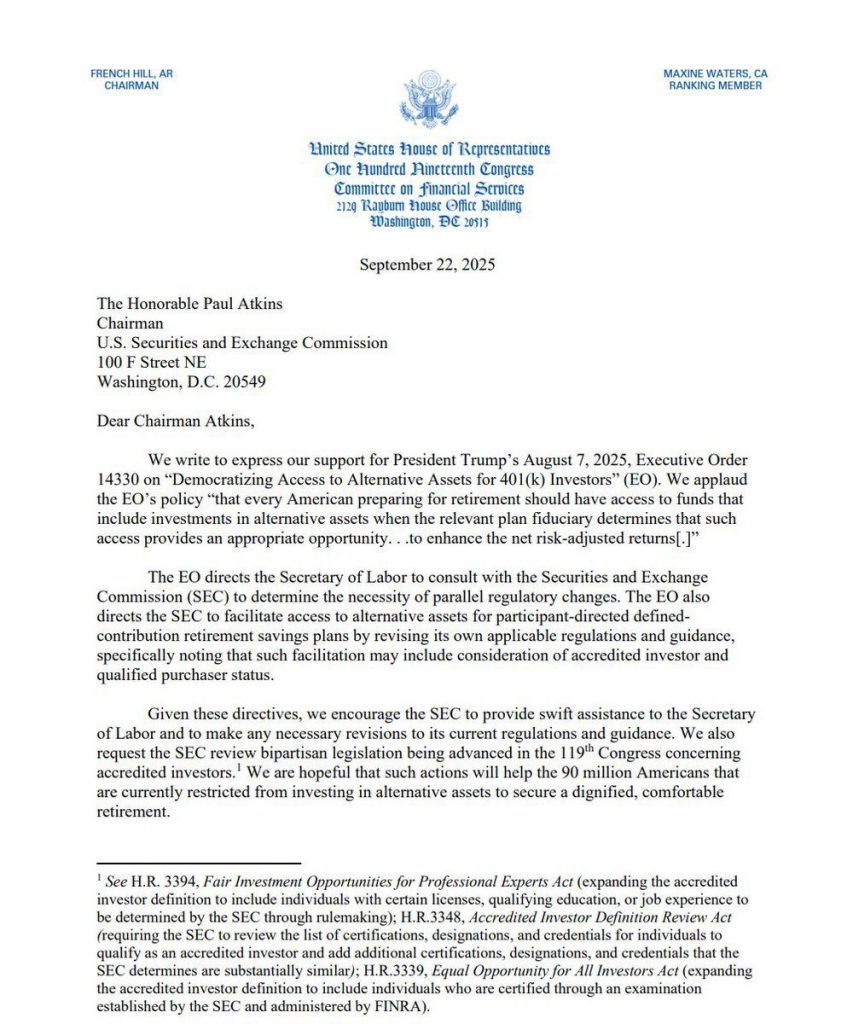
In a letter dated September 22, House Financial Services Committee Chairman French Hill and Ranking Member Maxine Waters urged SEC Chair Paul Atkins to move swiftly in revising rules to align with the directive.
Source: The White House

The letter calls on the agency to recognize FINRA-certified professionals as accredited investors and to expand the scope of who qualifies for access to alternative assets within retirement plans.

Trump’s 401(k) Executive Order Puts SEC at Center of Retirement Market Overhaul

The push follows Trump’s August 7 executive order, which directs the Department of Labor to reconsider guidance under the Employee Retirement Income Security Act (ERISA).

The order specifically tasks the Labor Secretary, in coordination with the Treasury Department, the SEC, and other regulators, to clear the path for 401(k) participants to allocate part of their portfolios to private equity, real estate, digital assets, and other alternatives.

The policy is intended to broaden investment choices for the more than 90 million Americans who currently participate in employer-sponsored defined contribution plans.

According to a White House fact sheet, total U.S. retirement assets reached $43.4 trillion as of March 31, 2025, but most savers remain restricted from accessing alternatives.

Lawmakers argue that allowing measured allocations into these assets could enhance net risk-adjusted returns and modernize retirement investment strategies.

The SEC is expected to play a central role in revising regulations, particularly around the accredited investor definition. Several bipartisan bills already before Congress seek to expand the criteria, including measures to recognize professional licenses, education, or SEC-administered examinations as pathways to accreditation.

Hill and Waters urged Atkins to incorporate these legislative efforts into the agency’s rulemaking process.

The move revives initiatives first introduced during Trump’s earlier term but later rolled back under President Biden.

Industry groups have long lobbied for such reforms, arguing that retirement portfolios limited to stocks and bonds do not reflect the broader evolution of capital markets.

The order also clarifies fiduciary obligations for plan administrators who choose to include alternative assets. Regulators are expected to outline how retirement plan sponsors can provide such exposure while maintaining safeguards for investors.

For the cryptocurrency sector, the development marks a pivotal step toward mainstream adoption.

While administrative hurdles remain, the inclusion of digital assets in retirement plans could create a new channel for capital inflows into the market, bringing crypto exposure to tens of millions of Americans saving for retirement.

SEC Breaks With Gensler Era, Pledges Flexibility on Crypto and Corporate Disclosures

The SEC is signaling a major policy shift, moving away from the lawsuit-driven approach of its previous administration and toward a more collaborative stance with the crypto industry and public companies.

The SEC is preparing a sweeping shift in both corporate disclosure rules and its approach to crypto regulation, marking a break from years of rigid oversight.

Speaking on CNBC on September 19, SEC Chair Paul Atkins confirmed that the agency is prioritizing reforms that could loosen quarterly earnings requirements.

The proposal would allow companies, including those in the crypto sector, greater flexibility to set reporting cadences in consultation with investors and banks.

Atkins noted that semiannual reporting is already standard for foreign issuers trading in U.S. markets and called the adjustment “a good way forward.”

The move follows President Donald Trump’s revived call on September 15 to replace quarterly earnings with semiannual disclosures, a change he argued would cut costs and reduce short-term pressures on executives.

With Republicans holding a 3-1 advantage at the SEC, the proposal faces a favorable political landscape.

Atkins has also unveiled a new regulatory philosophy for crypto. In a report published September 15, he said the SEC would end its “regulation by enforcement” approach, a hallmark of his predecessor Gary Gensler’s tenure.

Instead, firms will receive preliminary notices of potential technical violations and up to six months to address issues before enforcement is considered.

Atkins rejected the broad classification of cryptocurrencies as securities, showing openness to tokenized stocks and bonds that mirror existing instruments.

Since taking office in April, he has dropped several high-profile cases inherited from the Gensler era and launched a Crypto Task Force.

That task force will hold a public hearing on October 17 to examine financial privacy and surveillance tools.

Market Opportunity
EPNS Logo
EPNS Price(PUSH)
$0.010106
$0.010106$0.010106
+1.97%
USD
EPNS (PUSH) Live Price Chart
Disclaimer: The articles reposted on this site are sourced from public platforms and are provided for informational purposes only. They do not necessarily reflect the views of MEXC. All rights remain with the original authors. If you believe any content infringes on third-party rights, please contact service@support.mexc.com for removal. MEXC makes no guarantees regarding the accuracy, completeness, or timeliness of the content and is not responsible for any actions taken based on the information provided. The content does not constitute financial, legal, or other professional advice, nor should it be considered a recommendation or endorsement by MEXC.

You May Also Like

Why Everyone Is Talking About Saga, Cosmos, and Mars Protocol

Why Everyone Is Talking About Saga, Cosmos, and Mars Protocol

The post Why Everyone Is Talking About Saga, Cosmos, and Mars Protocol appeared on BitcoinEthereumNews.com. Layer-1 blockchain protocol Saga has faced a severe
Share
BitcoinEthereumNews2026/01/22 17:01
CME Group to Launch Solana and XRP Futures Options

CME Group to Launch Solana and XRP Futures Options

The post CME Group to Launch Solana and XRP Futures Options appeared on BitcoinEthereumNews.com. An announcement was made by CME Group, the largest derivatives exchanger worldwide, revealed that it would introduce options for Solana and XRP futures. It is the latest addition to CME crypto derivatives as institutions and retail investors increase their demand for Solana and XRP. CME Expands Crypto Offerings With Solana and XRP Options Launch According to a press release, the launch is scheduled for October 13, 2025, pending regulatory approval. The new products will allow traders to access options on Solana, Micro Solana, XRP, and Micro XRP futures. Expiries will be offered on business days on a monthly, and quarterly basis to provide more flexibility to market players. CME Group said the contracts are designed to meet demand from institutions, hedge funds, and active retail traders. According to Giovanni Vicioso, the launch reflects high liquidity in Solana and XRP futures. Vicioso is the Global Head of Cryptocurrency Products for the CME Group. He noted that the new contracts will provide additional tools for risk management and exposure strategies. Recently, CME XRP futures registered record open interest amid ETF approval optimism, reinforcing confidence in contract demand. Cumberland, one of the leading liquidity providers, welcomed the development and said it highlights the shift beyond Bitcoin and Ethereum. FalconX, another trading firm, added that rising digital asset treasuries are increasing the need for hedging tools on alternative tokens like Solana and XRP. High Record Trading Volumes Demand Solana and XRP Futures Solana futures and XRP continue to gain popularity since their launch earlier this year. According to CME official records, many have bought and sold more than 540,000 Solana futures contracts since March. A value that amounts to over $22 billion dollars. Solana contracts hit a record 9,000 contracts in August, worth $437 million. Open interest also set a record at 12,500 contracts.…
Share
BitcoinEthereumNews2025/09/18 01:39
Santander’s Openbank Sparks Crypto Frenzy in Germany

Santander’s Openbank Sparks Crypto Frenzy in Germany

 In Germany, the digital bank Santander Openbank introduces trading in crypto, which offers BTC, ETH, LTC, POL, and ADA in the MiCA framework of the EU. Santander, the largest bank in Spain, has officially introduced cryptocurrency trading to its clients in Germany, using its digital division, Openbank.  With this new service, users can purchase, sell, […] The post Santander’s Openbank Sparks Crypto Frenzy in Germany appeared first on Live Bitcoin News.
Share
LiveBitcoinNews2025/09/18 04:30