ECB’s Joachim Nagel sought to ease fears that the Euro’s rise is hurting Europe’s exporters, saying a focus on the US dollar alone overstates any hit to competitiveness. Nagel, who heads Germany’s Bundesbank, said Monday that currency moves should be judged against a broad set of trading partners. He noted that while the euro has gained strength by almost 14% against the dollar this year, a trade-weighted view shows a much smaller appreciation. “Simply looking at the euro’s gains against the US dollar therefore exaggerates the extent to which the local export economy is being burdened,” Nagel said. “Overall, I’m not concerned about the current valuation level of the euro.” The exchange rate is a recurring theme at the ECB. Some officials warn that large gains could slow the region’s recovery and push prices lower. Gediminas Simkus, Lithuania’s central bank head, said at the weekend that the euro’s level is among the reasons why the ECB needs to consider cutting interest rates in December. Others urged caution. Earlier this year, ECB Vice President Luis de Guindos said any rise above $1.20 would result in things becoming “a lot more complicated,” but last week he added that policymakers “do not have any concrete threshold at all” and that it is better not to look only at the dollar. The euro is trading around $1.18. The dollar’s weakness has been driven by rate cut expectations from the Fed and tariff policies by Trump. Those developments weakened the greenback and lifted hopes inside the ECB that the euro could take a bigger global role. Nagel mentions that the dollar won’t get replaced as the world’s main reserve currency. Even so, he said “there are trends toward greater diversification,” and called a stronger international role for the euro “desirable.” To reach that goal, he urged policymakers to remove barriers that still fragment Europe’s financial markets. A digital euro would help, he said. “It would be an important milestone for the savings and investment union and a sensible response to stablecoins,” he said. “The digital euro would make Europe more independent in terms of critical infrastructure.” Euro’s ‘global moment’ risks slipping away amid political division As concern over Donald Trump’s trade policy pushed the dollar toward multi-year lows, ECB President Christine Lagarde, in late May, used a Berlin speech to urge Europe’s leaders to act, saying alarm over Trump’s challenge to the economic status quo was a chance to advance the goal of boosting the single currency’s influence. Building on last year’s proposals for sweeping to Europe’s financial system, Lagarde referred to it as the “global euro moment.” Her thinking, a source familiar with her view said, was straightforward. Convinced this could be a defining moment, France’s former finance minister wasn’t too pleased by the lack of political leadership and thought the void should be filled by one voice. Four months on, that push has faded. Moves that might have made the euro more attractive to investors have been sidelined, the sources said. Proposals for jointly issuing debt in euros to fund Europe’s defense sector faced a lot of resistance from Paris and Berlin. Smaller countries with bigger financial sectors were against the centralization of supervisory powers in the European bodies. Furthermore, plans for the creation of the digital euro still aren’t clear. KEY Difference Wire: the secret tool crypto projects use to get guaranteed media coverageECB’s Joachim Nagel sought to ease fears that the Euro’s rise is hurting Europe’s exporters, saying a focus on the US dollar alone overstates any hit to competitiveness. Nagel, who heads Germany’s Bundesbank, said Monday that currency moves should be judged against a broad set of trading partners. He noted that while the euro has gained strength by almost 14% against the dollar this year, a trade-weighted view shows a much smaller appreciation. “Simply looking at the euro’s gains against the US dollar therefore exaggerates the extent to which the local export economy is being burdened,” Nagel said. “Overall, I’m not concerned about the current valuation level of the euro.” The exchange rate is a recurring theme at the ECB. Some officials warn that large gains could slow the region’s recovery and push prices lower. Gediminas Simkus, Lithuania’s central bank head, said at the weekend that the euro’s level is among the reasons why the ECB needs to consider cutting interest rates in December. Others urged caution. Earlier this year, ECB Vice President Luis de Guindos said any rise above $1.20 would result in things becoming “a lot more complicated,” but last week he added that policymakers “do not have any concrete threshold at all” and that it is better not to look only at the dollar. The euro is trading around $1.18. The dollar’s weakness has been driven by rate cut expectations from the Fed and tariff policies by Trump. Those developments weakened the greenback and lifted hopes inside the ECB that the euro could take a bigger global role. Nagel mentions that the dollar won’t get replaced as the world’s main reserve currency. Even so, he said “there are trends toward greater diversification,” and called a stronger international role for the euro “desirable.” To reach that goal, he urged policymakers to remove barriers that still fragment Europe’s financial markets. A digital euro would help, he said. “It would be an important milestone for the savings and investment union and a sensible response to stablecoins,” he said. “The digital euro would make Europe more independent in terms of critical infrastructure.” Euro’s ‘global moment’ risks slipping away amid political division As concern over Donald Trump’s trade policy pushed the dollar toward multi-year lows, ECB President Christine Lagarde, in late May, used a Berlin speech to urge Europe’s leaders to act, saying alarm over Trump’s challenge to the economic status quo was a chance to advance the goal of boosting the single currency’s influence. Building on last year’s proposals for sweeping to Europe’s financial system, Lagarde referred to it as the “global euro moment.” Her thinking, a source familiar with her view said, was straightforward. Convinced this could be a defining moment, France’s former finance minister wasn’t too pleased by the lack of political leadership and thought the void should be filled by one voice. Four months on, that push has faded. Moves that might have made the euro more attractive to investors have been sidelined, the sources said. Proposals for jointly issuing debt in euros to fund Europe’s defense sector faced a lot of resistance from Paris and Berlin. Smaller countries with bigger financial sectors were against the centralization of supervisory powers in the European bodies. Furthermore, plans for the creation of the digital euro still aren’t clear. KEY Difference Wire: the secret tool crypto projects use to get guaranteed media coverage

ECB's Nagel said the euro’s rise is overstated when judged only against the dollar

ECB’s Joachim Nagel sought to ease fears that the Euro’s rise is hurting Europe’s exporters, saying a focus on the US dollar alone overstates any hit to competitiveness.

Nagel, who heads Germany’s Bundesbank, said Monday that currency moves should be judged against a broad set of trading partners. He noted that while the euro has gained strength by almost 14% against the dollar this year, a trade-weighted view shows a much smaller appreciation. “Simply looking at the euro’s gains against the US dollar therefore exaggerates the extent to which the local export economy is being burdened,” Nagel said. “Overall, I’m not concerned about the current valuation level of the euro.”

The exchange rate is a recurring theme at the ECB. Some officials warn that large gains could slow the region’s recovery and push prices lower. Gediminas Simkus, Lithuania’s central bank head, said at the weekend that the euro’s level is among the reasons why the ECB needs to consider cutting interest rates in December.

Others urged caution. Earlier this year, ECB Vice President Luis de Guindos said any rise above $1.20 would result in things becoming “a lot more complicated,” but last week he added that policymakers “do not have any concrete threshold at all” and that it is better not to look only at the dollar. The euro is trading around $1.18.

The dollar’s weakness has been driven by rate cut expectations from the Fed and tariff policies by Trump. Those developments weakened the greenback and lifted hopes inside the ECB that the euro could take a bigger global role.

Nagel mentions that the dollar won’t get replaced as the world’s main reserve currency. Even so, he said “there are trends toward greater diversification,” and called a stronger international role for the euro “desirable.” To reach that goal, he urged policymakers to remove barriers that still fragment Europe’s financial markets. A digital euro would help, he said. “It would be an important milestone for the savings and investment union and a sensible response to stablecoins,” he said. “The digital euro would make Europe more independent in terms of critical infrastructure.”

Euro’s ‘global moment’ risks slipping away amid political division

As concern over Donald Trump’s trade policy pushed the dollar toward multi-year lows, ECB President Christine Lagarde, in late May, used a Berlin speech to urge Europe’s leaders to act, saying alarm over Trump’s challenge to the economic status quo was a chance to advance the goal of boosting the single currency’s influence.

Building on last year’s proposals for sweeping to Europe’s financial system, Lagarde referred to it as the “global euro moment.” Her thinking, a source familiar with her view said, was straightforward. Convinced this could be a defining moment, France’s former finance minister wasn’t too pleased by the lack of political leadership and thought the void should be filled by one voice. Four months on, that push has faded.

Moves that might have made the euro more attractive to investors have been sidelined, the sources said. Proposals for jointly issuing debt in euros to fund Europe’s defense sector faced a lot of resistance from Paris and Berlin. Smaller countries with bigger financial sectors were against the centralization of supervisory powers in the European bodies. Furthermore, plans for the creation of the digital euro still aren’t clear.

KEY Difference Wire: the secret tool crypto projects use to get guaranteed media coverage

Market Opportunity
MemeCore Logo
MemeCore Price(M)
$1.60096
$1.60096$1.60096
-1.90%
USD
MemeCore (M) Live Price Chart
Disclaimer: The articles reposted on this site are sourced from public platforms and are provided for informational purposes only. They do not necessarily reflect the views of MEXC. All rights remain with the original authors. If you believe any content infringes on third-party rights, please contact service@support.mexc.com for removal. MEXC makes no guarantees regarding the accuracy, completeness, or timeliness of the content and is not responsible for any actions taken based on the information provided. The content does not constitute financial, legal, or other professional advice, nor should it be considered a recommendation or endorsement by MEXC.

You May Also Like

Why Everyone Is Talking About Saga, Cosmos, and Mars Protocol

Why Everyone Is Talking About Saga, Cosmos, and Mars Protocol

The post Why Everyone Is Talking About Saga, Cosmos, and Mars Protocol appeared on BitcoinEthereumNews.com. Layer-1 blockchain protocol Saga has faced a severe
Share
BitcoinEthereumNews2026/01/22 17:01
CME Group to Launch Solana and XRP Futures Options
CME Group to Launch Solana and XRP Futures Options

The post CME Group to Launch Solana and XRP Futures Options appeared on BitcoinEthereumNews.com. An announcement was made by CME Group, the largest derivatives exchanger worldwide, revealed that it would introduce options for Solana and XRP futures. It is the latest addition to CME crypto derivatives as institutions and retail investors increase their demand for Solana and XRP. CME Expands Crypto Offerings With Solana and XRP Options Launch According to a press release, the launch is scheduled for October 13, 2025, pending regulatory approval. The new products will allow traders to access options on Solana, Micro Solana, XRP, and Micro XRP futures. Expiries will be offered on business days on a monthly, and quarterly basis to provide more flexibility to market players. CME Group said the contracts are designed to meet demand from institutions, hedge funds, and active retail traders. According to Giovanni Vicioso, the launch reflects high liquidity in Solana and XRP futures. Vicioso is the Global Head of Cryptocurrency Products for the CME Group. He noted that the new contracts will provide additional tools for risk management and exposure strategies. Recently, CME XRP futures registered record open interest amid ETF approval optimism, reinforcing confidence in contract demand. Cumberland, one of the leading liquidity providers, welcomed the development and said it highlights the shift beyond Bitcoin and Ethereum. FalconX, another trading firm, added that rising digital asset treasuries are increasing the need for hedging tools on alternative tokens like Solana and XRP. High Record Trading Volumes Demand Solana and XRP Futures Solana futures and XRP continue to gain popularity since their launch earlier this year. According to CME official records, many have bought and sold more than 540,000 Solana futures contracts since March. A value that amounts to over $22 billion dollars. Solana contracts hit a record 9,000 contracts in August, worth $437 million. Open interest also set a record at 12,500 contracts.…
Share
BitcoinEthereumNews2025/09/18 01:39
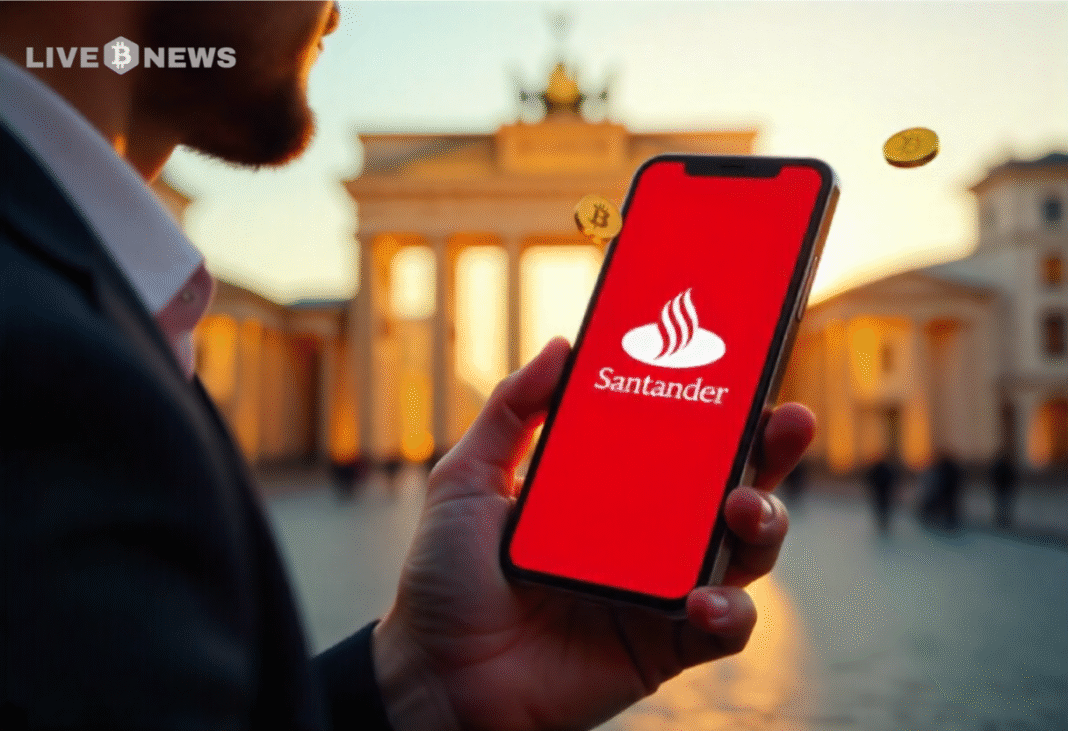
Santander’s Openbank Sparks Crypto Frenzy in Germany

Santander’s Openbank Sparks Crypto Frenzy in Germany

 In Germany, the digital bank Santander Openbank introduces trading in crypto, which offers BTC, ETH, LTC, POL, and ADA in the MiCA framework of the EU. Santander, the largest bank in Spain, has officially introduced cryptocurrency trading to its clients in Germany, using its digital division, Openbank.  With this new service, users can purchase, sell, […] The post Santander’s Openbank Sparks Crypto Frenzy in Germany appeared first on Live Bitcoin News.
Share
LiveBitcoinNews2025/09/18 04:30