

How DeFi Demand Is Shaping the Next Wave of RWA Tokenization
DeFi has long moved beyond yield experiments inside the crypto market. Today, it is a separate financial environment where demand is forming for new products, clearer income models, and assets connected to the real economy.
In this article, Artem Deshytskyi, CBDO at the tokenization project Sabai Protocol, shares his thoughts on how the DeFi market is developing, where its growth points are, which triggers may accelerate the next stage of its evolution, and where RWA tokenization fits into this logic.
How People’s Financial Behavior Is Changing
Let’s zoom out a bit and look at the market from a macro perspective: how it works, what it is built on, and what actually drives its progress.
Classic banking appeared more than a hundred years ago. Its basic function was simple: to protect money from theft. Over time, that role gradually evolved into lending money to businesses and offering depositors some return on their capital.
The “protecting money from theft” part eventually became something we all take for granted. And with digital technologies, it smoothly moved from the format of a reliable vault into the format of reliable IT infrastructure.
User behavior has changed too. Earlier, people put money into a bank mainly to earn income. Today, a bank is more of a payment infrastructure — something that simply makes it easy to spend money with a card.
Why Crypto Became Part of This New Model
And at that moment, crypto appeared. It was not backed by physical gold — much like currencies after the 1976 Jamaica Conference, to be fair. But as the COVID and post-COVID years showed, it behaved more steadily than many fiat currencies. At first glance, this may seem strange, because fiat money is supposedly backed by a country’s economy, laws, army, and so on.
But one way or another, the appearance of Bitcoin became a game-changer for the entire financial market and split it into new segments.
Why People Buy Crypto Today
But how did this affect the user? Why would someone buy crypto if the payment infrastructure still does not allow them to use it in everyday life as conveniently as the existing fiat infrastructure does?
At first, it was mostly trading or staking, with the goal of getting high returns from market speculation. Now, in a world of complete uncertainty around global politics and global security, crypto is becoming a symbol of stability — something more reliable and more flexible than fiat currency.
Let me repeat this once again: users now see crypto as more reliable than fiat currency. And then there are Zoomers with their own behavior patterns around crypto. For those who are not aware, Zoomers often ignore cafés and coffee shops where you cannot pay with crypto, seeing them as old-school or simply not cool.
What Global Practice and the FCA Research Show
So what does global practice show here? For example, ordinary users in Iran bought a huge amount of cryptocurrency in 2025–2026, trying to protect their savings from losing value. We see the same pattern in Nigeria, Bolivia, and Venezuela.
A similar behavior, strange as it may sound, can also be seen among people in the U.S. and the UK. Users buy crypto to diversify their risks.
According to a consumer research study on cryptoassets, conducted by YouGov for the UK Financial Conduct Authority (FCA) in 2025, the main reasons for buying cryptoassets include:
- Part of an investment portfolio: This is the most popular reason, mentioned by 33% of users. At the same time, people earning more than £50,000 a year choose this option noticeably more often — around 31–33% — than users with lower income.
- Excitement and speculation: 30% of respondents see buying crypto as a kind of “gamble,” where you can both make and lose money. This motive is more common among groups earning less than £100,000.
- Retirement savings: Around 17–22% of users buy cryptoassets as a way to save for the long term. This is especially visible among people with higher income levels.
- An alternative to traditional finance: 30% of users believe that cryptoassets and other alternative investments are better than what the mainstream financial sector offers.
What Users Do With Crypto After Buying It
Apart from simply holding crypto and hoping that the price will grow, users also take part in several other activities.
- Holding and accumulation: There is a clear trend toward larger portfolios. Users are now more likely to hold amounts between £1,001 and £10,000, moving away from very small allocations.
- Staking: 22% of users take part in staking — basically, helping validate blockchain transactions and receiving rewards for it.
- Lending and borrowing: 7% of users actively use their assets to take loans or lend them out for interest.
- Paying for goods and services: Around 12–24% of users, depending on income level, use cryptoassets for direct payments.
- Day trading: 10% of survey participants are involved in active intraday trading.
- Using stablecoins: Awareness of stablecoins among crypto owners has grown to 58%, which points to their growing role as a more stable instrument inside the ecosystem.
Why Interest in RWA Is Growing Against This Background
So, a quick summary: crypto is gaining popularity, and the more anxiety and crises there are in the world, the faster this happens. This means that the supply of goods and services, as well as IT infrastructure, is forced to catch up with consumer demand.
Assets that can be bought with crypto may come from both the real world — RWA — and the digital world, such as Bitcoin, Ether, and so on.
Next, we will focus on RWA assets, because they generally create more trust and a stronger sense of stability. These can include income-generating hotels, green energy projects, agricultural land, and many other projects that generate predictable returns and want to attract investors.
What It Really Takes to Launch a Tokenization Project
To launch a project like this, it is worth pointing out the importance of not only legal and IT infrastructure, but also the challenges faced by the project management team. The team needs to combine knowledge of the financial market, compliance, and blockchain technologies.
The requirements for companies and their organizational structure are also a separate challenge. Quickly hiring blockchain developers and paying the high cost of development is one thing. Finding a team with real expertise, the ability to test audiences and hypotheses, and the flexibility to work in fast-changing market conditions is another thing entirely.
In practice, RWA tokenization requires several layers to work together: compliance, platform infrastructure, onboarding, payment flows, asset management, investor communication, and market positioning. If one of these layers is missing, the project may still look good on paper, but it becomes much harder to operate and scale.
At Sabai Protocol, we came to this conclusion through hands-on work in the Web3 and tokenization market. Working on a project for a major Thai developer with $500M in assets helped us build practical experience in RWA tokenization. Later, by creating RENANCE — a marketplace for tokenized real estate from developers across Asia — we also built our own white-label infrastructure for managing tokenized assets.
Projects like these showed us how many moving parts have to be aligned before a tokenized asset becomes a real investment product.
So if you are following the trends and have already been thinking about tokenization, feel free to share your questions in the comments. I’ll be happy to discuss what usually matters at the early stage and what teams should think through before moving into implementation.
How DeFi Demand Is Shaping the Next Wave of RWA Tokenization was originally published in Coinmonks on Medium, where people are continuing the conversation by highlighting and responding to this story.


You May Also Like
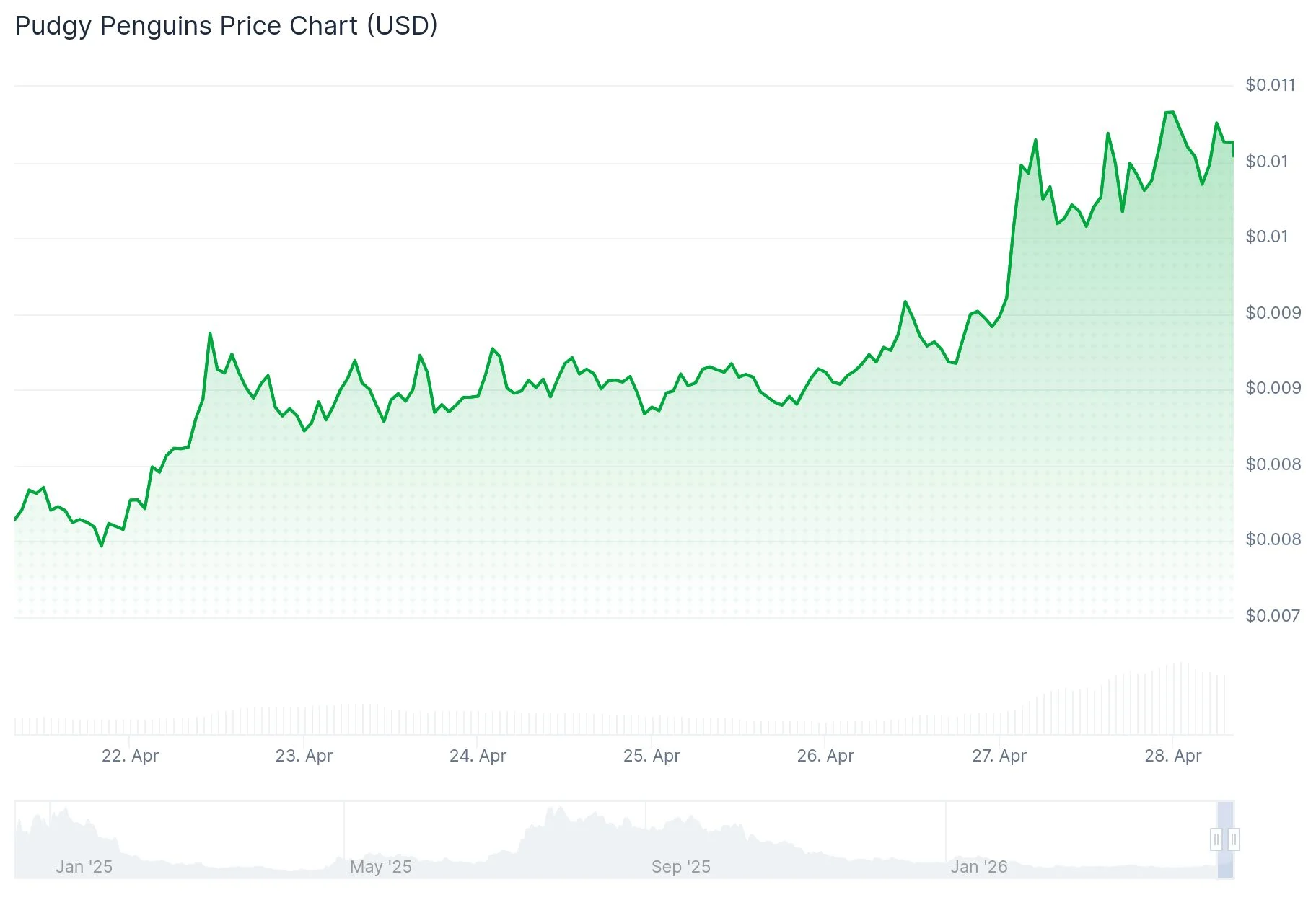
Pudgy Penguins (PENGU) Hits 3-Month Peak Amid NFT Token Revival

XRP Breakout Setup Faces Heavy Supply Test




