

HSC Asset Management Hong Kong VC Panel: ‘Flight To Stability’ Explores Macro Shifts, Crypto Risk, And Institutional Capital Flows
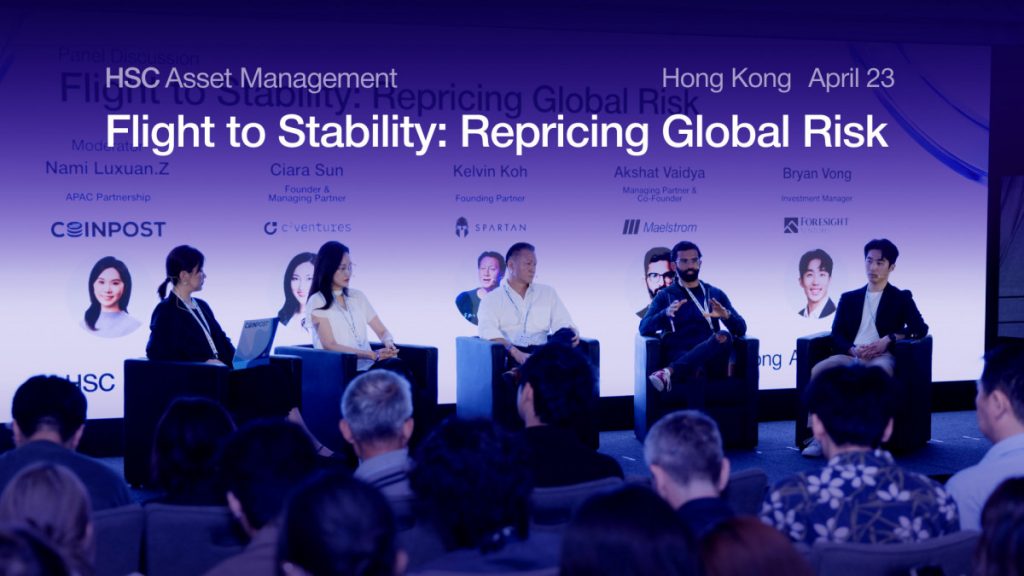
On April 23rd, the HSC Asset Management in Hong Kong brought together industry leaders to examine the evolving landscape of cryptocurrency and institutional finance.
One of the key panel discussions, titled “Flight to Stability: Repricing Global Risk,” explored how investors are repositioning across asset classes as macroeconomic uncertainty, geopolitical tensions, and regulatory shifts continue to reshape global risk premiums.
Moderated by Nami Luxuan Z. (APAC Partnerships, CoinPost & WebX), the panel featured Ciara Sun, Founder and Managing Partner of C² Ventures; Kelvin Koh, Co-Founder and CIO of Spartan Group; Akshat Vaidya, Managing Partner & Co-Founder of Maelstrom; and Bryan Vong, Investment Manager at Foresight Ventures.
Macro Risk, Liquidity, and the New Correlation Regime
The discussion opened with a sharp view of the broader market environment: geopolitics, trade tensions, shifting monetary policy, and fast-moving regulation are all forcing investors to reprice risk in real time. A central theme was that crypto is no longer isolated from traditional markets. One panelist argued that liquidity tightening in traditional assets now hits crypto especially hard, and often amplifies volatility rather than cushioning it. Another emphasized that correlations across asset classes have risen so much that diversification is becoming less effective in downturns. In that sense, crypto’s 24/7 trading structure was presented as both a strength and a weakness: it gives the market constant access, but also means liquidity stress is always present.
Regulation as a Long-Term Positive, Even in a Weak Sentiment Market
The panel then shifted to the contrast between short-term sentiment and long-term structural change. Several speakers noted that crypto markets remain heavily retail-driven and are still digesting the excesses of the previous cycle, which helps explain the muted activity in both venture and public markets. Yet they also saw meaningful progress in regulation, especially in the United States, where developments around stablecoins and broader market clarity were described as important steps toward institutional participation. The overall view was that regulation may not create an immediate rally, but it does lay the groundwork for a larger and more durable market. That long-term optimism stood in stark contrast to the current mood, which was described as cautious and at times outright bearish.
Dollarization, Tokenization, and the Global Spillover Effect
One of the more distinctive arguments in the panel was that the rise of crypto and tokenized assets may create a deeper macro issue: dollarization. As crypto becomes more connected to TradFi, and as tokenized stocks, bonds, and other assets increasingly settle in dollars, emerging markets could face a structural squeeze. The panelist making this point described scenarios in which workers, merchants, and savers in developing economies increasingly rely on dollar-linked digital assets rather than local currencies. That, in turn, could weaken local monetary policy and reduce financial sovereignty. This was framed not just as a crypto market trend, but as a broader global asset-allocation risk that investors should begin pricing in.
Security, Hacks, and the Difference Between Panic and Discipline
When the discussion turned to crypto-native risks, the panel focused on security incidents, liquidity fragility, and the limits of composability. A recent exploit was described as a stress test for DeFi, since assets can move quickly across protocols and liquidity can disappear faster than it accumulates. But there was disagreement over how severe the reaction really was. One speaker rejected the idea that the event was a bank run, arguing that the response was orderly rather than panicked. Another noted that many of the recent exploit patterns were not new at all: the real problems were poor operational security, social engineering, and weak internal controls rather than futuristic threats.
AI, Human Error, and Emerging Attack Surfaces
Artificial intelligence was treated as both a defensive tool and a new risk factor. On the positive side, panelists saw AI as useful for scanning smart-contract code, finding vulnerabilities, and improving security processes. On the negative side, the same capabilities could be weaponized if they fall into the wrong hands. One speaker went further, warning that AI agents may create an entirely new attack surface. Because these systems can hold memory, execute actions, and interact with wallets, the danger is no longer just smart-contract exploitation. It may also involve manipulation of the agent itself, with users unaware that their systems have been compromised from the inside.
What Makes a Protocol or Founder Resilient?
The panel spent considerable time on the question of how to judge resilience. Across the discussion, founder quality emerged as one of the strongest signals. Track record mattered, but so did temperament: the ability to stay calm, keep building, communicate transparently, and adapt quickly when conditions change. One speaker described how founders who accepted reduced salaries, cut costs, and pushed through adversity often ended up becoming the strongest operators. Another stressed that resilience also means transparency during crisis, especially when incidents occur and communities need fast communication. In other words, resilience was framed less as a technical feature and more as a human and organizational discipline.
Risk Management in a High-Leverage Market
The final theme was practical: how investors and protocols manage risk today. In venture, panelists said the goal is to size positions carefully, maintain conviction, and understand where gains can be protected before liquidity arrives. In liquid funds, the risks are more operational—collateral management, leverage, funding exposure, and the need to avoid being caught off guard in volatile markets. Several speakers warned that crypto still encourages excessive leverage, making discipline essential. The closing takeaway was simple but forceful: stability is not merely an asset to buy, but an infrastructure to build; patience matters; and in a market this fast, smart risk management is what separates the survivors from everyone else.
The post HSC Asset Management Hong Kong VC Panel: ‘Flight To Stability’ Explores Macro Shifts, Crypto Risk, And Institutional Capital Flows appeared first on Metaverse Post.


You May Also Like

Lululemon (LULU) Stock Plunges to 52-Week Low Amid Founder’s Support for Rivals

WLFI Falls Over 80% From ATH as Downtrend Continues: Here’s What Happened
