Morgan Stanley and Charles Schwab are rushing into crypto: what do they see coming?
The cumulative net inflows of US-traded spot Bitcoin ETFs has reached roughly $59.7 billion, with BlackRock's IBIT alone holding $66.7 billion in assets.
Morgan Stanley and Charles Schwab are now pushing direct crypto trading into ordinary brokerage accounts. The driver is that both firms can already see demand within their own client base, with clients executing trades elsewhere.
Charles Schwab's clients hold about 20% of US spot crypto exchange-traded products, which helps explain the timing. Demand is already concentrated inside Schwab's franchise, and every trade those clients execute on Coinbase or Robinhood is revenue and behavioral data leaving the brokerage.
Morgan Stanley faces the same math as E*Trade's 8.6 million self-directed clients, who generated 1.029 million average daily revenue trades in 2025 through a channel holding $1.67 trillion in assets.
The ETF era created a specific problem for both firms, as the products gave clients Bitcoin exposure inside familiar accounts, while spot trading, execution, and account stickiness went elsewhere.
A Schwab client who holds IBIT and then trades spot Bitcoin on Coinbase is splitting their financial life in two. Schwab gets assets under management, and Coinbase gets the trading relationship.
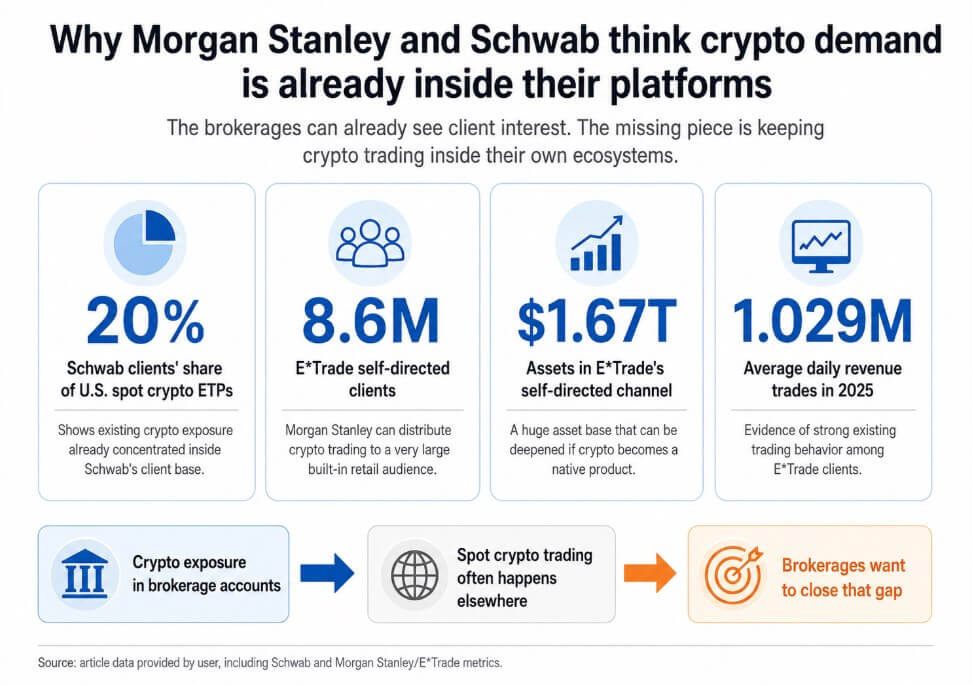 An infographic highlights four client metrics, including Schwab's 20% share of U.S. spot crypto ETPs, showing why both brokerages believe crypto demand already sits inside their platforms.
Why attack now
Both firms chose to move while the pure-play crypto model is threatened.
Robinhood's first-quarter results show app crypto notional volume down 48% year over year to $24 billion, with crypto revenue down 47%.
The infrastructure costs of building a crypto product are fixed regardless of market conditions, but launching into a lull gives compliance, pricing, and service teams time to work out the friction before retail enthusiasm returns at scale.
Incumbents rarely attack pure-play competitors at the peak of a cycle, moving when the window is open.
The regulatory environment gave them the runway to build. The FDIC rescinded its prior-approval requirement for permissible crypto activities in March 2025, while the OCC clarified in May 2025 that national banks may buy and sell customer-custodied crypto and outsource execution with proper risk management.
In April 2026, SEC staff followed with an interim statement on broker-dealer registration issues for certain crypto interfaces.
The directional shift cleared enough friction to build, even as Congress has work to do regarding the CLARITY Act.
What looks like an aggressive 2026 push is the visible end of a multi-quarter infrastructure project. Morgan Stanley's E*Trade crypto plan started in September 2025, targeting a first-half 2026 launch via Zerohash.
| Date | Event | Why it mattered |
|---|---|---|
| March 2025 | FDIC rescinded its prior-approval requirement for permissible crypto activities | Lowered a key procedural barrier for banks exploring crypto services |
| May 2025 | OCC clarified that national banks may buy and sell customer-custodied crypto and outsource execution with proper risk management | Gave banks clearer legal-operational footing to build crypto products |
| July 2025 | Standard Chartered launched institutional spot Bitcoin and Ethereum trading | Showed large financial institutions were moving beyond wrappers into direct trading |
| September 2025 | Morgan Stanley’s E*Trade crypto plan began, targeting a first-half 2026 launch via Zerohash | Indicates the 2026 push was planned well in advance, not a sudden reaction |
| December 2025 | JPMorgan began exploring institutional crypto trading | Reinforced the broader industry shift toward crypto infrastructure buildout |
| February 2026 | Fidelity received OCC approval for bank-based crypto custody and execution | Added evidence that regulated financial firms were building integrated crypto rails |
| April 2026 | SEC staff issued an interim statement on broker-dealer registration issues for certain crypto interfaces | Added more regulatory clarity for brokerage-style crypto access |
| 2026 rollout | Schwab launched with custody at Charles Schwab Premier Bank, execution through Paxos, educational tools, and phased access starting with Bitcoin and Ethereum | Shows a full-stack rollout focused on mainstream brokerage integration |
Schwab arrived with a full institutional stack, including custody at Charles Schwab Premier Bank, execution through Paxos, educational tools, and a phased rollout starting with Bitcoin and Ethereum.
The pattern extends beyond two brokerages, as Standard Chartered launched institutional spot Bitcoin and Ethereum trading in July 2025, and Goldman Sachs filed for its first Bitcoin ETF in April 2026.
JPMorgan started exploring institutional crypto trading in December 2025, and Fidelity received OCC approval in February 2026 for bank-based crypto custody and execution.
Across these separate decisions, the shared conclusion is that crypto custody, execution, and client access should be part of the same infrastructure that handles every other asset class.
What the fight decides
If ETF inflows continue to recover, as Bitcoin ETFs registered over $1.6 billion in inflows in May, and brokerage clients begin treating crypto as a routine line item alongside equities, both firms collect trading revenue while deepening the client relationship.
Schwab has said it intends to expand beyond Bitcoin and Ethereum and add transfer capability over time. Citi's 12-month Bitcoin target sits at $112,000, with a bull case of $165,000.
A brokerage with direct access already captures the demand as it broadens.
The bear case consists of Schwab's launch being constrained to Bitcoin and Ethereum only, with transfers deferred and unavailable in New York and Louisiana.
If Congress stalls on the CLARITY Act, the Fed stays restrictive, and retail engagement stays thin, then direct crypto trading becomes a table-stakes feature.
Citi's bear case puts Bitcoin at $58,000, and Standard Chartered has flagged a potential drawdown to $50,000, and Bitcoin is already down roughly 7% year to date.
In that environment, the product holds existing crypto-interested clients and adds little new account growth.
| Scenario | Market conditions | BTC reference level | What it means for Schwab and Morgan Stanley |
|---|---|---|---|
| Demand broadens / upside case | ETF inflows keep recovering, brokerage clients start treating crypto as a routine line item, and platform features expand over time | Citi 12-month target: $112,000; Citi bull case: $165,000 | Direct crypto trading becomes a meaningful revenue and retention tool; brokers capture more trading activity inside their own ecosystems |
| Muted adoption / downside case | CLARITY Act stalls, the Fed stays restrictive, transfers remain limited, and retail engagement stays thin | Citi bear case: $58,000; Standard Chartered downside: $50,000 | Crypto remains a table-stakes feature that helps retain existing crypto-curious clients, but does not materially drive new account growth |
Schwab and Morgan Stanley are responding to client behavior they can already observe, building distribution infrastructure before a demand surge they cannot afford to predict or miss.
The ETF era handed brokerages a clear signal that their own clients wanted crypto, while keeping the actual trading relationship on someone else's platform.
The firms that capture the next phase of retail crypto demand will be the ones that had direct, live access before retail asked for it.
The post Morgan Stanley and Charles Schwab are rushing into crypto: what do they see coming? appeared first on CryptoSlate.


You May Also Like

From Telegram to Browser: How Banana Gun Built a Unified Trading Layer Across Five Chains

Dogecoin Price Review: Can DOGE Reclaim $0.20?