This article explores LLM-Sim, a benchmark designed to test whether large language models can serve as “world simulators” in text-based environments. By framing the problem as a goal-conditioned partially observable Markov decision process (POMDP), the study evaluates how LLMs model both action-driven and environment-driven transitions, track object properties, and assess game progress. Using human- and AI-generated context rules, the research measures prediction accuracy across object states and rewards, providing insight into how well LLMs can reason about dynamic systems beyond simple text prediction.This article explores LLM-Sim, a benchmark designed to test whether large language models can serve as “world simulators” in text-based environments. By framing the problem as a goal-conditioned partially observable Markov decision process (POMDP), the study evaluates how LLMs model both action-driven and environment-driven transitions, track object properties, and assess game progress. Using human- and AI-generated context rules, the research measures prediction accuracy across object states and rewards, providing insight into how well LLMs can reason about dynamic systems beyond simple text prediction.

Markov Chains, Rewards & Rules

Abstract and 1. Introduction and Related Work

  1. Methodology

    2.1 LLM-Sim Task

    2.2 Data

    2.3 Evaluation

  2. Experiments

  3. Results

  4. Conclusion

  5. Limitations and Ethical Concerns, Acknowledgements, and References

A. Model details

B. Game transition examples

C. Game rules generation

D. Prompts

E. GPT-3.5 results

F. Histograms

2 Methodology

We examine the abilities of LLMs to serve as world simulators in text-based virtual environments, in which an agent receives observations and proposes actions in natural language in order to complete certain objectives. Each text environment can be formally represented as a goal-conditioned partially observable Markov decision process (POMDP) (Kaelbling et al., 1998) with the 7-tuple (S, A, T , O, R, C, D), where S denotes the state space, A denotes the action space, T : S × A → S denotes the transition function, O denotes the observation function, R : S × A → R denotes the reward function, C denotes a natural language “context message” that describes the goal and action semantics, and D : S × A → {0, 1} denotes the binary completion indicator function.

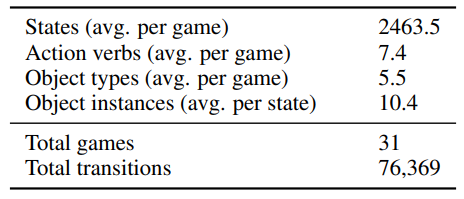
\ Table 1: Corpus statistics of BYTESIZED32-SP.
\

2.1 LLM-Sim Task

\

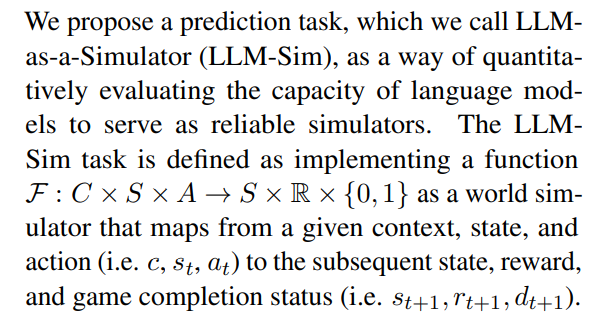
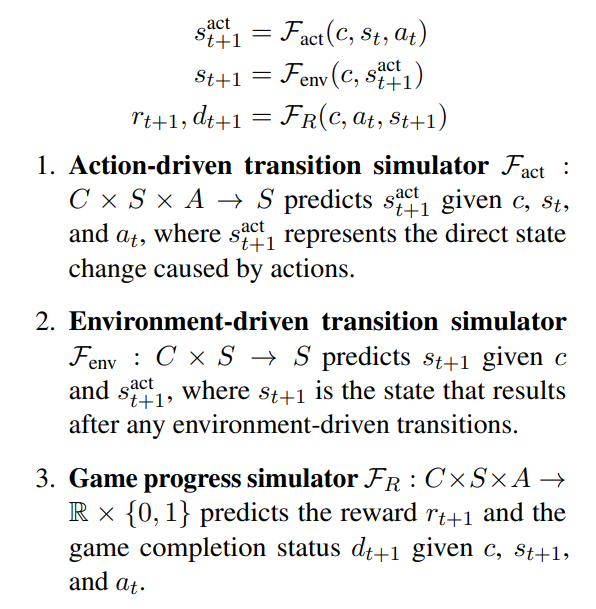
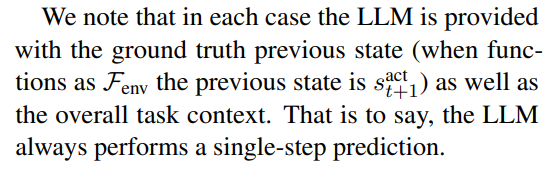
\ \ In practice, the whole state transition simulator F should consider two types of state transitions: action-driven transitions and environment-driven transitions. For the example in Figure 1, the action-driven transition is that the sink is turned on (isOn=true) after taking the action turn on sink, and the environment-driven transition is that water fills up the cup in the sink when the sink is on. To better understand LLM’s ability to model each of these transitions, we further decompose the simulator function F into three steps:

\ \
\ \ \
\

2.2 Data

\
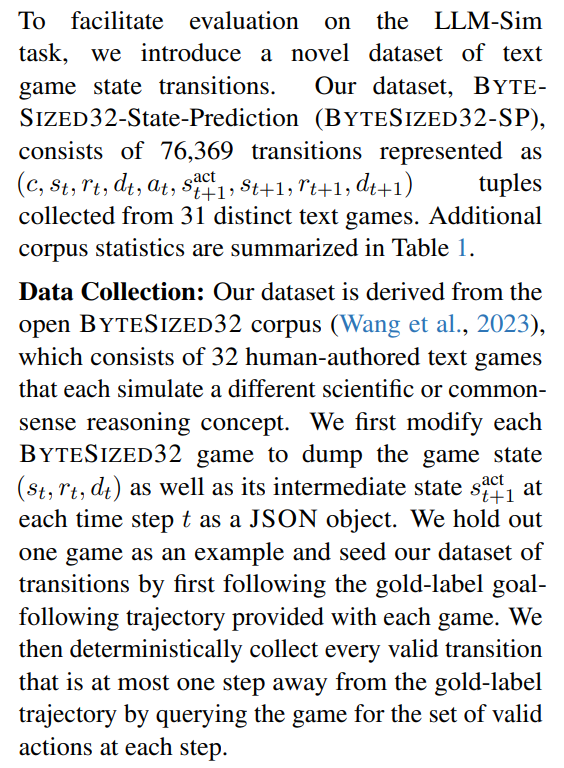
\ \ Additional Context: Each game also includes a context message, c, that provides additional information to the model. The context consists of four parts: action rules describing the effect of each action on the game state, object rules describing the meaning of each object property and whether they are affected by the game’s underlying dynamics, scoring rules describing how an agent earns reward and the conditions under which the game is won or lost, and one or two example transitions (see Appendix B for details) from the held-out game mentioned above. For each game we generate three

\ \
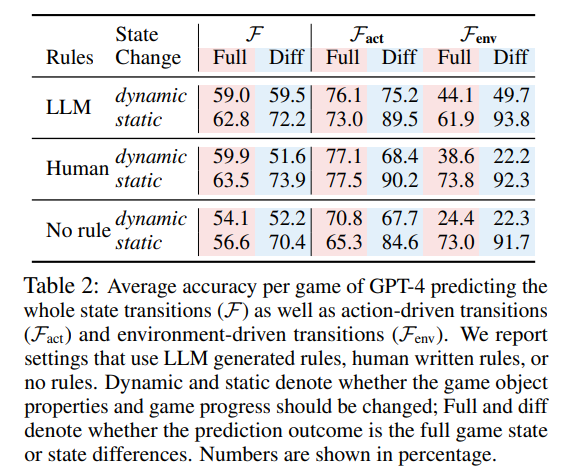
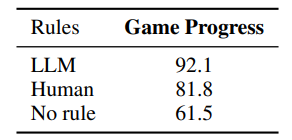
\ \ \ Table 3: GPT-4 game progress prediction results
\ \ versions of the context, one where the rules are written by a human expert (one of the game authors), and one where they are produced by an LLM with access to the game code, and one where no rules are provided. See Appendix C for additional details.

\

2.3 Evaluation

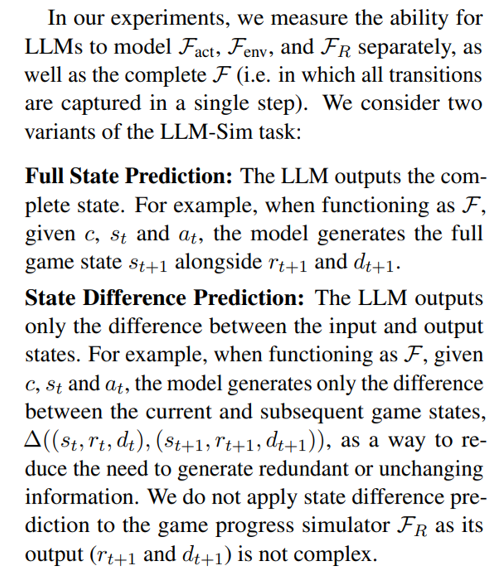
Performance on LLM-Sim is determined by the model’s prediction accuracy w.r.t. the ground truth labels over a dataset of test samples. Depending on the experimental condition, the LLM must model object properties (when simulating Fact, Fenv, or F) and / or game progress (when simulating FR or F), defined as:

\ Object Properties: a list of all objects in the game, along with each object’s properties (e.g., temperature, size) and relationships to other objects (e.g., being within or on top of another object).

\ Game Progress: the status of the agent w.r.t. the overall goal, consisting of the current accumulated reward, whether the game has terminated, and whether the overall goal has been achieved.

\ \
\ \ \

:::info Authors:

(1) Ruoyao Wang, University of Arizona (ruoyaowang@arizona.edu);

(2) Graham Todd, New York University (gdrtodd@nyu.edu);

(3) Ziang Xiao, Johns Hopkins University (ziang.xiao@jhu.edu);

(4) Xingdi Yuan, Microsoft Research Montréal (eric.yuan@microsoft.com);

(5) Marc-Alexandre Côté, Microsoft Research Montréal (macote@microsoft.com);

(6) Peter Clark, Allen Institute for AI (PeterC@allenai.org).;

(7) Peter Jansen, University of Arizona and Allen Institute for AI (pajansen@arizona.edu).

:::


:::info This paper is available on arxiv under CC BY 4.0 license.

:::

\

Market Opportunity
SQUID MEME Logo
SQUID MEME Price(GAME)
$38,2774
$38,2774$38,2774
-0,03%
USD
SQUID MEME (GAME) Live Price Chart
Disclaimer: The articles reposted on this site are sourced from public platforms and are provided for informational purposes only. They do not necessarily reflect the views of MEXC. All rights remain with the original authors. If you believe any content infringes on third-party rights, please contact service@support.mexc.com for removal. MEXC makes no guarantees regarding the accuracy, completeness, or timeliness of the content and is not responsible for any actions taken based on the information provided. The content does not constitute financial, legal, or other professional advice, nor should it be considered a recommendation or endorsement by MEXC.

You May Also Like

The Channel Factories We’ve Been Waiting For

The Channel Factories We’ve Been Waiting For

The post The Channel Factories We’ve Been Waiting For appeared on BitcoinEthereumNews.com. Visions of future technology are often prescient about the broad strokes while flubbing the details. The tablets in “2001: A Space Odyssey” do indeed look like iPads, but you never see the astronauts paying for subscriptions or wasting hours on Candy Crush.  Channel factories are one vision that arose early in the history of the Lightning Network to address some challenges that Lightning has faced from the beginning. Despite having grown to become Bitcoin’s most successful layer-2 scaling solution, with instant and low-fee payments, Lightning’s scale is limited by its reliance on payment channels. Although Lightning shifts most transactions off-chain, each payment channel still requires an on-chain transaction to open and (usually) another to close. As adoption grows, pressure on the blockchain grows with it. The need for a more scalable approach to managing channels is clear. Channel factories were supposed to meet this need, but where are they? In 2025, subnetworks are emerging that revive the impetus of channel factories with some new details that vastly increase their potential. They are natively interoperable with Lightning and achieve greater scale by allowing a group of participants to open a shared multisig UTXO and create multiple bilateral channels, which reduces the number of on-chain transactions and improves capital efficiency. Achieving greater scale by reducing complexity, Ark and Spark perform the same function as traditional channel factories with new designs and additional capabilities based on shared UTXOs.  Channel Factories 101 Channel factories have been around since the inception of Lightning. A factory is a multiparty contract where multiple users (not just two, as in a Dryja-Poon channel) cooperatively lock funds in a single multisig UTXO. They can open, close and update channels off-chain without updating the blockchain for each operation. Only when participants leave or the factory dissolves is an on-chain transaction…
Share
BitcoinEthereumNews2025/09/18 00:09
‘KPop Demon Hunters’ Gets ‘Golden’ Ticket With 2 Nominations

‘KPop Demon Hunters’ Gets ‘Golden’ Ticket With 2 Nominations

The post ‘KPop Demon Hunters’ Gets ‘Golden’ Ticket With 2 Nominations appeared on BitcoinEthereumNews.com. Mira (voice of May Hong), Rumi (Arden Cho) and Zoey (
Share
BitcoinEthereumNews2026/01/22 23:28
Tron Founder Justin Sun Invests $8M in River’s Stablecoin Abstraction Technology

Tron Founder Justin Sun Invests $8M in River’s Stablecoin Abstraction Technology

Justin Sun commits $8 million to River for stablecoin abstraction deployment across Tron ecosystem, including SUN pools and JustLend integration, as RIVER token
Share
Coinstats2026/01/22 22:59