QAD Redzone Pune Signals an AI-First Shift in Manufacturing Execution
Manufacturing software companies are entering a new competitive phase where operational adaptability matters more than operational scale. The inauguration of the new QAD Redzone Pune hub reflects that transition clearly.
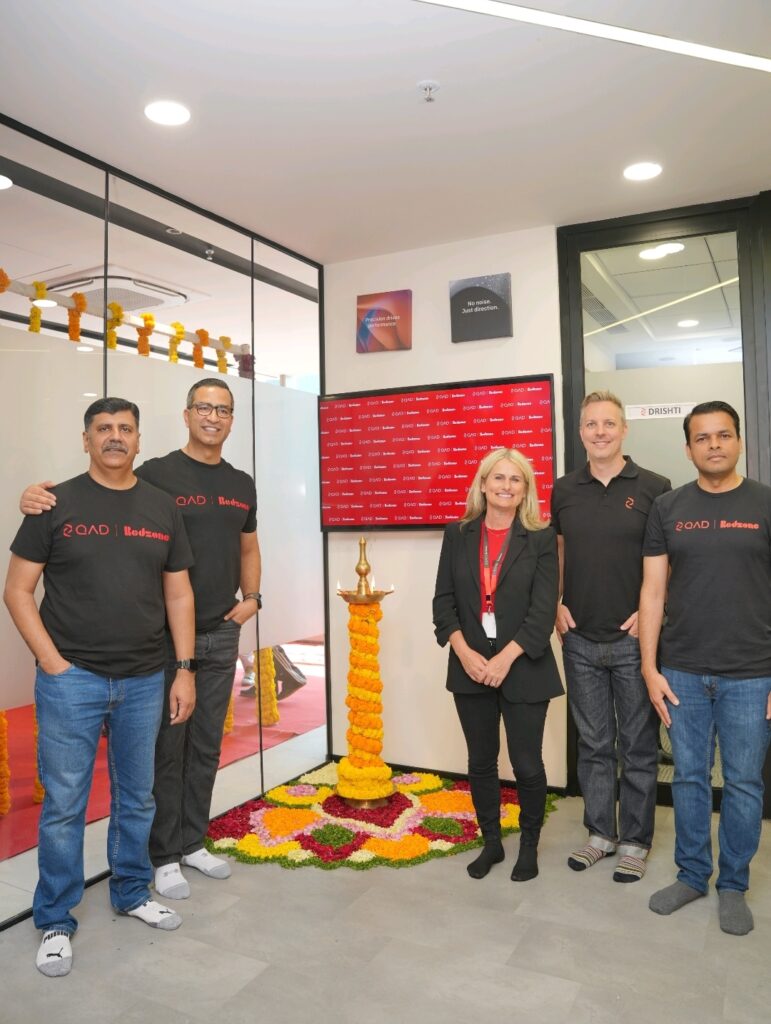
QAD | Redzone announced the launch of its new Pune regional hub to strengthen engineering, AI, and product development capabilities across three strategic platform pillars: Redzone, Adaptive Applications, and ChampionAI. The move is positioned as a long-term investment in manufacturing-focused AI innovation and global operational scalability.
“Manufacturing is at an inflection point, and the companies that will lead the next decade will not be the ones with the biggest systems. They will be the ones who can execute, adapt, and make decisions faster than everyone else. AI is fundamentally changing how manufacturing operates, and we intend to be at the center of that transformation,” — Sanjay Brahmawar, CEO, QAD | Redzone.
The announcement arrives at a time when manufacturers globally are dealing with increasingly unstable operating conditions. Supply chain fragmentation, labor shortages, geopolitical uncertainty, and EV transition pressures are exposing the limitations of traditional manufacturing systems.
What matters now is not just visibility — but coordinated execution.
QAD Redzone Pune Reflects a Broader Manufacturing AI Shift
For years, manufacturing digitization focused heavily on ERP modernization and process standardization. Those systems improved planning and reporting but often failed to solve frontline operational responsiveness.
This is where the shift occurs.
Modern manufacturing environments require systems capable of:
- Detecting operational disruptions early
- Coordinating workforce responses rapidly
- Rebalancing production dynamically
- Supporting real-time decision execution
QAD | Redzone’s platform strategy appears designed around precisely this requirement.
Its three operational pillars reveal a layered architecture:
- Redzone for frontline workforce enablement
- Adaptive Applications for operational orchestration
- ChampionAI for manufacturing-specific agentic intelligence
Strategically, this indicates a move away from static enterprise systems toward adaptive manufacturing ecosystems.
“The Pune hub is a strategic engineering and AI hub that will help shape the future of manufacturing technology. India has some of the best engineering talent in the world, and this investment enhances our ability to build faster, innovate faster, and deliver meaningful business outcomes for manufacturers globally,” — Sanjay Brahmawar, CEO, QAD | Redzone.
The deeper implication is that manufacturing technology vendors are no longer competing purely on software breadth. They are competing on execution intelligence.
Why Manufacturing Vendors Are Rebuilding Around AI-Native Execution
Traditional enterprise manufacturing systems were built around predictability.
Today’s manufacturing environment is defined by volatility.
Automotive manufacturers are balancing EV transitions and globally distributed supply chains. Food and beverage companies are under pressure to improve traceability and compliance while reducing waste. Life sciences firms require increasingly synchronized compliance and operational visibility systems.
These pressures are reshaping enterprise buying priorities.
From a CX standpoint, manufacturers increasingly evaluate technology vendors based on operational responsiveness rather than feature volume alone.
Operationally, this translates to questions such as:
- Can systems coordinate workforce actions faster?
- Can AI identify disruptions before escalation?
- Can operations rebalance dynamically?
- Can production variability be minimized in real time?
This is where manufacturing-specific AI becomes strategically important.
Generic enterprise copilots often lack industrial context awareness. Manufacturing AI requires understanding:
- Scheduling dependencies
- Production constraints
- Compliance requirements
- Inventory relationships
- Quality tolerances
- Workforce coordination dynamics
That domain specificity is becoming a competitive differentiator.
“This investment reflects both confidence and intent. We are building an engineering organization designed for the AI era, one that combines deep manufacturing expertise, modern cloud architecture, and agentic AI capabilities. Pune will play a pivotal role in helping us drive innovation at a global scale,” — Rajeev Purohit, GM India and Head of Engineering, QAD | Redzone.
The Competitive Positioning Behind the Expansion
The manufacturing technology landscape is increasingly fragmented across three strategic layers.
ERP vendors such as SAP and Oracle continue embedding AI into enterprise workflows and supply chain planning systems.
Industrial automation players like Siemens and Rockwell Automation focus heavily on connected operations, industrial automation, and factory intelligence.
QAD | Redzone appears to be positioning itself between those layers.
Its emphasis on frontline execution, adaptive operations, and manufacturing-focused agentic AI creates differentiation around operational coordination rather than infrastructure ownership alone.
This becomes critical because manufacturing failures often occur not due to lack of data, but due to delayed coordination between systems, people, and operational decisions.
At a structural level, the Pune investment also reinforces India’s growing strategic importance in industrial AI engineering.
Rather than functioning only as support centers, Indian hubs are increasingly becoming core innovation nodes for global enterprise platforms.
The Technology Architecture Driving the Strategy
The most important technological signal in the announcement is ChampionAI.
While many enterprise vendors are experimenting with AI assistants, manufacturing environments require something more operationally reliable: contextual execution intelligence.
Agentic AI in manufacturing must interact across:
- Operational workflows
- Industrial telemetry
- Workforce coordination
- Supply chain systems
- Production schedules
- Compliance frameworks
That level of orchestration requires significantly deeper domain specialization than generalized enterprise AI deployments.
The Pune hub is expected to focus on:
- AI engineering
- Industrial data systems
- Cloud infrastructure
- Product engineering
- Customer experience operations
- Scalable global service delivery
From a CX standpoint, this translates into faster operational responsiveness for manufacturers navigating volatility.
“The companies that will lead the next decade will not be the ones with the biggest systems. They will be the ones who can execute, adapt, and make decisions faster than everyone else,” — Sanjay Brahmawar, CEO, QAD | Redzone.
The statement reflects a broader industry transition from process digitization toward execution intelligence.
What This Means for Manufacturing CX
The customer experience impact of manufacturing AI is often underestimated.
Delivery delays, quality inconsistencies, inventory instability, and production disruptions all directly affect customer trust.
AI-enabled operational orchestration can improve:
- Delivery reliability
- Product traceability
- Production consistency
- Exception response times
- Supply chain resilience
For manufacturers, operational adaptability increasingly becomes a customer experience capability.
This is where platforms like Redzone and ChampionAI become commercially relevant.
The goal is not only automation.
The goal is coordinated operational intelligence capable of reducing friction between insight and execution.
That distinction matters.
Many manufacturers already possess operational data. The challenge lies in transforming fragmented information into synchronized execution decisions fast enough to manage volatility effectively.
The Long-Term Implication of the Pune Expansion
The QAD Redzone Pune expansion signals more than regional growth. It reflects how industrial software markets are evolving toward AI-native operational ecosystems.
Manufacturing companies increasingly require platforms capable of:
- Continuous operational adaptation
- Workforce coordination
- AI-assisted decision support
- Predictive disruption management
- Real-time execution intelligence
This creates pressure on both manufacturers and software vendors.
For enterprise technology providers, the next competitive battleground may center on operational adaptability rather than transactional process management.
For manufacturers, operational responsiveness is rapidly becoming a measurable competitive advantage.
The deeper implication is clear: manufacturing AI is moving from experimentation toward operational infrastructure.
And vendors capable of combining industrial expertise with adaptive AI execution systems may define the next phase of manufacturing transformation.
The post QAD Redzone Pune Signals an AI-First Shift in Manufacturing Execution appeared first on CX Quest.


You May Also Like

XRP To $10? Thesis Links CLARITY Act To Bank-Scale Liquidity
MSTR Stock Keeps Falling as MSTY’s Huge Yield Sparks a New Debate