AI Service Transformation: Srini Raghavan on Operationalizing Agentic AI Across Enterprise Service Ecosystems
CX Industry Context
Enterprise service operations are entering a decisive transition phase. For more than a decade, organizations approached service transformation primarily through workflow digitization, ticket consolidation, and automation layering. But the emergence of enterprise-grade generative and agentic AI is fundamentally altering what organizations now expect from service operations platforms. The conversation is no longer centered on incremental productivity improvements alone. It is shifting toward autonomous orchestration, contextual intelligence, operational resilience, and AI-governed decision execution across distributed enterprise environments.
This transition is being accelerated by a structural reality many enterprises are only beginning to fully recognize: modern work has become permanently asynchronous. Freshworks’ telemetry showing that nearly half of IT tickets are now submitted outside standard working hours is more than an operational statistic. It reflects a broader evolution in workforce behavior, digital dependency, and employee expectations. The rise of the “ghost shift” worker exposes a widening gap between always-on employee expectations and legacy support architectures still optimized for business-hour responsiveness.
Enterprise AI Adoption
At the same time, enterprise AI adoption is encountering a new maturity challenge. Organizations are moving beyond experimentation and pilot deployments toward operationalization. That shift introduces entirely different concerns: governance, contextual reliability, integration complexity, workflow accountability, organizational readiness, and measurable business outcomes. Many enterprises have already discovered that AI value creation is constrained less by model sophistication and more by fragmented operational data, disconnected service layers, and implementation drag.
This is where the competitive landscape is becoming increasingly differentiated. Legacy enterprise service platforms often struggle under accumulated architectural complexity, fragmented data structures, and prolonged deployment cycles. In contrast, newer cloud-native vendors are positioning platform unification, shared data layers, and AI-native orchestration as strategic advantages rather than feature enhancements. The market conversation is therefore evolving from “Who has AI?” to “Who can operationalize AI responsibly, contextually, and at enterprise speed?”
Against this backdrop, Freshworks’ latest Freshservice announcement is strategically significant because it frames AI not as a standalone capability, but as an operational layer embedded into a unified ServiceOps architecture. The broader industry implication is substantial: service operations may increasingly become the control center for enterprise-wide autonomous execution, extending far beyond IT support into HR, finance, facilities, and cross-functional operational ecosystems.
Interviewee Perspective
Srinivasan Raghavan represents a particular category of enterprise technology executive increasingly shaping the future of AI-enabled service operations: the operator-product strategist. His career trajectory across Freshworks, RingCentral, Five9, and Cisco places him at the intersection of enterprise communications, AI automation, digital workflows, and large-scale SaaS product execution.
What makes Raghavan’s perspective especially relevant in the current market cycle is the breadth of operational domains he has navigated. His background spans AI automation, enterprise collaboration, digital workflow orchestration, and customer engagement infrastructure — disciplines that are increasingly converging as organizations attempt to operationalize AI across service ecosystems rather than within isolated applications.
As Chief Product Officer at Freshworks, Raghavan is helping shape the company’s evolution from a modern service management provider into a broader AI-powered ServiceOps platform company. That strategic shift requires balancing competing enterprise realities: speed versus governance, automation versus trust, flexibility versus control, and operational efficiency versus employee experience quality.
The Freshservice launch also positions Raghavan less as a feature-focused product executive and more as an architectural transformation leader. The emphasis on AI Agent Studio, MCP Gateway integration, xLAs, and unified service data layers suggests a product philosophy focused on enabling enterprise adaptability rather than prescribing rigid operational frameworks.
Company Intelligence
Freshworks has historically differentiated itself by positioning enterprise software around usability, faster deployment cycles, and lower operational friction compared to legacy incumbents. Its expansion into AI-powered ServiceOps reflects a broader strategic ambition to compete not merely on interface simplicity, but on enterprise operational orchestration.
Freshservice now sits at the center of that evolution. The platform’s integration of ITSM, ITAM, ITOM, ESM, incident management, and embedded AI capabilities signals a deliberate move toward platform consolidation at a time when many enterprises are struggling with fragmented operational ecosystems and disconnected service intelligence.
The introduction of Freddy AI Agent Studio and MCP Gateway also indicates an important maturity shift in enterprise AI positioning. Rather than presenting AI as a generalized assistant layer, Freshworks is emphasizing contextual execution, workflow extensibility, and integration portability. That approach aligns with growing enterprise demand for operationally grounded AI systems capable of working within existing ecosystems rather than forcing complete process redesigns.
Operationally, the company’s emphasis on deployment speed, governance, and enterprise context suggests recognition that the next phase of AI competition will likely be determined less by model novelty and more by implementation realism, organizational trust, and measurable workflow impact.
Strategic Editorial Lens
This interview matters because it sits at the convergence of several major enterprise transitions simultaneously: agentic AI adoption, workforce decentralization, service operations modernization, and the growing pressure to operationalize AI beyond experimentation.
The broader industry conversation is rapidly moving from “Can AI assist employees?” toward “Can AI autonomously coordinate operational outcomes across enterprise systems?” That transition introduces profound architectural, governance, and organizational implications that many enterprises are still unprepared for.
Freshworks’ positioning around Service Transformation, Made Real reflects a notable strategic reframing. Rather than emphasizing AI as an isolated innovation layer, the company is arguing that AI effectiveness depends on the integrity of the operational foundation beneath it — unified service data, contextual workflows, integrated asset visibility, and orchestration readiness. That is a materially different argument from many AI narratives currently dominating enterprise technology marketing.
Gap Between Employee Expectations and Operational Responsiveness
The interview also surfaces an increasingly important tension in enterprise AI adoption: the gap between employee expectations and operational responsiveness. The “ghost shift” insight highlights how asynchronous work patterns are exposing limitations in traditional service delivery models. Enterprises are being forced to rethink what service availability, responsiveness, and experience continuity actually mean in an always-on work environment.
Another critical dimension involves governance and operational trust. Many organizations remain cautious about autonomous AI execution because workflow accountability, data access control, integration integrity, and escalation transparency remain unresolved challenges. Freshworks’ emphasis on deployment flexibility, governance, and contextual integration suggests recognition that enterprise AI adoption is ultimately a trust architecture challenge as much as a technology challenge.
Enterprise leaders should pay particular attention to how this conversation addresses operational realism. The most valuable insights are likely to emerge not from discussions of AI potential, but from examining deployment friction, organizational resistance, measurable outcomes, cross-functional coordination, and the practical constraints involved in scaling autonomous service execution responsibly.
Service Transformation, Made Real
Q1. Freshworks framed this launch around “Service Transformation, Made Real” rather than simply announcing new AI capabilities. What does that wording signal about how you believe the enterprise AI conversation is evolving beyond experimentation and pilots?
SR: The goal isn’t “AI transformation” for its own sake. It is “Service Transformation”, and AI simply makes it possible. We want to give IT teams the freedom to stop fixing yesterday’s problems and start building what’s next. We deliver this through Freshservice’s unified platform connecting service, assets, and incidents, allowing customers to deploy trusted AI at the speed their business demands.
Q2. Your telemetry shows that 47% of IT tickets are now created outside standard working hours. How much of this reflects a temporary post-pandemic work pattern versus a permanent restructuring of enterprise operational expectations?
SR: Our telemetry highlights a permanent restructuring where employees work from anywhere at any time, creating a critical support gap. Because 47% of tickets are submitted outside work hours, it has created a scenario where workers lose time hunting for answers and SLA rates fall. This requires 24/7 autonomous AI orchestration to deliver immediate resolutions.
Q3. The press release repeatedly emphasizes employee experience rather than just operational efficiency. How has the definition of “service quality” changed in an AI-enabled workplace?
SR: The true measure of AI’s value isn’t just technical capability; it’s what it gives back to the employee: time, focus, and freedom. Service quality is now defined by eliminating the frustrating wait times and directly optimizing both service delivery and the actual employee experience.
Q4. Experience Level Agreements (xLAs) suggest a move beyond traditional SLA-driven thinking. What organizational behaviors change when companies start measuring employee sentiment alongside operational responsiveness?
SR: Legacy metrics like ticket volume do not reflect the true employee experience. By introducing XLAs and Executive Overview Insights, we use AI-driven analysis to connect service performance directly to employee sentiment. This provides the superior visibility leaders need to make faster, data-driven decisions that improve both operations and employee satisfaction.
Copilots and Assistive Interfaces
Q5. Much of the AI market still focuses on copilots and assistive interfaces. Freshworks appears to be positioning toward autonomous orchestration. Where do you think enterprises are still underestimating the operational complexity of agentic AI?
SR: Enterprises often underestimate the “implementation drag” and friction that stall enterprise AI effectiveness. To successfully orchestrate autonomous AI, organizations cannot rely on manual data mapping. They need a unified ServiceOps foundation that natively integrates service, assets, and enterprise knowledge so agents have the immediate context required to execute complex workflows.
Q6. Freddy AI Agent Studio emphasizes no-code extensibility and deployment flexibility. How important is organizational democratization becoming in enterprise AI adoption compared to centralized technical ownership?
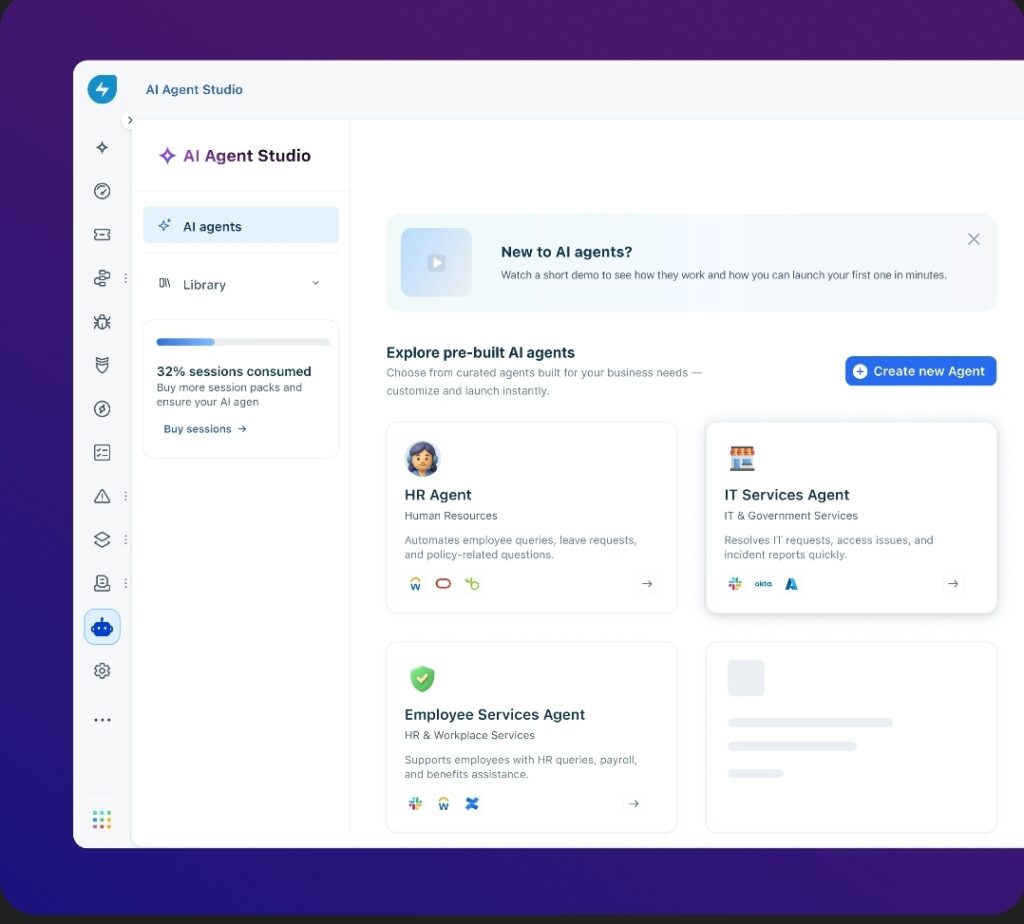
SR: It is essential because organizations need total flexibility to deploy AI on their own terms. With our no-code Freddy AI Agent Studio, teams can quickly create custom agents or use pre-built workflows that meet employees directly in Slack or MS Teams. This democratization gives organizations the agility to deploy AI in weeks, not quarters.
Q7. Many AI deployments fail not because the models are weak, but because the surrounding enterprise context is fragmented. Was that operational reality a major driver behind the MCP Gateway approach?
SR: Absolutely. Fragmented context is exactly why we launched the Model Context Protocol (MCP) Gateway. It enables Freddy AI to instantly pull external context from third-party tools like Notion, ClickUp, and Linear without requiring any custom code. This allows organizations to solve complex, cross-departmental issues and bypass the integration friction that stalls AI.
Q8. One of the biggest enterprise concerns around autonomous AI systems is governance accountability. How do organizations balance AI autonomy with escalation transparency and operational control?
SR: We balance this by building trust into the platform. Freshworks provides a strict governance framework that gives leaders complete control through transparent agent governance: a single registry for all agents, policies that travel with the agent, and full audit trails so every action is visible and reviewable.
Q9. Legacy enterprise platforms often struggle with implementation drag and data normalization complexity. What architectural decisions allow Freshservice to claim deployment timelines measured in weeks rather than quarters?
SR: The key is our unified ServiceOps foundation. Unlike legacy platforms where manual data cleanup stalls progress, our unified data layer natively integrates service, assets (ITAM), and incident management (FireHydrant). This gives AI Agents immediate context to execute workflows, bypassing the manual mapping that typically slows deployments down.
Q10. What separates organizations that will operationalize agentic AI successfully from those that may remain stuck in perpetual pilot mode?
SR: Successful organizations stop treating AI as a pilot and commit to a unified platform with shared data. This approach reduces integration complexity and allows them to confidently deploy trusted, domain- specific AI into production environments rapidly. Success is generally when IT teams spend less time on reactive work, ticket volumes drop, resolution times improve. That’s what getting out of pilot mode actually delivers.
Key CX Leadership Insights
1. Enterprise AI Success Depends More on Operational Architecture Than Model Sophistication
The Freshservice announcement reflects a broader market realization: enterprise AI effectiveness is increasingly constrained by fragmented workflows, disconnected data layers, and operational silos rather than raw AI capability itself.
This shifts competitive differentiation toward architectural readiness. Unified service ecosystems, contextual data integrity, and interoperable workflows may become more strategically valuable than standalone AI features. Organizations pursuing AI transformation without addressing foundational operational fragmentation risk creating highly intelligent systems with limited execution utility.
The implication for CX and service leaders is substantial. AI strategy can no longer remain isolated within innovation teams; it must become deeply connected to operational modernization and enterprise workflow governance.
2. Employee Experience Is Becoming an Always-On Operational Discipline
The “ghost shift” data signals a structural evolution in workforce behavior. Employees increasingly expect service responsiveness aligned with asynchronous, distributed work patterns rather than traditional business-hour support models.
This creates a new operational mandate for enterprise service organizations: continuity of experience regardless of time zone, schedule, or organizational boundary. Autonomous AI systems are therefore emerging not merely as efficiency tools, but as continuity infrastructure.
For enterprise leaders, this raises new strategic questions around workforce productivity, burnout prevention, digital responsiveness, and organizational resilience.
Central Enterprise AI Battleground
3. Governance Will Become the Central Enterprise AI Battleground
As organizations move from assistive AI toward autonomous orchestration, governance complexity increases exponentially. Accountability, escalation visibility, contextual reliability, and workflow transparency become essential operational requirements rather than compliance afterthoughts.
Freshworks’ emphasis on deployment flexibility combined with governance-aware orchestration suggests recognition that enterprise AI adoption ultimately depends on institutional trust.
Organizations that operationalize governance successfully may gain a long-term competitive advantage because trust increasingly determines scalability.
4. Service Operations Are Expanding Into Enterprise Coordination Infrastructure
Historically, service management platforms were viewed primarily as support systems. Increasingly, they are evolving into enterprise coordination layers connecting IT, HR, finance, facilities, knowledge systems, and operational intelligence.
That evolution materially elevates the strategic importance of service operations leadership within enterprises. Service platforms may increasingly influence employee productivity, organizational responsiveness, and enterprise adaptability at scale.
This transformation also blurs traditional boundaries between customer experience, employee experience, operational efficiency, and digital workplace strategy.
AI Experimentation to AI Operationalization
5. The Market Is Transitioning From AI Experimentation to AI Operationalization
The enterprise AI market is entering a maturity phase where implementation realism matters more than conceptual enthusiasm. Deployment timelines, integration friction, governance readiness, measurable outcomes, and organizational adaptability are becoming central evaluation criteria.
This creates pressure on vendors to demonstrate not only AI capability, but operational viability. Enterprises are increasingly skeptical of generalized transformation claims and more focused on measurable execution outcomes.
The next phase of enterprise AI competition will likely reward operational depth rather than narrative scale.
Editorial Reflection
The Freshworks announcement reflects a broader recalibration occurring across enterprise technology markets. For years, digital transformation narratives emphasized workflow digitization, automation efficiency, and cloud migration. The rise of generative and agentic AI has altered the stakes considerably. Organizations are no longer asking whether AI can assist service operations. They are beginning to ask whether AI can become an operational participant capable of coordinating workflows, interpreting enterprise context, and executing outcomes across increasingly fragmented environments.
That transition fundamentally changes the nature of enterprise service management itself. Service operations are evolving from reactive support functions into strategic orchestration layers influencing workforce productivity, operational continuity, and organizational responsiveness. The significance of this shift extends well beyond IT. It affects how enterprises structure employee experience, govern automation, allocate operational accountability, and design organizational trust architectures.
What makes this conversation particularly important is the tension between acceleration and maturity. Enterprise demand for AI deployment speed is intensifying, yet organizational readiness often remains uneven. Many companies still operate fragmented data ecosystems, inconsistent workflows, and disconnected governance structures. The result is a growing risk that AI sophistication may outpace operational coherence. In that environment, platform unification and contextual orchestration become strategic necessities rather than architectural preferences.
The Ghost Shift
The “ghost shift” insight introduced by Freshworks also deserves broader attention because it captures a deeper workforce transformation underway. Employees increasingly operate within asynchronous, always-connected environments where traditional support assumptions no longer hold. Organizations that fail to adapt service responsiveness to these realities may encounter widening gaps in productivity, employee trust, and operational resilience.
Equally significant is the emerging governance challenge surrounding autonomous enterprise systems. The next phase of AI adoption will not be determined solely by model intelligence. It will depend on whether enterprises can establish scalable trust mechanisms around escalation transparency, contextual reliability, workflow accountability, and decision visibility. In many ways, governance may become the defining operational competency of the agentic AI era.
Ultimately, this interview sits within a much larger industry evolution: the transformation of enterprise AI from a productivity enhancement layer into an operational infrastructure layer. The organizations that succeed will likely be those capable of aligning architecture, governance, culture, workflows, and employee experience into a coherent execution model rather than treating AI as a standalone technology initiative.
3 Key Takeaways for CX Leaders
1. Unified Operational Context Is Becoming the Foundation of Effective AI
AI systems cannot deliver meaningful enterprise outcomes when workflows, service data, and operational intelligence remain fragmented. Organizations pursuing autonomous service transformation must prioritize architectural cohesion alongside AI adoption.
The operational implication is clear: enterprises need integrated service ecosystems capable of providing AI systems with contextual visibility across departments, workflows, and knowledge sources.
This elevates service architecture from a technical concern to a strategic CX and operational leadership priority.
2. Employee Experience Expectations Are Reshaping Service Operations
The rise of asynchronous work environments is permanently altering expectations around responsiveness, accessibility, and continuity of support.
Organizations must increasingly design service operations around always-on employee realities rather than fixed operational schedules. AI-enabled orchestration can help close that gap, but only when combined with governance, escalation clarity, and workflow trust.
The broader implication is that employee experience and operational resilience are becoming deeply interconnected disciplines.
3. AI Governance Will Define Enterprise Scalability
The organizations that scale agentic AI successfully will likely be those that operationalize governance early rather than treating it as a secondary concern.
Visibility into decision flows, escalation pathways, contextual integrity, and accountability structures will determine whether enterprises trust autonomous systems at scale.
For CX and transformation leaders, governance maturity is rapidly becoming a strategic differentiator rather than merely a compliance function.
The post AI Service Transformation: Srini Raghavan on Operationalizing Agentic AI Across Enterprise Service Ecosystems appeared first on CX Quest.


You May Also Like

Not a loophole: Singapore AI export controls let China tap US AI legally

Q2 Market Insights: Bitcoin regains dominance in risk-averse environment, ETFs remain critical to market structure

Crypto Market Drops as Fear Grows and Major Assets Decline