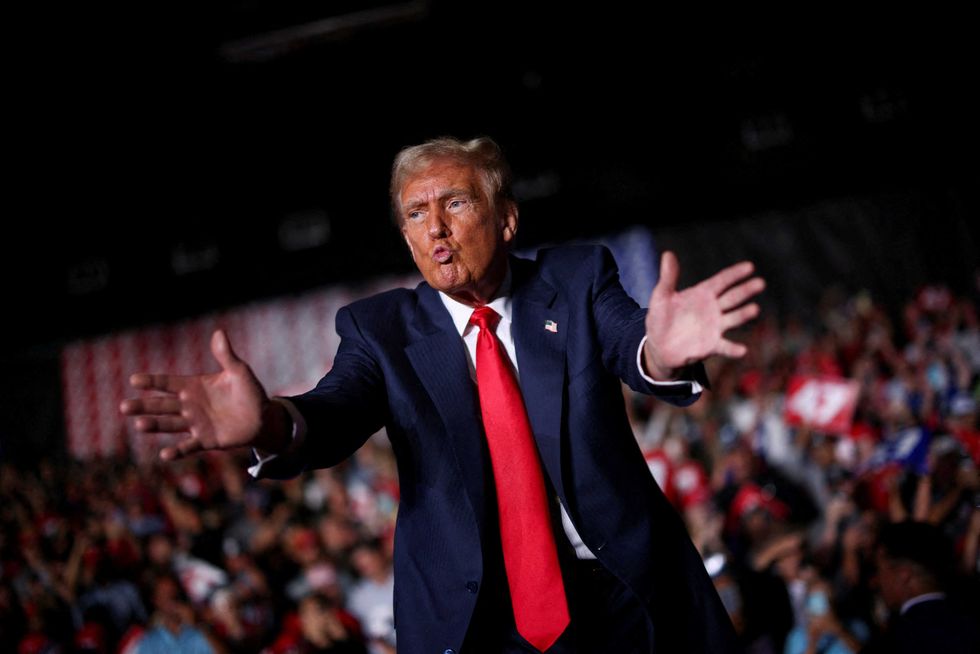
As a researcher focused on the values and rhetoric of American presidents, I study how presidents and their administrations communicate to the public about foreign policy. My primary aim is to understand the values systems and policy priorities that make up a president’s public persona.
I have found the second Trump administration exceptionally difficult to track and assess. Keeping up with Truth Social posts, press conferences and off-the-cuff Oval Office remarks from the president can feel like drinking from a fire hose.
Gone for now are the days when a U.S. president stepped to the lectern and delivered a speech direct from the teleprompter or released a carefully crafted statement that was understood to be official U.S. policy.
In its place is an unpredictable barrage of communication – ranging from traditionally worded executive orders in the mold of previous administrations to an expletive-laden Truth Social post on Easter morning in the midst of Operation Epic Fury, the Pentagon name for the war in Iran.
The president’s rhetorical style, heard most recently on his mid-May trip to China, is explained by political allies as part of Trump’s strategic approach and criticized by his opponents as the dangerous musings of an unstable leader.
In either case – whether it’s Trump’s defenders or detractors – it is increasingly difficult to ascertain whether the language of the president signals actual policy positions from the White House.
If the words of the American president no longer function as reliable indicators of U.S. foreign policy, where can the public, U.S. allies and America’s adversaries look to better understand the administration’s geopolitical priorities?
One answer may be found by examining the words of key Cabinet members.
Vance redefines ‘Western’ values
Trump’s second term has introduced a political paradox: because he is president, his words carry enormous weight. And yet, because of his hyperbolic and often erratic communication style, each statement also carries significant political uncertainty.
Will the next social media post threatening to exit NATO hint at a real policy position? Or will it simply disappear into the digital information ecosystem as another “Trump being Trump” moment?
The rhetoric of Cabinet members increasingly serves as a bridge between Trump’s erratic communication style and actual policy.
Public statements delivered in 2025 by Vice President JD Vance, Secretary of State Marco Rubio and Defense Secretary Pete Hegseth offered, I believe, critical insight into the administration’s foreign policy vision and helped lay the groundwork for major policy actions in 2026.
In February 2025, Vance stood at a lectern at the Munich Security Conference to address a gathering of prominent European political and military leaders. Many analysts expected an aggressive speech from Vance criticizing Europe’s spending on defense in the context of shared American-European security concerns, such as NATO and the war in Ukraine.
Instead, Vance argued that Europe’s political elites had failed to defend “Western” values. Speaking over audible gasps from attendees, Vance declared: “What I worry about is the threat from within, the retreat of Europe from some of its most fundamental values, values shared with the United States of America.”
Using freedom of speech as a shared value, Vance argued that many left-leaning European governments – not authoritarian-led Russia or Hungary – posed the real threat to this cornerstone of Western society.
As the first major foreign policy speech delivered abroad by the second Trump administration, Vance’s remarks signaled a major shift in America’s approach to the trans-Atlantic alliance.
The speech suggested that, in the eyes of the administration, the “values-and-interests” framework that shaped the U.S.-European relationship post-World War II had weakened. In that phrase, “values” are understood as a country’s moral and cultural preferences and its “interests” as the factors that advance its security and prosperity.
Instead, Vance argued that liberal values alone would no longer guarantee cooperation, and the administration made clear it would not avoid public fights over ideological differences with European allies.
The speech also appeared to send a clear signal to right-leaning political leaders in Europe, including then-Hungarian Prime Minister Viktor Orbán, that their brand of “Western” values had become increasingly attractive to Washington.
It is not difficult to connect Vance’s Munich speech to the administration’s subsequent embrace of right-leaning political leaders and its pullback from postwar liberal foreign policy priorities, such as a commitment to international aid.
Rubio: Trade over humanitarian aid
One of the most tumultuous domestic periods of Trump 2.0 came during the DOGE process of massive budget cutting, which eliminated programs across the government.
One DOGE flash point was the fate of the U.S. Agency for International Development, or USAID, which since 1961 had been the American government’s primary organization delivering humanitarian aid globally.
On July 1, 2025, the administration officially announced that USAID would stop providing foreign assistance, which it had been doing in approximately 130 countries.
That same day, Rubio published an article on the State Department’s Substack account titled Make Foreign Aid Great Again, arguing for a new approach that prioritized “trade over aid, opportunity over dependency, and investment over assistance.”
Like Vance in Munich, Rubio adopted an overtly aggressive tone in criticizing both USAID and America’s broader humanitarian aid model. Rubio argued that the “charity-based model failed.” Rubio’s rhetoric built on and complemented themes from Vance’s speech.
First, it reinforced the administration’s broader free-ride-is-over argument that prioritized quid pro quo relationships over established liberal values-based commitments. While Vance applied this logic to European allies in the context of “Western” values and military support, Rubio applied it to humanitarian aid projects and America’s relationships across the Global South.
Second, Rubio’s remarks made clear that a quid pro quo foreign policy rooted in what he deemed to be U.S. national interests would increasingly shape State Department decision-making – regardless of the humanitarian consequences from cuts to international aid programs or multilateral institutions such as the United Nations.
Hegseth rewrites US rules of war
In September 2025, Secretary of Defense Pete Hegseth stood in the Oval Office alongside Trump to discuss his department’s renaming to the “Department of War.” Hegseth asserted that the War Department would focus on “maximum lethality, not tepid legality; violent effect, not politically correct.”
Viewed alongside the administration’s actions in late 2025 and into 2026 – from attacks on nonmilitary vessels around Venezuela to the extraction of Maduro, to the scale of destructive force deployed against Iran – the “maximum lethality” statement may prove to be one of the most consequential rhetorical moments from a Trump Cabinet official.
As Operation Epic Fury continues, Hegseth has defiantly reaffirmed the administration’s “maximum lethality” posture. At one point he declared that “we negotiate with bombs,” and at another briefing he called for “no quarter, no mercy for our enemies” – a practice that violates international law.
These remarks and others underscore the administration’s rejection of international law and diplomacy in favor of military force as the preferred tool of American foreign policy.
Beyond the noise
In 2025, Vance, Rubio and Hegseth articulated new visions of America’s role in the world. In their own ways, they deployed rhetoric that sought to reshape U.S. foreign policy by redefining Western values, embracing quid pro quo relationships and prioritizing military force as guiding principles of the Trump administration’s agenda.
Despite the daily frenetic social posts and statements from Trump, members of his Cabinet will surely continue to project their own moral and political visions of America throughout 2026 and beyond.
Kevin Maloney, PhD student, Governance and Global Affairs, Leiden University
This article is republished from The Conversation under a Creative Commons license. Read the original article.