

We Asked Logistics Operators Across Four Continents How Freight Actually Moves. Here Is What They Told Us.
By Faruk Olawale Quadri, Co-Founder and COO, Circuit 40s Ltd
The global logistics market is worth $9.4 trillion. It moves everything from temperature-controlled pharmaceuticals out of Mumbai to cross-border cargo through the Mutukula border between Tanzania and Uganda. And yet, when you ask the operators who actually move that freight how they receive a job, the answer is almost always the same. WhatsApp.
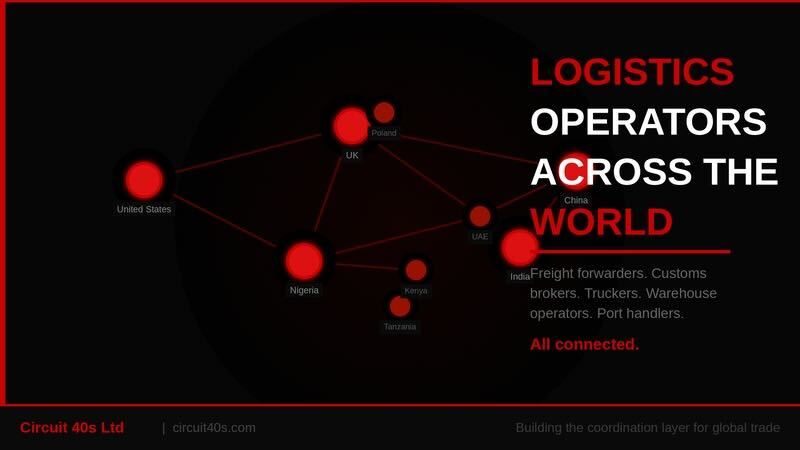
Before we wrote a single line of code for Circuit 44, our operator platform, we went out and spoke to logistics operators across Nigeria, Kenya, Tanzania, India, Poland, Hong Kong, and beyond. We asked them one question above everything else: walk us through how a shipment actually moves through your hands, from the moment you hear about it to the moment it leaves you.
What we heard changed how we think about what we are building. The job comes in on WhatsApp
Across every operator we spoke to, regardless of company size or geography, the pattern was the same. New shipments arrive via WhatsApp, email, or phone call. An independent operator in Lagos told us he waits for his quotation to be approved by WhatsApp before he commits to anything. A cross-border road freight company in Tanzania said the same. An operator handling 80 shipments a month out of Mundra, India said inquiries come in through WhatsApp, email, or client calls before any formal process begins.
This is not a small operator problem. Even a global freight management company confirmed that exception management, last-minute schedule changes, and cross-party alignment still rely heavily on email and messaging, despite having formal systems in place.
This is the reality of how freight moves. Not through platforms. Through conversations.The handoff is where it breaks A single international shipment does not move through one operator. It moves through several. A customs agent in Lagos clears the cargo at port. A trucker picks it up. A freight forwarder coordinates the ocean leg. At each transition, something has to pass between operators. Documents, instructions, confirmation that the previous stage is complete.
The managing director of a freight forwarding and customs brokerage firm in Nigeria was direct about what goes wrong at these transitions. Mismatched documents between shipping companies and customs. Lack of clear communication, particularly around demurrage and cargo descriptions. These are not edge cases. They are the norm.
An operator handling air and ocean freight on the Nairobi to UAE trade lane told us that delays happen primarily at customs clearance, and occasionally at origin due to documentation or airline delays. A Poland-based operator said incomplete documentation is the most common issue they face and they communicate requirements upfront specifically to reduce it.
The pattern across every operator we spoke to was consistent. The physical movement of cargo is rarely the problem. The movement of information between operators is.

What operators actually need at each handoff
We asked an operator moving cargo across global routes, including the UK, Europe, USA, and Dubai, what they need from the previous operator before they can start their stage. The answer was specific: a booking note, cargo ready time, container type, cargo photos, original shipping documents, and any special handling reminders.
What they pass to the next operator is equally structured: a full shipment schedule, cargo specification, sailing or flight date, a document checklist, contact information, and any special risk notice.
That is a clear, defined information layer that has to move between operators for a shipment to progress without friction. But today, most of it travels through email threads and WhatsApp messages, with no single place where it lives, no confirmation that it was received, and no way to know whether the next operator has what they need before a problem occurs.
The technology exists. The coordination layer does not.
Only 23% of freight forwarders had digitised at least 75% of their processes, and 38% of shippers reported being slightly satisfied or not satisfied at all with their forwarders’technological capabilities. The industry has the capital, the ambition, and the technology.
What it is missing is not another tracking dashboard or rate comparison tool.
What is missing is the coordination layer between operators. The structured, reliable flow of information from one operator to the next, at every stage of a shipment, so that each party knows what they are receiving, what they are responsible for, and what they need to pass on.
That is the gap Circuit 40s is building for.
Why we went to operators first
Most logistics technology is designed by people who understand the macro picture. Shipping lanes, freight rates, container capacity. What rarely gets documented is the micro reality. What does an operator in Nairobi actually need to see when a job lands on their phone? What does a customs agent at Tin Can Island port need from the previous party before they can move?
We went to operators first because they are the ones executing the work. And what they told us was not what we expected.
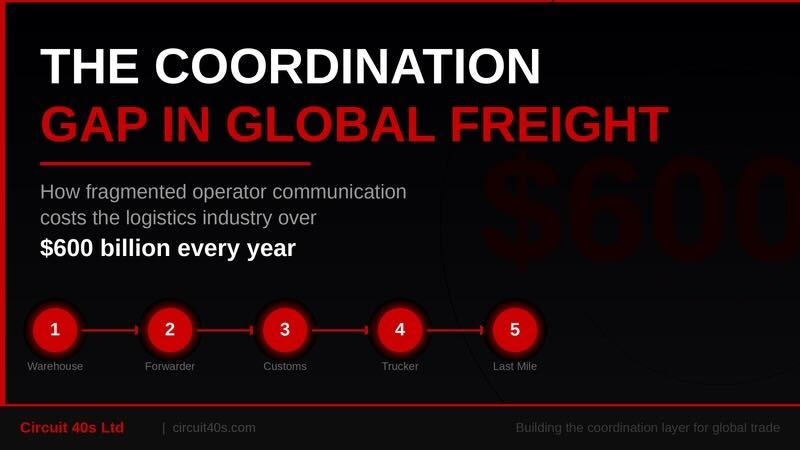
The problems are not about tracking or visibility in the way the industry talks about it. They are about the handoff. Who is responsible. What information is moving. Whether it got there. Whether it is complete.
Until that is solved, no amount of AI routing or predictive analytics changes the reality on the ground. Freight will still move on WhatsApp. And handoffs will still break when the documents do not match.
We are building from that reality outward. Not the other way around.
Source:
According to the Magaya State of Digitization in Freight Forwarding Report, 90% of shippers prioritize digital capabilities when selecting logistics partners, yet only 23% of freight forwarders have digitized more than 75% of their operations. Combined with the fact that 38% of shippers report dissatisfaction with their partners’ technological capabilities, this highlights a significant coordination and interoperability gap across the freight industry.
Faruk Olawale Quadri is Co-Founder and COO of Circuit 40s Ltd, a UK-based freight technology company building the digital coordination infrastructure for international shipments. Circuit 40s connects shippers with verified logistics operators across multiple continents. Learn more at www.Circuit40s.com.
Read also: Freight logistics startup MVX raises $1.3m seed to expand operations, grow team


You May Also Like

Dems corner GOP on Trump's 'rank corruption' as public sours

Sen. Warren launches a probe into the OCC, accusing the Trump administration of illegally granting “national trust” bank charters




