

Aurum Partners With Tangem, Allocating 1,000 Co-Branded Wallets to its Community
The global crypto payments market is accelerating. According to Grand View Research, the cryptocurrency payment apps market is projected to grow at a CAGR of 17.8% from 2025 to 2033, reaching $2.4 billion, driven by rising merchant acceptance and consumer demand for flexible spending options. Meanwhile, Visa reported more than $1 billion spent on crypto-linked cards in the first half of 2021 alone, with activity continuing to rebound and expand globally through 2025—signaling that traditional payment rails are increasingly accommodating digital assets.
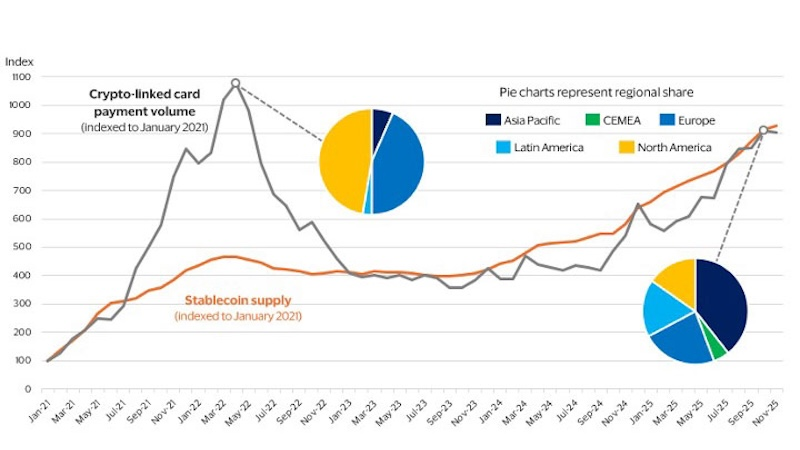 Source: Visa
To help cater to this rising demand, financial technology ecosystem Aurum Foundation has announced a new partnership with Tangem, allowing Aurum’s community to get Tangem hardware wallets for self-custody, paired with Tangem Pay, a virtual Visa card that makes those assets usable for real-world spending wherever Visa is accepted.
The collaboration is designed to supply Aurum’s community with another direct bridge between self-custodied crypto holdings and everyday spending—without requiring users to manually off-ramp through an exchange first.
How It Works: Tangem Wallet and Tangem Pay
For readers unfamiliar with the Tangem ecosystem, it is important to distinguish between two separate products at play here.
Tangem is a self-custody hardware wallet that comes in card and ring form. These physical devices store private keys and let users manage their crypto securely—but they do not have any built-in payment functionality. Think of them as a secure vault for digital assets.
Tangem Pay is an optional feature available for users from eligible regions: a virtual Visa card issued through the Tangem app. Tangem Pay connects to a user’s self-custodied holdings and enables spending at any merchant that accepts Visa—regardless of currency or location. It also integrates with Apple Pay and Google Pay for both online and contactless in-store payments.
Aurum’s choice to work with Tangem was informed by the platform’s multi-card wallet architecture. Tangem wallets ship in sets of three cards—offering built-in backup and key recovery options that most competing hardware wallet solutions do not provide out of the box.
“The crypto industry is gradually moving beyond the era of fancy utility showcase to tangible rollout of products that can make a difference,” says Andrew Isaacs, COO at Aurum Foundation, “Our rollout of self-custody wallets in partnership with Tangem is in alignment with our goals to enable easy access to innovative financial services for users with no geographical barriers. This product comes with a positive incentive that further confirms how inventive digital assets are.”
To mark the launch, Aurum has allocated 1,000 co-branded Tangem wallet cards to its community in a limited activation campaign aimed at expanding access to practical crypto payments and building long-term user engagement.
A Growing Market for Crypto Payment Products
The Aurum-Tangem partnership arrives at a moment when crypto payment infrastructure is gaining serious traction. According to Chainalysis’2025 Geography of Crypto Report, global crypto transaction volume rebounded sharply in 2025, with regions like Asia-Pacific seeing a69% year-over-year increase in value received.
Stablecoins, which topped$27.6 trillion in transfer volume in 2024 according to a CEX.IO research report, continue to anchor much of this growth, while real-world asset (RWA) tokenizationcrossed $20 billion in on-chain value in January 2026.
Regulatory frameworks in key markets—including the EU’s MiCA regime and evolving U.S. stablecoin legislation—are catching up with these developments, making it easier for both crypto-native firms and traditional financial institutions to enter the space.
As more fintech players enter the crypto payments arena, partnerships between industry leaders like Aurum and Tangem contribute to a competitive environment that ultimately benefits the end user.


You May Also Like

The changing face of elder care in Malaysia — Sayed Mohammad Reza Yamani Sayed Umar

Not a loophole: Singapore AI export controls let China tap US AI legally

Exclusive interview with Smokey The Bera, co-founder of Berachain: How the innovative PoL public chain solves the liquidity problem and may be launched in a few months



