

Trading Mentorship vs. Self-Teaching: What the Data and Real Traders Actually Show
One thing traders starting without advice have in common is that they think independence is faster. Self-paced learning seems effective, lessons are free, and the material is readily available. That confidence is natural, but it often fails when theory meets real-world market realities.
Whether self-teaching yields any outcomes at all is not the question. It functions rather well for developing core terminology and comprehending fundamental mechanics like determining support and resistance levels or reading candlestick patterns. Bridging the gap between conceptual understanding and disciplined, repeatable performance under actual pressure is what it continuously fails at.
Growing demand for structured education reflects how many traders discover that guided programs address precisely what solo study cannot. Namely, they bridge the gap between conceptual understanding and disciplined live market execution. That difference becomes visible not in a classroom but in real trading behavior, and it compounds over time.
The Appeal of Self-Directed Learning
The attraction of self-teaching in trading is easy to understand. Online resources are abundant, free content covers most foundational concepts, and the ability to learn at one’s own pace suits many people. Trading forums, YouTube channels, and broker education centers have also made technical knowledge more accessible than ever before.
For many traders, self-teaching also feels more genuine. There is a real sense of ownership in building knowledge independently. This approach can work well for grasping how leverage operates or what a common indicator measures.
Beyond that initial layer, however, the limitations start to show. Reading about a risk management rule and applying it while a live position moves against you are entirely different skills. That execution gap is where self-directed learning consistently falls short.
What Structured Mentorship Actually Delivers
Real-Time Feedback That Changes Behavior
The most significant difference between mentorship and self-teaching is not the content itself, but the feedback structure around it. In self-directed learning, traders evaluate their own decisions, which creates an inherent problem. The blind spots that cause losses are often the same ones that prevent accurate self-assessment.
A mentor observes decisions in real time and corrects poor habits before they become entrenched. That corrective loop matters especially in trading, where repetition without feedback can reinforce wrong behaviors as effectively as it reinforces the right ones. Many self-taught traders, as a result, practice their mistakes as much as their strengths.
Here is what structured mentorship delivers that solo study does not:
- Real-time corrective feedback on decisions and trade execution
- A sequenced curriculum that closes foundational gaps systematically
- Accountability built into every session, not applied inconsistently
- Simulation practice reviewed by an expert before live capital is involved
- Psychology coaching integrated into the practical training process.
A Shorter Path Through Common Errors
Most experienced traders can identify a predictable set of errors that self-taught beginners make. These include overleveraging early, abandoning strategies during normal drawdowns, and misreading price action due to technical gaps. These are not random patterns. They are structural failures of unguided learning.
Mentorship targets those gaps before they reach the live market. Traders who learn under structured guidance tend to encounter these errors first in simulation or coaching sessions. That sequencing significantly reduces the financial and psychological cost of working through them.
Comparing the Two Learning Paths
Setting both approaches side by side makes the structural differences clear. The table below outlines the key distinctions across the dimensions most relevant to a developing trader.
| Learning Dimension | Self-Teaching | Structured Mentorship |
| Decision feedback | Delayed, self-assessed | Real-time from experienced traders |
| Error correction | After financial loss | During simulation or coaching |
| Strategy development | Built independently | Guided and refined progressively |
| Accountability | None external | Integrated throughout the program |
| Learning timeline | Unpredictable, often longer | Structured and milestone-based |
| Psychology development | Typically absent | Incorporated throughout training |
Data from regulated broker disclosures across major markets consistently shows that a significant majority of retail traders using leveraged instruments lose capital. That figure does not reflect market difficulty alone. It reflects how many traders enter without adequate preparation, without structure, and without strategies that have been tested in a guided environment.
Does Structured Learning Actually Change Outcomes?
The answer is yes, and the mechanism is worth understanding clearly. Structure changes the quality of practice, not just its volume. Trading hours without critical feedback rarely produce the same results as guided sessions with corrective input. That pattern mirrors what happens in elite sports: effort alone does not create consistent performance, but directed effort with expert feedback consistently does.
Accountability also changes behavior in ways that self-directed study cannot replicate. When traders explain and justify each decision to a coach, the standard of thinking required improves noticeably. That external discipline tends to produce more consistent execution than self-managed learning cycles develop on their own.
What Self-Taught Traders Consistently Miss
The Gaps That Tend to Cost the Most
The limitations of self-directed trading education are not always obvious early on. Initial stages can feel manageable because markets occasionally move favorably regardless of preparation level. That misleading early experience often delays the recognition of deeper structural weaknesses in approach.
As traders move into more complex instruments, those gaps surface clearly. A thorough analysis of the common mistakes novice traders make reveals a consistent pattern: beginners without formal structure tend to trade on impulse rather than plan, mismanage position sizing, and skip systematic trade review altogether. Those are not talent failures. They are structural failures of the learning approach, and they appear far more often in self-taught traders than in those who have followed a guided program.
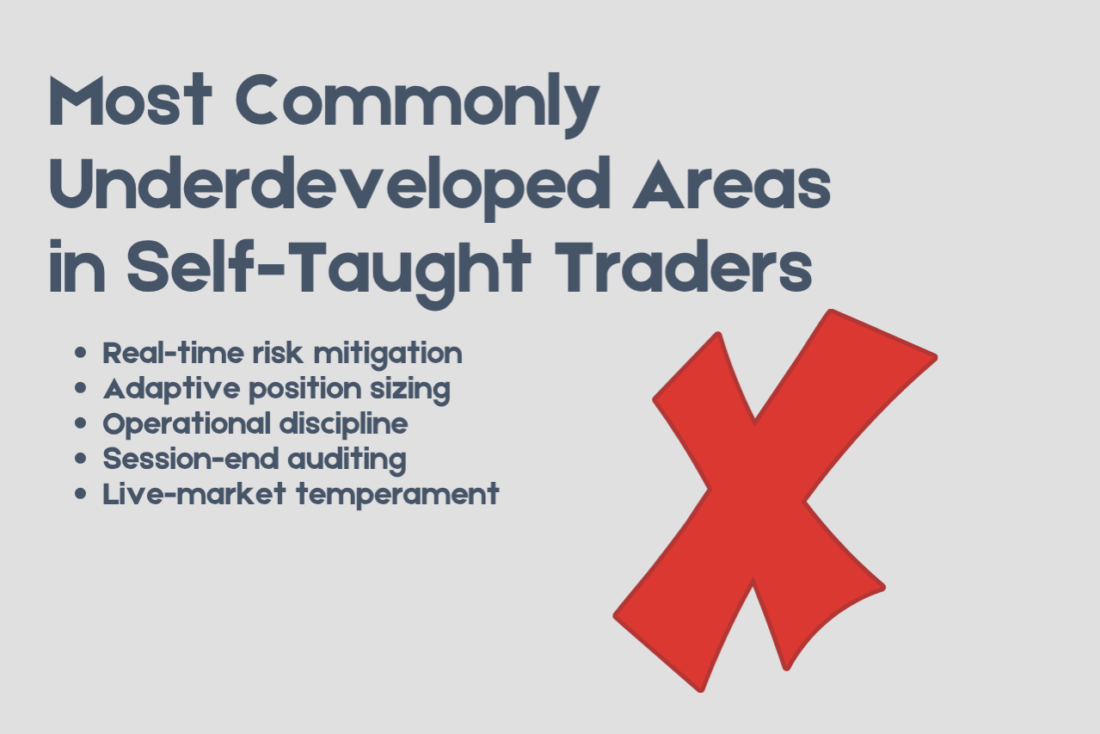
Below are the areas most commonly underdeveloped in self-taught traders:
- Risk management under real market pressure, not just in theory
- Consistent position sizing applied across different setups and conditions
- Strategy discipline maintained through drawdown periods
- Systematic trade review conducted after every session
- Emotional regulation when live decisions carry real financial consequences.
These findings reinforce the case for mentorship in a concrete way. The habits, review processes, and decision frameworks that solo learners rarely develop naturally are exactly what structured programs build deliberately and systematically.
Why Market Complexity Raises the Stakes for Preparation
Modern financial markets span a broad and growing range of instruments and conditions. Traders who move into crypto, CFDs, or leveraged forex positions encounter dynamics that require both technical fluency and strategic adaptability. Self-teaching, with its fragmented and unguided structure, tends to leave critical gaps in precisely those higher-complexity areas.
Understanding how market cycles behave, how capital rotates between asset classes, and how volatility patterns shift between stable and fast-moving periods are all areas where guided education makes a measurable difference. A detailed look at how crypto market cycles evolve and how experienced traders navigate them illustrates just how many interconnected variables a trader must track to make informed decisions. Dominance shifts, sentiment rotations, and macroeconomic catalysts all influence price action simultaneously. Mapping those dynamics takes structured coaching to develop reliably.
A mentor who has traded through multiple market cycles brings pattern recognition that years of solo reading cannot easily replicate. That contextual depth is one of the clearest advantages of structured learning over independent study.
When Should You Choose Mentorship Over Self-Teaching?
Self-teaching works well in the early conceptual phase. Beyond that foundation, however, the returns on unguided study diminish quickly for most traders. The following signals suggest that structured guidance is likely to accelerate development:
- Repeated losses without a clear understanding of the underlying cause
- Strategy switching driven by doubt rather than new or relevant information
- Emotional reactions to normal market fluctuations that disrupt planned decisions
- Difficulty building consistent habits even after extended independent study
- No regular or systematic review process for evaluating closed trades.
If several of these patterns are present, adding structured feedback through trading mentorship for beginners will likely produce more improvement than additional solo study. The goal is not to eliminate independent thinking but to build the discipline that makes independent decision-making reliable.

Choosing the Approach That Fits Your Stage
Matching the learning method to the actual stage of development is what makes the difference in practice. The table below provides a practical framework for thinking through that decision.
| Development Stage | Best Approach | Key Reason |
| Foundational learning | Self-teaching | Works well for concepts, vocabulary, and instrument basics |
| Strategy development | Structured mentorship | Provides feedback and simulation that solo learning rarely replicates |
| Live market transition | Mentored program | Traders enter with reviewed strategies and tested risk habits |
| Performance correction | Structured coaching | Addresses behavioral and strategic gaps that self-review tends to miss |
Each stage requires a different type of support, and recognizing which one applies makes the decision considerably clearer. The common thread across all of them is that structure accelerates progress, accountability reinforces discipline, and guided feedback shortens the distance between where a trader starts and where consistent trade execution in live markets begins.
Disclaimer: This is a paid post and should not be treated as news/advice. LiveBitcoinNews is not responsible for any loss or damage resulting from the content, products, or services referenced in this press release
The post Trading Mentorship vs. Self-Teaching: What the Data and Real Traders Actually Show appeared first on Live Bitcoin News.


You May Also Like

Why liquidity fragmentation became one of crypto’s biggest trading problems

Philippine Supreme Court junks bid to block transfer of senator to ICC

Shiba Inu Price Prediction Weakens as AI Token Sector Surges 30% to $19B While Pepeto SHIB and TAO Take Different Paths



