

How Kevin Warsh’s Fed Could Reshape Bitcoin’s Next Bull Market Structure
- Kevin Warsh’s discipline-focused Fed may weaken the liquidity tailwinds that fueled previous Bitcoin bull markets.
- A negative Coinbase Premium under Warsh’s Fed would signal fading U.S. institutional demand during any BTC price rally.
- If ETF inflows recover and exchange reserves fall, Bitcoin could sustain a bull run even under tighter monetary conditions.
How Kevin Warsh’s Fed shapes monetary policy could redefine Bitcoin’s bull market structure entirely.
Markets are no longer focused solely on rate cuts. Instead, attention has shifted to whether the Fed’s operating philosophy is changing at its core.
With institutional capital, ETFs, and derivatives now deeply tied to BTC, tighter financial conditions carry more weight than in past cycles. The next phase of Bitcoin’s market structure may look very different.
A Shift in Fed Philosophy Is Already Pressuring Bitcoin’s Demand Side
Kevin Warsh has consistently opposed excessive quantitative easing throughout his career. His approach favors monetary discipline over continuous market support and intervention.
That philosophy contrasts sharply with the Fed posture Bitcoin bulls have relied on. Institutional players built positions partly on the assumption that the Fed would act as a backstop.
That assumption is now being tested in real time. A discipline-focused Fed removes one of the key tailwinds behind Bitcoin’s institutional adoption narrative.
Hedge funds and ETF managers are reassessing how they size risk in this environment. The bull market structure that formed under looser monetary conditions may not hold the same shape.
Coinbase Premium is the on-chain metric most likely to move first in response. It tracks U.S. institutional spot demand against global exchange pricing.
If prolonged high rates reduce buying appetite, Coinbase Premium will turn negative before price does. That sequence has historically preceded broader corrections in Bitcoin’s bull runs.
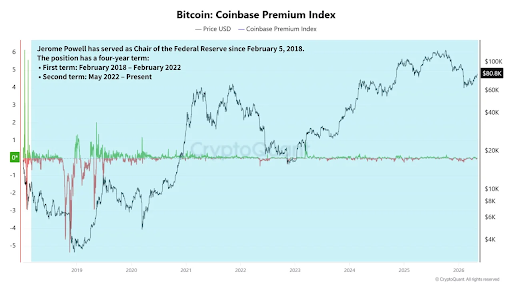 Source: Cryptoquant
Bitcoin Exchange Netflow adds another layer to this picture. Increasing inflows to exchanges signal defensive positioning among short-term holders.
A risk-off shift under the Warsh regime could accelerate that behavior noticeably. When netflows rise alongside weakening Coinbase Premium, the bull market structure begins to crack at its foundation.
What a Sustainable Bull Market Would Look Like Under Warsh’s Fed
Not every outcome under Warsh points toward a prolonged Bitcoin bear market. There is a credible path where tighter monetary conditions reshape, rather than end, the bull structure.
Bitcoin’s appeal as a politically neutral store of value may actually strengthen under fiscal discipline. That narrative gains power precisely when trust in fiat systems comes under pressure.
ETF inflows are the clearest signal to watch for this alternative scenario. Sustained inflows alongside declining exchange reserves would indicate genuine accumulation is happening.
That combination suggests capital is flowing into Bitcoin independent of Fed stimulus. It would mark a structural evolution beyond liquidity-driven price cycles.
A return of positive Coinbase Premium would further confirm that thesis in practice. It would mean U.S. institutional buyers are re-entering with conviction, not just covering shorts.
Spot-led demand is what separates a durable bull market from a leverage-inflated one. The current market has too much leverage and not enough confirmed spot absorption underneath.
If those conditions align, Bitcoin may establish a new bull market structure built on monetary independence. That would represent a maturation of the asset class beyond its early macro-sensitive years.
The Warsh era, while challenging near-term, could ultimately force Bitcoin to prove its case on stronger ground. Whether that transition happens cleanly or through a deeper correction remains the defining question ahead.
The post How Kevin Warsh’s Fed Could Reshape Bitcoin’s Next Bull Market Structure appeared first on Live Bitcoin News.


You May Also Like
The History and Future of Physical Bitcoin
Analyst Sees Fed Rate Cuts Under Warsh, Crypto Regulation

OpenAI Shows ChatGPT Completing Paperwork Using Voice and Image Uploads



