TLDR SOS surges after hours despite widening losses and sharp cash depletion. SOS pivots to commodities; revenue up, but losses and cash risks grow. SOS earnings lift stock post-market as revenue jumps 48% on rubber sales. SOS revenue surges, but losses deepen and liquidity remains a concern. SOS stock rallies after hours on growth, despite [...] The post SOS Limited (SOS) Stock: Revenue Surges 48%, But Net Loss and Cash Burn Raise Red Flags appeared first on CoinCentral.TLDR SOS surges after hours despite widening losses and sharp cash depletion. SOS pivots to commodities; revenue up, but losses and cash risks grow. SOS earnings lift stock post-market as revenue jumps 48% on rubber sales. SOS revenue surges, but losses deepen and liquidity remains a concern. SOS stock rallies after hours on growth, despite [...] The post SOS Limited (SOS) Stock: Revenue Surges 48%, But Net Loss and Cash Burn Raise Red Flags appeared first on CoinCentral.

SOS Limited (SOS) Stock: Revenue Surges 48%, But Net Loss and Cash Burn Raise Red Flags

2025/09/27 05:08

TLDR

  • SOS surges after hours despite widening losses and sharp cash depletion.
  • SOS pivots to commodities; revenue up, but losses and cash risks grow.
  • SOS earnings lift stock post-market as revenue jumps 48% on rubber sales.
  • SOS revenue surges, but losses deepen and liquidity remains a concern.
  • SOS stock rallies after hours on growth, despite cash crunch and losses.

SOS stock closed at $1.95 during regular trading on September 26, 2025, down 3.94% from the prior session. However, shares surged 17.95% after hours to $2.30 following the earnings release. The contrasting stock reaction reflects optimism around revenue growth but concern over losses and cash depletion.
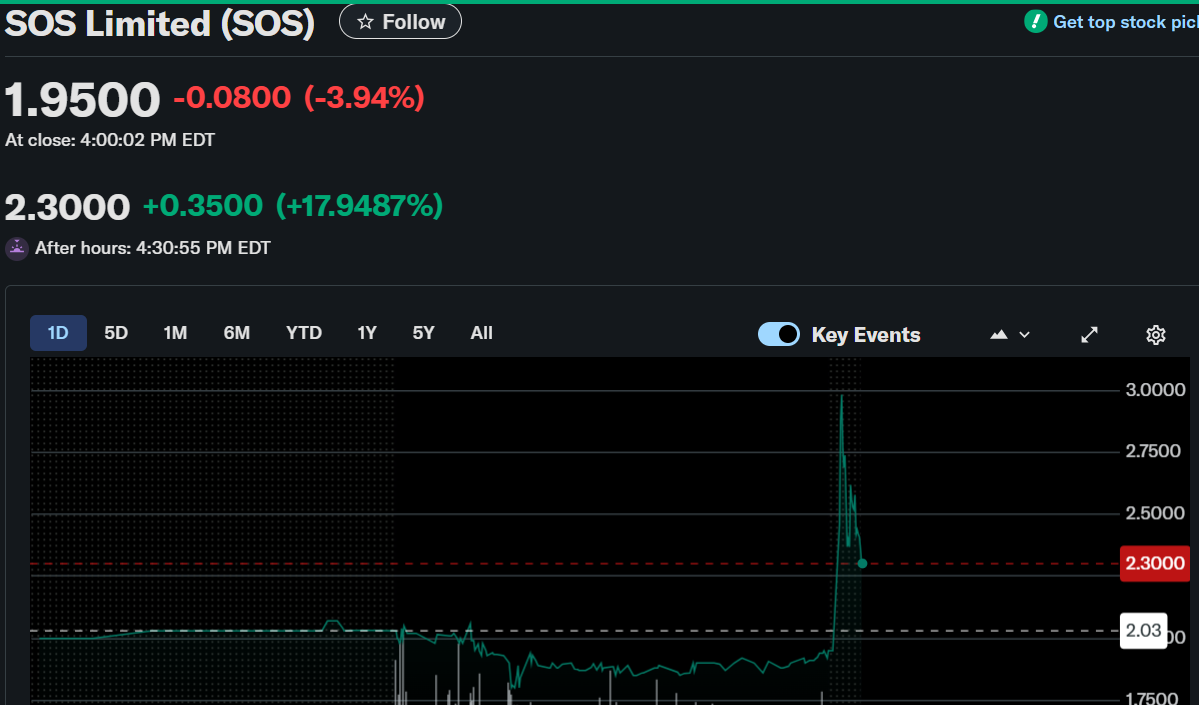
SOS Limited (SOS

Revenue Growth Driven by Commodities Trading

SOS Limited reported semi-annual results for the six months ended June 30, 2025. The company achieved revenue of $89.6 million, reflecting a 48.1% increase from the prior year. Growth came mainly from higher natural rubber sales as demand in China recovered steadily.

The commodities trading segment contributed 94.9% of revenue, while hosting services delivered 4.3% and others provided 0.8%. The company shifted away from cryptocurrency mining operations to focus on hosting services. Management highlighted stronger demand for third-party hosting despite suspending self-mining.

Nevertheless, despite higher revenue, SOS faced a gross loss of $1.3 million, reversing a gross profit of $2.4 million in 2024. The gross margin stood at negative 1.5%, down from a positive 4% in the previous year. Falling rubber spot prices and losses from petroleum coke weighed heavily on profitability.

Losses Widen and Costs Escalate

The company recorded a GAAP net loss of $14.2 million, a 30.3% increase from last year’s $10.9 million. Operating costs surged 56.5% to $90.9 million, outpacing revenue growth and further pressuring margins. Selling expenses rose slightly to $2.3 million, mainly due to higher transportation costs.

General and administrative expenses dropped 35% to $9.4 million as mining machines were fully impaired and required no depreciation. However, this reduction did not offset the broader rise in costs across operations. The loss per share was $(0.0139), compared with $(0.0299) a year earlier.

The company sold petroleum coke inventory at cost and absorbed over $1.6 million in losses from rubber price declines. Management emphasized a strategy of pursuing market share over short-term profitability. Competitive pricing was prioritized to maintain trading volume amid challenging conditions.

Liquidity Risks and Strategic Investments

Cash and cash equivalents fell sharply to $4.2 million from $246.7 million a year earlier. The decline of 98.3% resulted mainly from a $228.4 million prepayment for blockchain commodity trading platform development. Management described the payment as a move to secure long-term value and secure critical partner resources.

During the reporting period, the company raised $6.8 million in net proceeds through a registered direct offering under Form F-3. Despite this, liquidity remains constrained, and further capital raising plans have been confirmed. The shift underscores the company’s ongoing dependence on external funding to sustain operations.


The post SOS Limited (SOS) Stock: Revenue Surges 48%, But Net Loss and Cash Burn Raise Red Flags appeared first on CoinCentral.

Disclaimer: The articles reposted on this site are sourced from public platforms and are provided for informational purposes only. They do not necessarily reflect the views of MEXC. All rights remain with the original authors. If you believe any content infringes on third-party rights, please contact service@support.mexc.com for removal. MEXC makes no guarantees regarding the accuracy, completeness, or timeliness of the content and is not responsible for any actions taken based on the information provided. The content does not constitute financial, legal, or other professional advice, nor should it be considered a recommendation or endorsement by MEXC.

You May Also Like

SSP Stock Surges 11% On FY25 Earnings And European Rail Review

SSP Stock Surges 11% On FY25 Earnings And European Rail Review

The post SSP Stock Surges 11% On FY25 Earnings And European Rail Review appeared on BitcoinEthereumNews.com. SSP Group stock rebounded strongly today. (Photo Illustration by Pavlo Gonchar/SOPA Images/LightRocket via Getty Images) SOPA Images/LightRocket via Getty Images Shares in travel food retailer SSP Group rose sharply today after the company posted solid FY25 results, highlighting good growth in two of its four regional divisions, and a decision to review its under‑performing Continental European rail business. The food and beverage (F&B) company’s stock closed 11.3% up in London on the back of a revenue rise of 7.8% (at constant currency) to £3.6 billion ($4.8 billion) in the 12 months to September. Operating profit jumped by 12.7% to £223 million ($298 million). Under statutory IFRS reporting, however, operating profit fell 58% to £86 million, which SSP said in a statement “reflected £183 million of non‑underlying expenses and impairment charges.” The decision to review its rail business in Continental Europe—the biggest of the F&B giant’s four divisions by revenue at £1,205 million ($1,607 million)—was welcomed by the market, given its weak performance of 2% like-for-like (LFL) growth. A carrot was also dangled— a reward to shareholders arising from the July IPO of SSP’s Indian joint venture Travel Food Services (TFS) with K Hospitality, India’s largest privately held F&B company. SSP Group CEO Patrick Coveney said in a statement: “We acknowledge there is more to do to strengthen our operational performance, most notably in Continental Europe, where we have now reset our team, model, and balance sheet, and have a range of initiatives underway. In addition, we are launching a wide-ranging review of our rail business in Continental Europe. We are also considering options to realise value for our shareholders in line with the delivery of the TFS free float requirement.” SSP currently retains a 50.01% stake in TFS and said: “We believe that India’s market potential, combined with TFS’s attractive…
Share
BitcoinEthereumNews2025/12/05 13:37
Hong Kong Backs Commercial Bank Tokenized Deposits in 2025

Hong Kong Backs Commercial Bank Tokenized Deposits in 2025

The post Hong Kong Backs Commercial Bank Tokenized Deposits in 2025 appeared on BitcoinEthereumNews.com. HKMA to support tokenized deposits and regular issuance of digital bonds. SFC drafting licensing framework for trading, custody, and stablecoin issuers. New rules will cover stablecoin issuers, digital asset trading, and custody services. Hong Kong is stepping up its digital finance ambitions with a policy blueprint that places tokenization at the core of banking innovation.  In the 2025 Policy Address, Chief Executive John Lee outlined measures that will see the Hong Kong Monetary Authority (HKMA) encourage commercial banks to roll out tokenized deposits and expand the city’s live tokenized-asset transactions. Hong Kong’s Project Ensemble to Drive Tokenized Deposits Lee confirmed that the HKMA will “continue to take forward Project Ensemble, including encouraging commercial banks to introduce tokenised deposits, and promoting live transactions of tokenised assets, such as the settlement of tokenised money market funds with tokenised deposits.” The initiative aims to embed tokenized deposits, bank liabilities represented as blockchain-based tokens, into mainstream financial operations. These deposits could facilitate the settlement of money-market funds and other financial instruments more quickly and efficiently. To ensure a controlled rollout, the HKMA will utilize its regulatory sandbox to enable banks to test tokenized products while enhancing risk management. Tokenized Bonds to Become a Regular Feature Beyond deposits, the government intends to make tokenized bond issuance a permanent element of Hong Kong’s financial markets. After successful pilots, including green bonds, the HKMA will help regularize the issuance process to build deep and liquid markets for digital bonds accessible to both local and international investors. Related: Beijing Blocks State-Owned Firms From Stablecoin Businesses in Hong Kong Hong Kong’s Global Financial Role The policy address also set out a comprehensive regulatory framework for digital assets. Hong Kong is implementing a regime for stablecoin issuers and drafting licensing rules for digital asset trading and custody services. The Securities…
Share
BitcoinEthereumNews2025/09/18 07:10
Headwind Helps Best Wallet Token

Headwind Helps Best Wallet Token

The post Headwind Helps Best Wallet Token appeared on BitcoinEthereumNews.com. Google has announced the launch of a new open-source protocol called Agent Payments Protocol (AP2) in partnership with Coinbase, the Ethereum Foundation, and 60 other organizations. This allows AI agents to make payments on behalf of users using various methods such as real-time bank transfers, credit and debit cards, and, most importantly, stablecoins. Let’s explore in detail what this could mean for the broader cryptocurrency markets, and also highlight a presale crypto (Best Wallet Token) that could explode as a result of this development. Google’s Push for Stablecoins Agent Payments Protocol (AP2) uses digital contracts known as ‘Intent Mandates’ and ‘Verifiable Credentials’ to ensure that AI agents undertake only those payments authorized by the user. Mandates, by the way, are cryptographically signed, tamper-proof digital contracts that act as verifiable proof of a user’s instruction. For example, let’s say you instruct an AI agent to never spend more than $200 in a single transaction. This instruction is written into an Intent Mandate, which serves as a digital contract. Now, whenever the AI agent tries to make a payment, it must present this mandate as proof of authorization, which will then be verified via the AP2 protocol. Alongside this, Google has also launched the A2A x402 extension to accelerate support for the Web3 ecosystem. This production-ready solution enables agent-based crypto payments and will help reshape the growth of cryptocurrency integration within the AP2 protocol. Google’s inclusion of stablecoins in AP2 is a massive vote of confidence in dollar-pegged cryptocurrencies and a huge step toward making them a mainstream payment option. This widens stablecoin usage beyond trading and speculation, positioning them at the center of the consumption economy. The recent enactment of the GENIUS Act in the U.S. gives stablecoins more structure and legal support. Imagine paying for things like data crawls, per-task…
Share
BitcoinEthereumNews2025/09/18 01:27
