

Cryptopolitan Report: 37% Of Our Readers Say “Nope” To Consulting AI On Life Decisions. So Who Actually Is?
A little over a year ago, Sam Altman highlighted that Gen Z do not tend to make major life calls without consulting them over ChatGPT. He went onto say that while the older generation treat the tool as a “google replacement”, the younger populace in their 20’s and 30’s use it like a “life advisor”. That comment has aged almost like a cultural diagnosis rather than a prediction. Our newsletter poll, conducted last week as the conversation picked up again, suggests our audience is far less convinced with what was said.
The Comment That Set This Off
OpenAI CEO Sam Altman made a comment at Sequoia Capital’s AI Ascent event last year that made the rounds across newsrooms and social media. His assertion was that different age groups and generations used ChatGPT for various purposes. This did not come as a warning but rather as what he saw in the data.
Older people, he said, use ChatGPT like a smarter version of Google. Meanwhile, people in their 20s and 30s used it more as a tool akin to a life advisor. College students, in his words, use it like an operating system, embedded into how they study, plan, write and make calls about their day.
The initial reaction to these comments were not even to say the least. Some people saw it as evidence that this tool is finding its native users. Others on the other hand read it as a subtle warning or danger that an entire cohort or generation was using a machine for judgement even though it runs the risk of sounding confident even when it’s wrong. The truth is probably somewhere in the middle, and our poll suggests that even among readers who follow this space closely, the jury is still out.
How Big Has This Behaviour Actually Become?
A report published by OpenAI in September 2025 showed that nearly half of ChatGPT messages now come from users below the age of 26, making younger adults the dominant demographic.
Younger users are pulling in even quicker. A Pew Research Center survey of 1,391 U.S. teens, conducted between September and October 2024, found that 26% of teens aged 13 to 17 had used ChatGPT for schoolwork, double the 13% recorded the year before. The pattern is even more pronounced among older students: 31% of 11th and 12th graders reported using it. Pew’s more recent 2026 follow-up survey shows the shift has moved beyond homework. According to that survey, 57% of teens now use chatbots for information searches, 54% for schoolwork, and 16% for casual conversation. Around 12% say they use these tools for emotional support or advice.
That last number is the one worth sitting with. It is small, but it suggests that the line between “tool” and “confidant” is already being crossed in measurable ways.
What The Poll Actually Tells Us
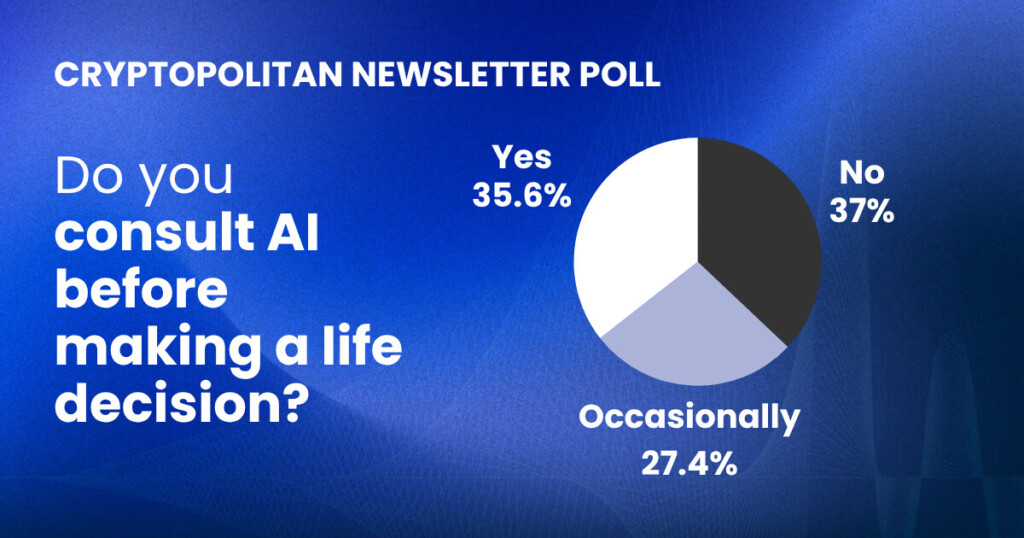
As mentioned in our previous poll, these are readers who track AI developments closely and many of them follow OpenAI and Anthropic releases the day they drop. The average age of our newsletter audience sits at around 30, which places this cohort squarely within the “life advisor” group Altman described in his Sequoia talk. If anyone in a general audience would be expected to lean on AI for personal decisions, it would be this group. The fact that the leading response is “Nope” is therefore the most interesting part of the result.
Note: The 30-year-old average is based on internal Cryptopolitan estimates and is provided as directional context. It has not been formally surveyed and individual respondents will fall on either side of that figure.
Nope (36.76%): Around a third of responses in the poll do not ask AI for any sort of life decisions. It provides a clear view on how this cohort views the utility of AI, perhaps for more technical and productive tasks for work, code research or even thinking out loud. That said, certainly not for the kind of decision that has personal weight behind it. The line being drawn is not anti-AI. It is anti-outsourcing.
Yes (~36%): Almost identical in size to the “Nope” cohort. Just over one in three respondents say they do consult AI before life decisions. This is the group most aligned with the behaviour Altman described back in 2025, and it is sizeable. The split between this group and the “Nope” cohort is essentially even, which is itself the story. Even in a tech-forward audience that demographically maps onto the cohort he was talking about, there is no consensus on whether AI belongs in the room when something important is being decided.
Occasionally (~27.2%): Roughly one in four respondents sit in the middle. They will use it when it helps, but they are not running every choice through the chatbot. This is probably the most honest answer for most people, and it is a group worth watching. As AI tools improve, this cohort is the one most likely to drift toward the “Yes” column.
Combine the “Yes” and “Occasionally” responses and you get just under 63% of readers using AI for personal decisions at least some of the time. That number lines up reasonably well with the broader behavioural trend Altman pointed to. What the poll adds is the texture underneath it, a clear segment of people who have looked at this technology, understood what it can do and then decided that some calls don’t require AI intervention and it’s theirs to make.
The Quieter Trend Under The Headline
The discussion about AI and decision-making usually splits into two camps. One worries about cognitive atrophy and the slow erosion of judgement. The other points to all the small, useful ways AI already helps people think more clearly. Both are right, depending on the type of decision.
What our poll suggests is that the question may already be sorting itself out at the user level. Roughly equal portions of the audience are landing in three different places, and the largest of the three is the one drawing a line. That is not what you would expect to see if AI advice was simply replacing human judgement across the board. It looks more like people are learning where it helps and where it does not, and that calibration is happening in real time.
The cohort to watch is still the one Altman described, the students who arrived on campus in 2022 with ChatGPT already in their pocket and never knew an academic environment without it. They are graduating now. The data on what happens when an entire working generation makes decisions with an AI assistant in the loop does not exist yet, because they are the first ones generating it. The next few years will tell us whether this is the smartphone moment for cognition, or something more complicated. Our poll suggests that even among people who follow this space for a living, the answer is still being worked out.
If you're reading this, you’re already ahead. Stay there with our newsletter.


You May Also Like

Next Block Expo 2026 in Warsaw Brings Institutional Focus to Crypto

Crypto selloff deepens with $400 million liquidations and rising short interest

Franklin Templeton CEO Dismisses 50bps Rate Cut Ahead FOMC



