

UK Sanctions HTX Over Russia Support, Signals Compliance Risk
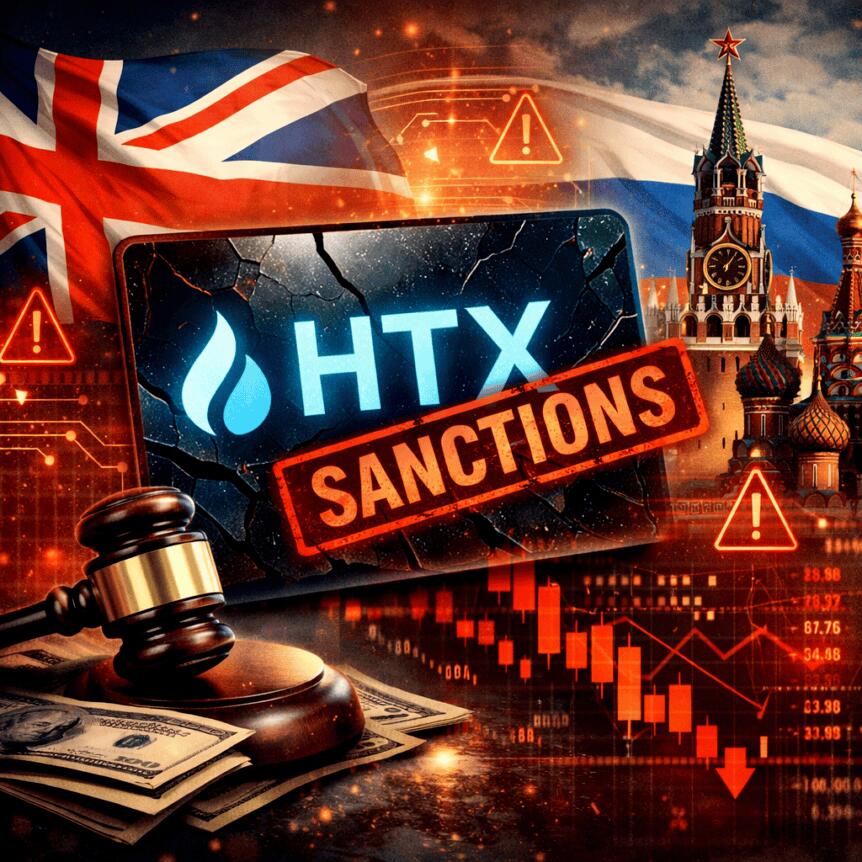
The United Kingdom has added HTX, the exchange formerly known as Huobi Global, to its sanctions list in response to alleged support for the Russian government. The designation underscores the UK’s tightening stance on crypto entities that may be exploited to bypass financial restrictions amid ongoing tensions over Moscow’s actions in Ukraine.
Authorities stated there were “reasonable grounds to suspect” that HTX facilitated financial services and funds linked to Russia through entities tied to A7 Limited Liability Company and Garantex, both sanctioned in separate actions. HTX, which is registered as a Panama-based company, was singled out as part of a broader crackdown on firms “exploited by Russia to circumvent UK sanctions.”
According to Cointelegraph, HTX told the publication that regulatory compliance remains its top priority and that the firm actively monitors and adheres to regulatory frameworks in all jurisdictions where it operates, including the United Kingdom. The exchange’s official stance highlights ongoing tensions between global regulators and crypto platforms over sanctions enforcement and cross-border compliance.
Separately, the broader sanctions environment around crypto and Russia has continued to evolve. In April, the European Commission announced a package of crypto-related sanctions targeting stablecoins and digital-asset operators connected to Belarus, reinforcing a trend toward tightening oversight of crypto vehicles used in sanctioned-adjacent activity. The measures come amid a wider push by Western authorities to limit Russia’s access to crypto-enabled financial services.
HTX has previously drawn scrutiny from the UK’s Financial Conduct Authority. In 2025, the FCA initiated legal proceedings against the exchange for allegedly illegal crypto promotions conducted on social media, with the regulator contending that HTX violated marketing rules across platforms such as TikTok, X, Facebook, Instagram and YouTube.
Key takeaways
- The UK designated HTX (formerly Huobi Global) as a sanctioned entity due to alleged support for the Russian government via tied financial channels, intensifying sanctions enforcement in the crypto sector.
- The designation reflects ongoing regulatory concern that crypto networks could be exploited to evade financial restrictions, prompting enhanced scrutiny of exchanges with cross-border operations.
- EU authorities have separately broadened crypto-related sanctions, including actions targeting stablecoins and operators linked to Russia and Belarus, illustrating harmonized, cross-jurisdictional risk management for crypto firms.
- HTX has faced prior FCA action in the UK over alleged illegal crypto promotions, signaling that regulatory oversight of marketing practices remains a compliance priority for crypto platforms operating in the UK.
Regulatory landscape and enforcement implications
The UK’s designation of HTX adds to a growing matrix of regulatory tools used to constrain Russian-linked financial activity within crypto markets. Sanctions classifications carry practical implications for exchanges, banks, and institutions that provide banking or on/off-ramp services to sanctioned entities or customers. For crypto firms, this elevates the importance of comprehensive sanctions screening, robust AML/KYC controls, and the ability to demonstrate auditable compliance across multiple regulatory regimes. While HTX asserts its commitment to regulatory adherence, the designation increases the operational burden of maintaining up-to-date sanctions lists, monitoring counterparties, and ensuring effective geographic risk management.
From a policy perspective, the action aligns with the evolving approach of Western regulators to treat crypto platforms as potential vectors for sanction evasion. The UK government’s stance dovetails with broader international efforts to prevent sanctioned entities from accessing or laundering funds through crypto rails, while also emphasizing that regulatory latitude and enforceability extend beyond traditional banking channels. This has immediate implications for licensing requirements, oversight, and potential penalties for non-compliance, particularly for platforms with global footprints or those that advertise services in multiple jurisdictions.
Analysts should watch for how UK sanctions interact with ongoing global discussions on crypto regulation, including cross-border information sharing, the emergence of standardized due-diligence procedures, and potential alignment or friction with frameworks such as MiCA in the European Union. While MiCA provides a harmonized EU regime for crypto-asset service providers, the UK’s post-Brexit regulatory posture continues to develop its own standards for licensing, oversight, and enforcement, potentially creating complex compliance frontiers for exchanges that operate in both markets.
Geopolitical and historical context shaping regulatory risk
The sanctions narrative around HTX sits within a broader historical arc of tightening controls on crypto activities tied to geopolitical conflict. The EU’s April sanctions package, which targeted crypto-related instruments and operators connected to Belarus, illustrates a continuing trend toward constraining crypto-enabled financial activity in sanctioned contexts. The parallel focus in the UK reinforces the idea that national regulators are converging on a zero-tolerance approach to sanction circumvention via digital assets.
On the regulatory front in Russia, lawmakers advanced measures that could criminalize unlicensed digital-asset services and compel registration with the central bank. Proposals also included retail investor limits and restrictions on digital asset payments, signaling a potential tightening of domestic crypto activity and a push for formalization of the sector within a state-centric framework. This policy trajectory—criminal penalties for unregistered services and mandatory central-bank registration—could raise the cost and complexity for foreign exchanges seeking access to the Russian market whether directly or via correspondent banking relationships.
For institutional and compliance teams, these developments underscore the need for a holistic, policy-aware risk posture. Firms operating across multiple jurisdictions must reconcile divergent regulatory expectations, implement consistent cross-border sanctions screening, and anticipate evolving requirements for licensing, registration, and ongoing oversight. In an ecosystem where enforcement can be asymmetric and penalties for non-compliance are increasing, robust governance, transparent disclosures, and defensible compliance controls become central to risk management strategy.
Related coverage from Cointelegraph notes that regulatory authorities continue to scrutinize the broader crypto landscape as authorities pursue more assertive enforcement. The interplay between sanctions regimes, consumer protection rules, and evolving technological risk requires ongoing adaptation by exchanges, custodians, and financial institutions that engage with crypto markets.
Looking ahead, observers should monitor how UK and EU regulators coordinate with other jurisdictions to close gaps that could enable sanction evasion through digital assets. The balance between fostering legitimate innovation in crypto markets and safeguarding financial integrity will shape licensing regimes, capital requirements, and the due-diligence expectations for market participants in the coming years.
Closing perspective: The HTX designation signals a sustained regulatory counterweight to sanctioned activity in crypto markets. As enforcement tools mature and cross-border cooperation intensifies, firms must embed rigorous governance, export-control awareness, and sanctions-compliance into their core operations to navigate a rapidly changing policy environment.
This article was originally published as UK Sanctions HTX Over Russia Support, Signals Compliance Risk on Crypto Breaking News – your trusted source for crypto news, Bitcoin news, and blockchain updates.


You May Also Like

Not a loophole: Singapore AI export controls let China tap US AI legally

CoreWeave (CRWV) Stock Surges 12% on $8.5B GPU-Backed Financing Deal — Here’s the Full Picture

CoreWeave (CRWV) Stock Jumps on Historic $8.5B GPU-Backed Loan — What Investors Need to Know



