

Oil Prices Rise After U.S. and Iran Exchange Air Strikes in Escalating Conflict
TLDR
- Brent crude surged over 2.5% to $96.74 and WTI rose to $90.95 after fresh U.S.-Iran strikes
- Iran’s Revolutionary Guard hit a U.S. airbase in Kuwait; Kuwait reported missile and drone attacks
- Trump dismissed reports Iran would reopen the Strait of Hormuz within a month
- The Strait’s closure is disrupting around one-fifth of global oil supplies
- Analysts warn the oil market is approaching a dangerous stage for both Iran and global supply
Oil prices climbed sharply on Thursday after the U.S. and Iran exchanged air strikes, raising fears that a peace deal remains far off.
Brent crude jumped more than 2.5% to $96.74 a barrel in early European trading. U.S. West Texas Intermediate futures rose to $90.95 a barrel.
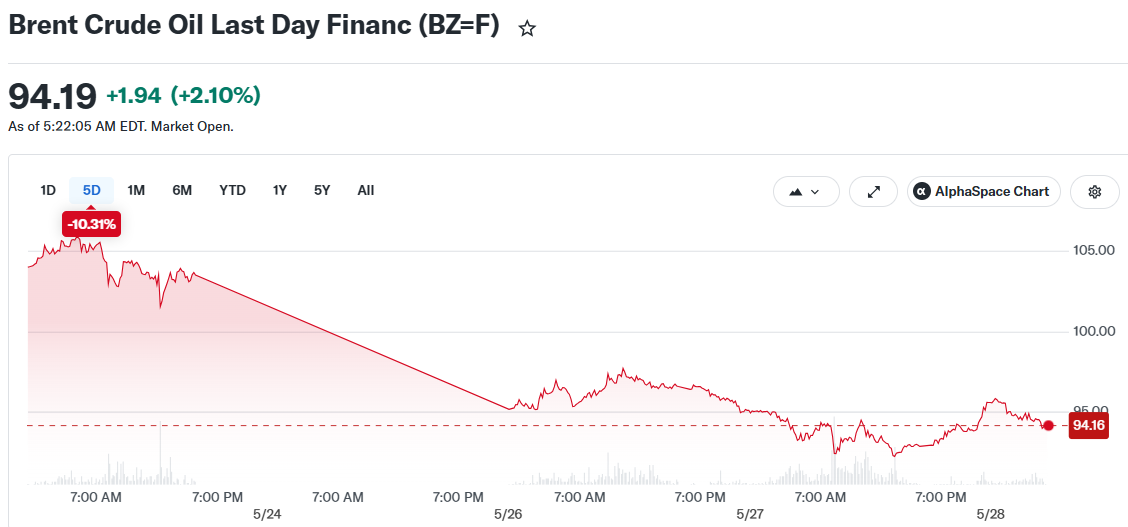 Brent Crude Oil Last Day Financ (BZ=F)
The gains came after Iran’s Islamic Revolutionary Guard Corps said it struck a U.S. airbase in Kuwait. This was in retaliation for U.S. attacks on the Iranian port city of Bandar Abbas.
Kuwait confirmed it was defending against missile and drone attacks but did not name the source.
The strikes marked a return to open hostilities, despite Washington’s repeated claims that a ceasefire was still in place.
President Donald Trump had earlier dismissed reports that Iran would reopen commercial shipping through the Strait of Hormuz within a month.
Trump also said he was not yet satisfied with a potential peace agreement, signaling that a deal may be further away than markets had expected.
Oil prices had actually fallen on Wednesday on bets that a U.S.-Iran deal was close. Trump’s comments quickly reversed that optimism.
Hormuz Blockage Keeping Supply Tight
The Strait of Hormuz has been closed for three months as a result of the conflict. That closure is disrupting about one-fifth of global oil supplies.
Some ships have been passing through in recent weeks, but flows remain well below pre-war levels.
Trump also rejected a proposal for Iran and Oman to jointly control the strait, saying no single country could control the channel.
Analysts at ANZ noted that oil supply remains constrained and that key issues between the two sides have yet to be resolved.
Analysts at Yardeni Research warned that the market is approaching a critical point. They said Iran faces a lack of oil storage that could force it to cut production entirely.
They also noted that global oil infrastructure is running on thin supplies, which could begin affecting pipelines and other systems.
Traders are waiting on U.S. Energy Information Administration stockpile data due Thursday. Supply disruptions have already been triggering large inventory drawdowns.
Market analysts say volatility remains high across commodities as geopolitical risk has not fully eased.
The situation remains fluid, with both the U.S. and Iran still at odds over Tehran’s nuclear activities and control of the strait.
The post Oil Prices Rise After U.S. and Iran Exchange Air Strikes in Escalating Conflict appeared first on CoinCentral.


You May Also Like
'Pathetic' Lindsey Graham brutally mocked for wanting to rename Nobel Prize after Trump

Exclusive interview with Smokey The Bera, co-founder of Berachain: How the innovative PoL public chain solves the liquidity problem and may be launched in a few months

CoreWeave (CRWV) Stock Surges 12% on $8.5B GPU-Backed Financing Deal — Here’s the Full Picture



