

BlockDAG BDUSD Beta Disclaims USDT Backing After ‘Fully Pegged to Tether’ Promotion
BlockDAG launched the beta version of its BDUSD stablecoin on June 1, introducing what the project describes as a "synthetic dollar asset" backed by BDAG collateral.
The launch followed weeks of promotion from BlockDAG's official channels, which advertised a forthcoming BlockDAG stablecoin as "pegged to USDT" and "fully pegged to Tether." However, the product that appeared on the project's official beta platform differs from that earlier marketing.
According to the BDUSD beta page, the token is not backed by USDT or fiat reserves. The platform instead describes BDUSD as a BDAG-collateralized synthetic dollar and states that BlockDAG does not guarantee redemption into USDT, USD, or any other asset. The beta disclaimer also says the project does not guarantee any specific value, peg, or exchange rate.
Fiat-backed stablecoins such as USDT are generally backed by reserve assets and supported by redemption mechanisms, while crypto-collateralized synthetic assets rely on cryptocurrency collateral, liquidation systems, and market incentives to target a specific value.
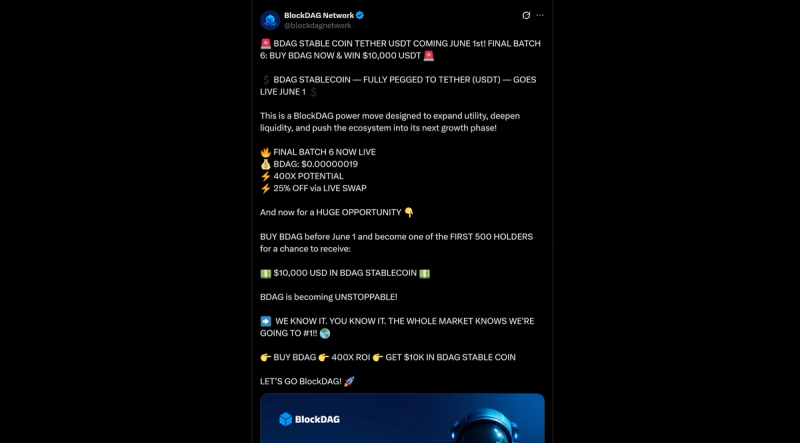 BlockDAG X post advertised Tether-pegged stablecoin. Source: X
BlockDAG Previously Promoted BDUSD as a USDT-Pegged Stablecoin
BlockDAG began promoting its upcoming stablecoin across official channels in late May ahead of the planned June 1 launch.
One promotional post described the product as a “BDAG Stable Coin Pegged to USDT Launching June 1,” while other marketing materials referenced Tether and presented the launch as a major addition to the BlockDAG ecosystem. The campaign included countdown-style posts in the days leading up to the June 1 launch.
The emphasis on USDT was a recurring theme throughout the marketing. Promotional posts repeatedly linked the upcoming stablecoin to Tether and presented the product as a USDT-pegged stablecoin.
The messaging positioned the stablecoin as part of BlockDAG's broader decentralized finance strategy. The project's roadmap has previously outlined products including a decentralized exchange, lending and borrowing services, oracle integrations, and stablecoin support. The current Wiki roadmap still references "USDT, USDC integration" rather than a BlockDAG-issued synthetic dollar backed by BDAG collateral.
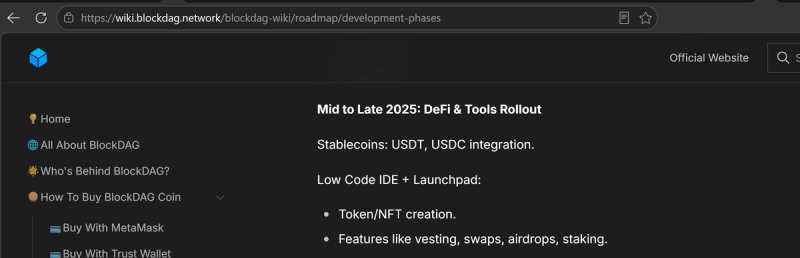 BlockDAG Wiki roadmap references USDT and USDC. Source: BlockDAG Wiki
BDUSD Beta Documentation Describes a Synthetic Dollar
On its official beta platform, BlockDAG describes BDUSD as a “beta synthetic dollar asset backed by BDAG collateral.” The platform outlines a system in which users deposit BDAG into a collateral vault and mint BDUSD against that collateral, indicating that the token is backed by the network's native asset rather than by fiat reserves.
The beta disclaimer also distances the product from traditional stablecoin models. According to the document, BDUSD is not backed by USDT, USD, bank deposits, cash equivalents, or other reserve assets. BlockDAG further states that it does not guarantee users will be able to redeem BDUSD for USDT, USD, or any other asset.
The same disclaimer also states that the company does not guarantee any specific market value, exchange rate, liquidity level, or trading relationship with either the U.S. dollar or USDT. In practical terms, this means BDUSD's market price could differ from one dollar depending on collateral conditions and market demand.
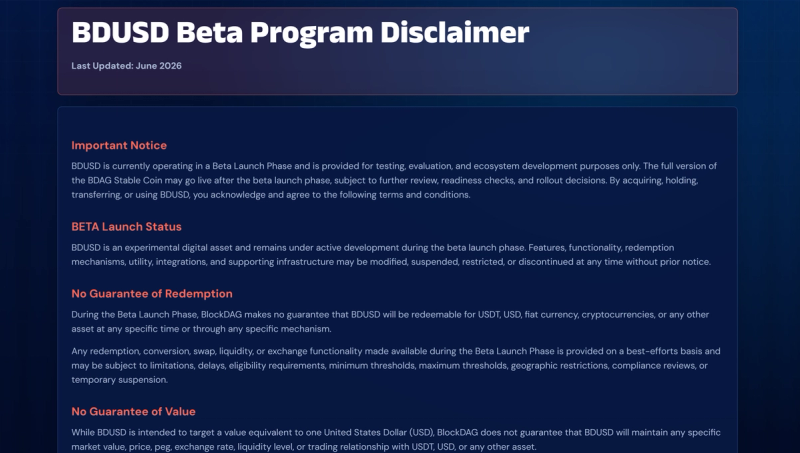 BDUSD beta disclaimer outlines redemption and value limits. Source: BlockDAG stablecoin page
Fiat-backed stablecoins and crypto-collateralized synthetic assets operate differently. Fiat-backed stablecoins such as USDT are generally designed around reserve assets and redemption mechanisms intended to support a stable value. Synthetic assets, by contrast, rely on cryptocurrency collateral, price oracles, and market incentives to maintain their target price.
Based on the beta documentation, BDUSD appears closer to a crypto-collateralized synthetic asset than a traditional reserve-backed stablecoin. The product is presented as a dollar-referenced token supported by BDAG collateral rather than by USDT reserves, bank deposits, or other fiat-backed assets.
BDUSD Launch Echoes Earlier Claims About Marketing and Engineering Disconnect
The difference between BlockDAG's stablecoin marketing and the product that ultimately appeared on the BDUSD beta platform resembles accusations previously raised by former BlockDAG employee Liza Van Den Berg.
In an interview covered by TheHolyCoins in January 2026, Van Den Berg claimed that marketing decisions and public announcements were controlled from Dubai by WPRO Agency and were made without technical input from engineering teams based in Cape Town. According to her account, development teams were frequently informed of public commitments only after they had already been announced externally.
Van Den Berg described a recurring pattern in which marketing campaigns introduced new milestones, deadlines, and product expectations before engineering teams had confirmed technical readiness. She claimed these announcements often put pressure on developers to meet timelines they had no role in setting.
The contrast between earlier promotions describing a stablecoin that was "fully pegged to Tether (USDT)" and the actual beta platform of a BDAG-collateralized synthetic dollar spotlights a gap between the marketing language and the product that ultimately accompanied the launch.
Readers can read our previous coverage of Van Den Berg's allegations here: "BlockDAG Ex-Employee Reveals Internal Misconduct: Alleged Unpaid Salaries, Fund Control Issues, and Presale Irregularities."


You May Also Like

ETH Enters High-Stakes Decision Zone
Fed Beige Book Reports Modest U.S. Growth as Energy Prices Rise

XRP Is Lining Up for Its Bridge Currency Moment. Here’s the Latest



