

Bitcoin is Bleeding: Is It Too Early to Say “This is the Bottom”? 4 Reasons Behind the Decline
The cryptocurrency market started June with a very sharp correction. Bitcoin (BTC), which had been trying to hold its ground and turn upwards for weeks, is bleeding dry due to successive selling pressure in recent days. The leading cryptocurrency, which quickly fell to the $60,400 mark, dragged the altcoin market along with it, causing a veritable “red bath.”
So, amidst the panic in the market, the only question on investors’ minds is: Has Bitcoin hit bottom, or will the decline deepen further?
Related News: When Will Institutional Selling Pressure on Bitcoin End? What Does On-Chain Data 'Coinbase Premium' Show?
What Triggered the Market? The 3 Big Reasons Behind the Decline
There isn’t a single reason behind Bitcoin’s sudden pullback; a combination of macroeconomic factors and institutional actions brought the market to this point.
-
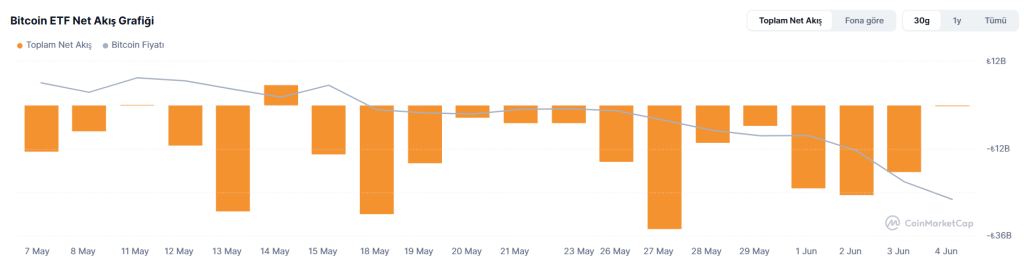
Massive Cash Outflow from ETFs: US spot Bitcoin ETFs have experienced net cash outflows for 14 consecutive days. Total outflows exceeding $4.4 billion indicate a significant decrease in institutional risk appetite.
-
Strategy and Whale Sales: The Bitcoin sale carried out by Michael Saylor’s company Strategy and the transfer of large amounts of BTC by major whales to exchanges (especially Binance) amplified the selling pressure exponentially.
-
Liquidation Earthquake in Futures Trading: With the downward break in price, over $1.3 billion in leveraged long positions were liquidated in the last 24 hours. This triggered a chain reaction of selling.
-
The critical security vulnerability discovered in Zcash and the temporary shutdown of the network increased security concerns in the cryptocurrency market, causing investors to shift from risky assets to cash. It is believed that, amidst panic, some large investors sold Bitcoin to meet their liquidity needs, which accelerated the decline in BTC.
What Does Technical Analysis Say? Critical Levels
From a technical perspective, Bitcoin has fallen below its long-term moving averages (200-day EMA and MA) on the daily charts.
On the weekly chart, the price also fell below the 200-week simple moving average today. The Bitcoin price had been above this average for almost three years.
-
Critical Support (Psychological Boundary): Currently, all eyes are on the $60,000 – $59,700 range. If Bitcoin fails to maintain a sustained hold above this level, the decline could deepen to $55,000 and even $48,700.
-
First Resistance Point: In the event of a potential rebound, the first area that could ease market tensions is the $64,000 – $67,000 range. Unless liquidity that has shifted towards technology stocks and the AI sector in global markets returns, overcoming these resistance levels seems difficult.
Is It Too Early to Say “This is the Bottom”?
According to experts, it’s still far too early to say “the bottom has been reached.” On-chain data shows that whales haven’t yet entered an aggressive accumulation phase, but rather prefer to remain cautious. On the macro level, escalating geopolitical tensions in the Middle East and a decrease in global risk appetite are also contributing factors.
The most sensible strategy for investors right now would be to avoid panic selling but closely monitor whether the $60,000 support level will hold. It’s impossible to know when the tide will turn in the crypto world, but current volumes suggest the waters will remain turbulent for some time.
*This is not investment advice.
Continue Reading: Bitcoin is Bleeding: Is It Too Early to Say “This is the Bottom”? 4 Reasons Behind the Decline


You May Also Like

Former U.S. President Joe Biden’s Son Hunter Biden Makes an Interesting Crypto Statement: He Named a Single Altcoin

Crypto Expert Says Something Bad Is Coming For Bitcoin, What To Expect

Ethereum Liquidation Risk Mounts as $547 Million in DeFi Positions Near Critical Levels



