

When Real-World Assets Move On-Chain, What Becomes Visible?
From tokenization to RWA visibility
The prior tokenization article made one boundary explicit: assets do not literally move on-chain. A Treasury note does not move to Ethereum. A gold bar does not enter the blockchain. What moves is a programmable representation of the claim and the rules for transferring it.
The stablecoin audit series turned that boundary into a working problem. In pieces such as Local Pegs, Dollar Rails and The Stablecoin Map, simple labels kept breaking into dependency maps: issuer, reserve composition, attestation standard, redemption path, deployment topology, and bridge or liquidity surface. The contract was the easy object to query. It was not the whole product.
This is where RWA starts for me. If dollar claims can become on-chain settlement assets, what happens when Treasuries, gold, equities, real estate, and private credit get the same treatment?
I am not ranking products by price or yield. I am trying to keep the boring questions attached to the token: what claim is being tokenized, what backs it, who can redeem, who can change the control plane, what a transfer means, and which record is authoritative.
My suspicion is that crypto often expands the distribution surface first and leaves verification to catch up later. Sometimes that gap closes. Sometimes the wrapper becomes normal before the evidence does.
Necessity may be the mother of invention. In crypto, demand can also make unfinished plumbing look finished. RWA widens that problem because one token can wrap legal claim, custody, redemption, and cashflow at once. Distribution can scale quickly; verification does not scale by default.
Why RWA is not just another token category
The standard RWA pitch is easy to understand. Bring Treasuries, gold, real estate, private credit, funds, or equities on-chain. Trade them around the clock. Shorten settlement. Fractionalize access. Plug them into decentralized finance (DeFi) as collateral, yield-bearing instruments, or settlement assets.
That is the part I do not want to accept too quickly: a cleaner financial wrapper does not automatically mean the market has become more disciplined.
The token itself is usually the easy part. An ERC-20 balance can represent almost anything. The hard work starts where the token points outside the chain: legal claim, custodian, process for calculating net asset value (NAV), redemption path, oracle, transfer restrictions, system of record.
Minting is not the bottleneck. Making the token stand for something the blockchain does not natively control is.
Stablecoins already taught this lesson. USDC and USDT are interesting not because their token contracts are complicated, but because the token layer is simple while the reserve, issuer, redemption, and jurisdictional layers carry the real trust assumptions. In that broad sense, stablecoins are arguably the most successful RWA-like case so far.
The sequencing is the part I do not want to hand-wave away. ICOs, stablecoins, security tokens, and now RWA all test whether distribution expands faster than verification. RWA has better institutions around it than earlier wrapper cycles. That helps. It does not remove the sequencing risk.
Where the chain helps, and where it stops
The asset itself stays off-chain. The chain records a programmable representation of the claim: balances, transfers, mint/burn events, and sometimes compliance logic.
That is still useful. Blockchain adds shared state, programmable compliance, tamper-resistant history, and a settlement interface. It matters when several parties need the same state machine.
But the rest has to be proven somewhere else: legal claim, reserve quality, NAV calculation, redemption process, cashflow source, and canonical record.
Some of those are real bottlenecks. Shared settlement state, programmable transfers, role-based controls, public event trails, and wallet or DeFi integration can reduce operational friction. The stubborn parts sit around the edges: custody, redemption, legal recognition, NAV calculation, transfer-agent recordkeeping, and the market structure where the asset actually trades.
Token logs can show balances, transfers, holders, and sometimes permissioning behavior. NAV method, administrator role, transfer-agent setup, redemption terms, and reserve or custody evidence live in product documents. PAXG has monthly attestations on Paxos’ attestation page; the chain does not inspect a vault.
The chain enforces what it is told. Custody quality, NAV accuracy, legal enforceability, redemption willingness, and cashflow origin are decided off-chain. The contract does not reach them.
Security has the same boundary. A secure contract protects the token layer: state, transfer rules, mint/burn controls, admin permissions, and settlement history. It does not verify the vault, prove NAV, guarantee redemption, or make a legal claim enforceable. For RWA, “is the token safe?” is only the first question. The harder question is what the token’s security model actually covers.
Fig. 1. RWA verification stack. A token-level event is observable, but it is not proof of an off-chain claim.RWA categories as audit primitives
The primitive matters because it tells me where to look first.
Stablecoins make the boundary easiest to see: reserve, redemption, and jurisdictional evidence sit outside the contract even when the token is public and liquid. Tokenized Treasuries and money-market products are often permissioned by design, so narrow visible activity can reflect a restricted counterparty surface rather than inactivity. Gold tokens expose more public transfer traffic, but vault attestations are still separate documents.
Equities, fund wrappers, and private credit are harder to read. The token interface can look like a stock, ETF, fund unit, or yield wrapper while the actual claim is a tracker certificate, issuer obligation, transfer-agent record, or off-chain loan workflow.
I can query the token. The product evidence may sit elsewhere.
Observable RWA activity: what the token makes visible
After working through the sample, I stopped treating “RWA” as one audit category. I kept coming back to six checks: claim, backing, exit path, control plane, transfer meaning, and canonical record.
The small data probe below covers eleven contracts and one platform-level reference. It is not a market ranking. It asks a narrower question: what kind of activity does each token leave on-chain, and where does interpretation start to break?
The first mistake I made was trying to split the sample into active and inactive tokens. That split was only a first-pass filter: it showed whether a contract left visible activity, not what workflow that activity represented. BENJI broke the filter. A narrow Polygon surface did not mean the fund workflow was inactive; it meant the observed contract was not the whole recordkeeping system. So I treated every number as domain-bound: one chain, one contract or platform, one time window, one event definition, and one labeling process. A volume number without that observation domain is not an economic metric.
Fig. 2. RWA activity surface. Token rows use contract-level ERC-20 activity, mainly May 2026 transfer volume and monthly unique senders. xStocks is a platform-level trailing-30D reference, not token-equivalent.The raw activity map shows the first problem: volume and sender count mix very different surfaces.
Fig. 3. Visible transfer breadth by asset. The chart counts sender addresses needed to explain 80% of outgoing May 2026 transfer volume. Address counts are not user counts.The more useful split is broad surface versus concentrated workflow. PAXG and XAUT require many more sender addresses to explain most visible May transfer volume. BUIDL, OUSG, and USTB are much narrower. USDY is the warning case: high aggregate volume, near-daily activity, and still a small operational surface.
Fig. 4. Workflow signature across visible ERC-20 activity. The x-axis measures calendar continuity; the y-axis measures top-five sender concentration. This separates continuity from openness: USDY remains highly concentrated despite near-daily transfers. The figure does not classify individual transfers.The workflow signature makes the same point more sharply.
Fig. 5. 30-day observable activity, shown as 7-day moving averages. The volume panel uses a log scale. xStocks is excluded because no comparable daily platform series was available. Permissioned treasury rails look narrower and more episodic; open commodity tokens are broader and more continuous.The time series adds rhythm: permissioned treasury rails look episodic, open commodity tokens look more continuous, and USDY sits between those patterns.
That is also why mint and burn cannot be read as simple supply mechanics in this context. A mint may be subscription, reserve-backed issuance, or bridge representation. A burn may be redemption, cancellation, or bridge exit. The audit question is what workflow created or destroyed the claim, not just the net change. A future `supply_events` pass should resolve event boundaries such as zero-address mint/burn, issuer-wallet movement, and bridge representation; this article only uses them as workflow clues.
The useful split was not active versus inactive. It was surface type: open transfer surfaces, permissioned counterparty rails, routed operational activity, and incomplete contract-level visibility. That is where interpretation starts to break: documents, redemption paths, transfer-agent records, address labels, and private-credit origination and repayment data.
Closing: better interfaces, larger audit surfaces
The old pattern is access first, verification later. ICOs did it with network-value claims. Stablecoins did it with reserve-backed dollar claims before reserve disclosure became routine. Security tokens did it while the legal-claim layer remained uneven. RWA has better inputs: funds, custodians, prospectuses, transfer agents, third-party attestations. I do not know yet whether RWA breaks the pattern or repeats it with better paperwork.
The next distribution surface will not only be the token contract. Institutions already use multi-party computation (MPC) setups, multisig, hardware security modules (HSMs), and policy engines to control minting, burning, and whitelisting. Consumer apps abstract keys through embedded wallets, passkeys, and gas sponsorship: a user may buy a tokenized asset without seeing a seed phrase or knowing which chain settled the transaction. In RWA, what that interface encapsulates may include the issuer, transfer agent, custodian, bridge, platform ledger, and redemption path. The audit has to include the control plane: who can sign, recover, pause, whitelist, or redeem, and what system is authoritative when the interface abstracts the machinery.
The failure mode I am watching: the wrapper becomes normal before the evidence improves. If that happens, the audit layer is late even if the token contract is clean.
The next place to look is not whether the token exists, but where the tokenized claim actually clears liquidity. Pools, broker platforms, lending markets, issuer redemption windows, and permissioned settlement rails are different surfaces. Treating them as one number turns visibility back into confusion.
Appendix: sources and reproduction
GitHub Repo. rwa-audit
- Artifacts include the registry, metrics, `rwa_data_quality_notes.md`, and `feasibility_report.md`.
Data caveats.
- Token rows are contract-level ERC-20 observations unless labeled otherwise.
- PAXG and XAUT high-volume transfer counts involve sampled/extrapolated log collection.
- BENJI is Polygon-only in this run; product materials point to transfer-agent-controlled recordkeeping outside the observed Polygon contract.
- xStocks is a platform-level trailing-30D reference; Ondo Global Markets is excluded from the main scatter because the available figure is cumulative platform trading volume.
Product sources.
- Paxos: PAXG terms, attestations.
- Superstate: USTB, smart contract docs.
- Ondo: USDY docs, USDY developer docs, OUSG important notes.
- Filings and reports: Franklin Templeton SEC 485BPOS, Backed Assets Base Prospectus, 8 May 2026, XAUT BDO ISAE 3000R report.
- BUIDL: BlackRock/Securitize launch and expansion releases, including the multi-chain expansion release.
This post was originally published on my personal blog: https://egpivo.github.io/2026/06/07/if-everything-can-be-tokenized-what-should-we-audit.html
When Real-World Assets Move On-Chain, What Becomes Visible? was originally published in Coinmonks on Medium, where people are continuing the conversation by highlighting and responding to this story.


You May Also Like
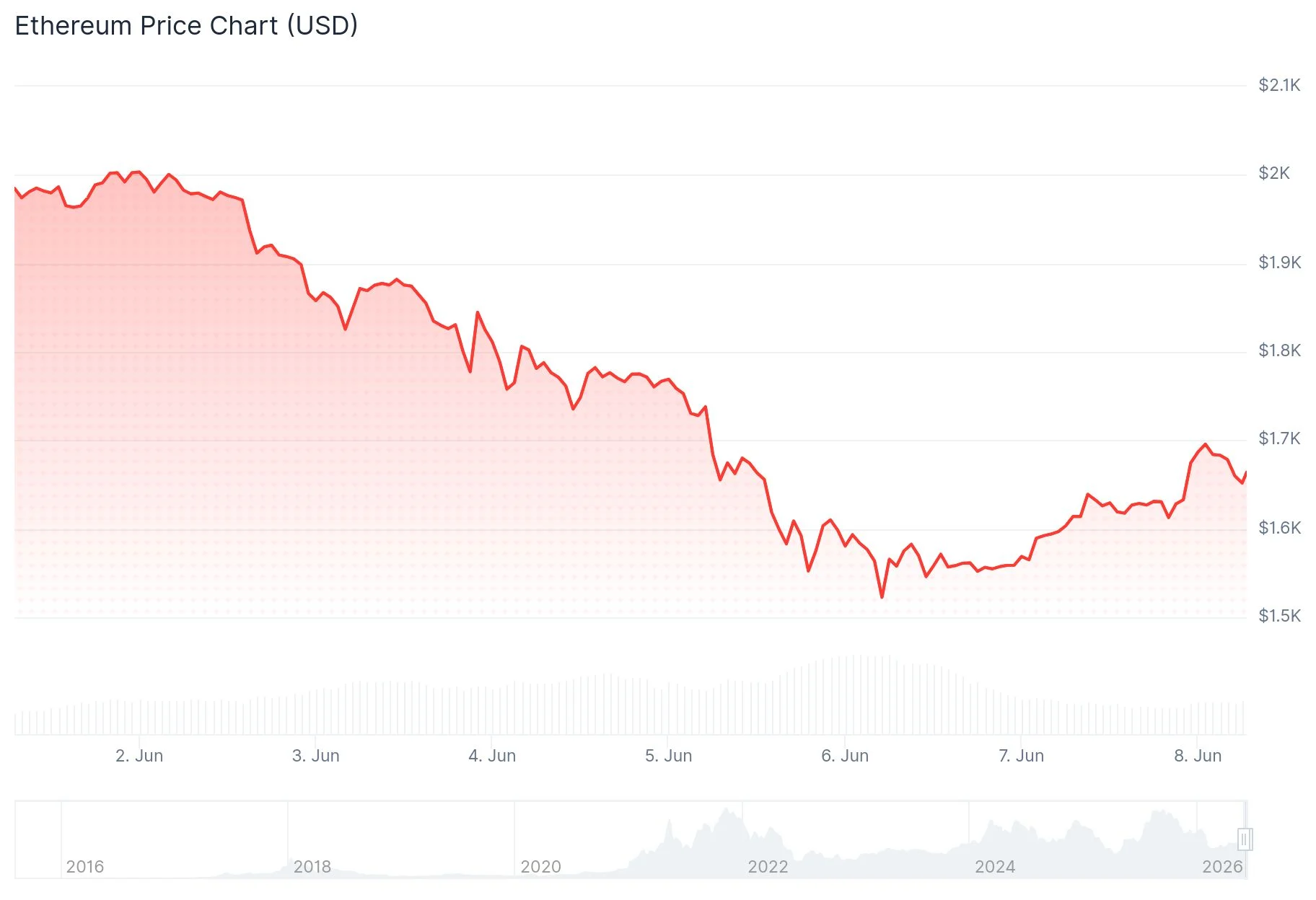
Ethereum (ETH) Crashes to $1,500 — Can Bulls Defend or Is $1,000 Coming?

Arthur Hayes says ‘I Didn’t Buy’ amid $2M HYPE transfer

Safe Havens Are Failing — Why Gold, Silver, and Crypto Are All Falling Together



