

Bank of America Issues Stark Warning After Nasdaq’s 4.8% Friday Plunge
Key Takeaways
- Friday saw the Nasdaq-100 plummet 4.8%, marking its sharpest volatility-adjusted decline since October 2025
- BofA strategists caution that an additional 2% drop could unleash widespread CTA fund deleveraging
- Leveraged and inverse ETFs dumped more than $12 billion in Nasdaq holdings on Friday—an unprecedented amount
- Monday brought relief as semiconductor stocks including Nvidia and Micron led a market rebound
- Israeli-Iranian missile exchanges drove oil to nearly $98 per barrel, complicating the inflation outlook
The dramatic Nasdaq retreat on Friday has left investors questioning whether the worst is behind us or still ahead. Here’s a breakdown of the situation and what market watchers are monitoring.
The Catalyst Behind Friday’s Market Tumble
The Nasdaq-100 experienced a brutal 4.8% decline on Friday—its most severe volatility-adjusted fall since October 2025 and ranking as the 13th worst such movement dating back to 1985. The catalyst? A robust May employment report that exceeded expectations and increased speculation about potential Federal Reserve rate hikes in the coming months.
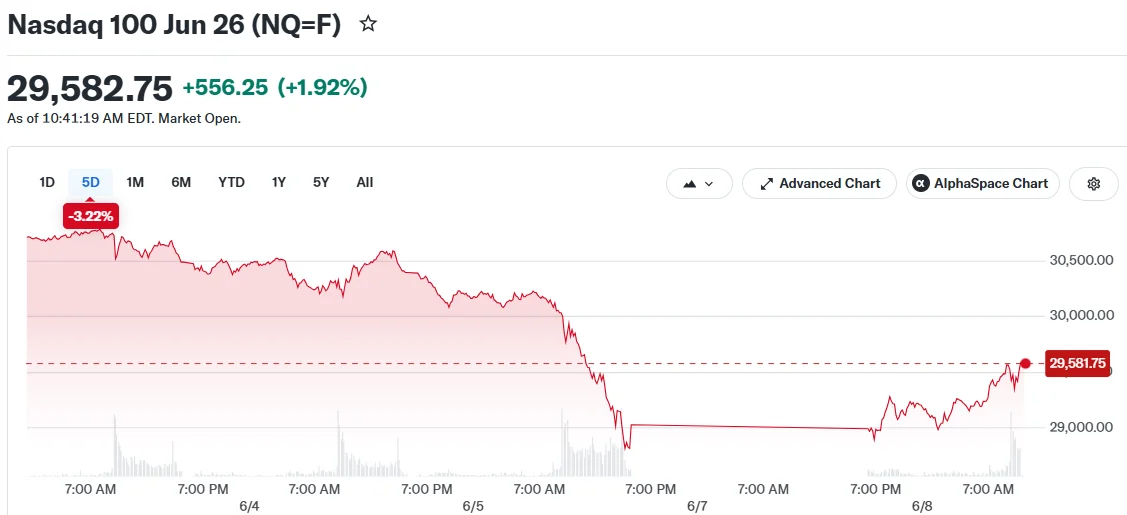 Nasdaq 100 Jun 26 (NQ=F)
The surprising jobs strength forced market participants to recalibrate their interest rate forecasts. Elevated borrowing costs typically pressure technology and growth-oriented equities, which had enjoyed an extended period of gains.
According to Bank of America strategist Chintan Kotecha, Friday’s downturn likely initiated an unwinding process among systematic trading strategies, particularly CTA funds. These algorithm-based investment vehicles operate on trend-following principles and execute automatic sell orders when prices breach predetermined thresholds.
BofA’s analysis suggests that stop-loss parameters for the Nasdaq-100 were positioned approximately 4.3% to 6.8% beneath pre-Friday valuations. This indicates that the most cautious algorithmic models probably activated their selling protocols during Friday’s session.
The firm emphasized that the unwinding cycle may continue. An additional decline of 90 basis points to 2% could activate more extensive liquidation from these systematic strategies. For the S&P 500, stop-loss thresholds sit roughly 40 basis points to 2.6% lower, while the Russell 2000’s danger zone extends from 2% to 5% below current levels.
Friday witnessed leveraged and inverse ETFs liquidating over $12 billion worth of Nasdaq exposure—a record-breaking figure based on BofA’s tracking data.
Monday’s Market Recovery Efforts
Equity markets staged a comeback on Monday. The Dow Jones Industrial Average advanced approximately 0.3%, while the S&P 500 gained around 0.6%, and the Nasdaq Composite posted a 0.9% increase.
Semiconductor stocks spearheaded Monday’s rally. Micron surged 9% while Nvidia climbed 2% following comments from CEO Jensen Huang, who characterized Friday’s selloff as a potential opportunity for AI-focused investors.
Friday’s decline had ended the S&P 500’s impressive nine-week winning run. While Monday’s advances didn’t completely erase those losses, they demonstrated renewed appetite for discounted technology shares.
Market participants are now focused on Wednesday’s Consumer Price Index release, which will reveal whether climbing oil costs are fueling inflationary pressures. This data could prove pivotal for Federal Reserve policy decisions later this year.
Oracle’s quarterly earnings are also scheduled for Wednesday. Additionally, the highly anticipated SpaceX IPO, projected to become the largest public offering in history, is slated for Friday.
On the geopolitical front, Iran launched missiles at Israel for the first time since April, prompting Israeli retaliation. Brent crude oil prices spiked nearly 4% to approach $98 per barrel before moderating slightly.
These international tensions introduce additional complexity as market participants evaluate the inflation trajectory and rate environment for the remainder of June.
The post Bank of America Issues Stark Warning After Nasdaq’s 4.8% Friday Plunge appeared first on Blockonomi.


You May Also Like

India’s Central Bank Issues Detailed Guidelines for Forex Swap Facility
Trump’s presidency is finished: political analyst

UK FCA Proposes Letting Authorized Funds Hold Crypto ETNs Under Strict Limits



