How to Buy Crypto with UPI? Use UPI to Buy Bitcoin on Binance and Other Platforms
If you want to buy crypto with UPI without turning it into a weekend project, you’re one of many. For many people in India, UPI is the easiest way to move money, so it's the first payment method they look for when buying crypto.
Right now, Binance P2P is the clearest UPI route for Indian users. That's different from saying UPI is always a standard direct-buy option inside the main app flow. On crypto platforms, payment methods can change by coin, platform, and country, sometimes without much warning.
In this guide, I’ll explain how UPI works and how to actually buy crypto with UPI.
Let’s dive in!
Key highlights:
- UPI is a payment method, not a crypto-selling platform
- Binance P2P is one of the clearest UPI routes for Indian users
- UPI support can change by app, coin, country, and payment partner
- Always check fees, spreads, seller history, escrow, and withdrawal rules before buying
What UPI means for crypto buyers in India
UPI is the payment rail. It moves rupees between bank accounts in seconds through apps that people already use every day. That's why it feels natural for crypto buyers in India.
There are no cards, bank forms, or waiting around for a manual transfer to show up.

I need to clear this part up: UPI itself doesn't sell you crypto. It only handles the payment. The actual buy happens on an exchange, a broker app, or a P2P marketplace that supports UPI in that moment.
Think of it like a road, not the store. UPI gets your money from point A to point B. The crypto platform is where the trade happens.
This is important to understand because not every app or exchange supports UPI for every coin. Some platforms may allow UPI for USDT but not BTC. Others may show UPI for INR purchases one week and hide it the next.
Before you enter an amount, check the current payment screen, the fiat currency, and the coin pair. A two-minute check can save you from a failed order or a bad-priced trade.
How to buy Bitcoin with UPI on Binance P2P
For most Indian users, Binance P2P is the straightforward way to use UPI for Bitcoin. In a P2P trade, you're paying another user, not topping up a normal exchange wallet with UPI. Binance keeps the crypto in escrow until the seller confirms your payment.
That escrow step is the whole point. It gives the trade some structure instead of turning it into a trust exercise with a stranger online.
Set up your Binance account and complete verification
Start with the basics. Create a Binance account with your email or phone number, set a strong password, and turn on two-factor authentication. Confirm your identity for KYC with a passport or another identity document.
Create Binance Account
Find a BTC offer that accepts UPI
Open the Binance app or website
- Go to Trade > P2P
- Set the fiat currency to INR
- Choose the cryptocurrency (in my example I’m using Bitcoin)
- Filter payment methods to UPI
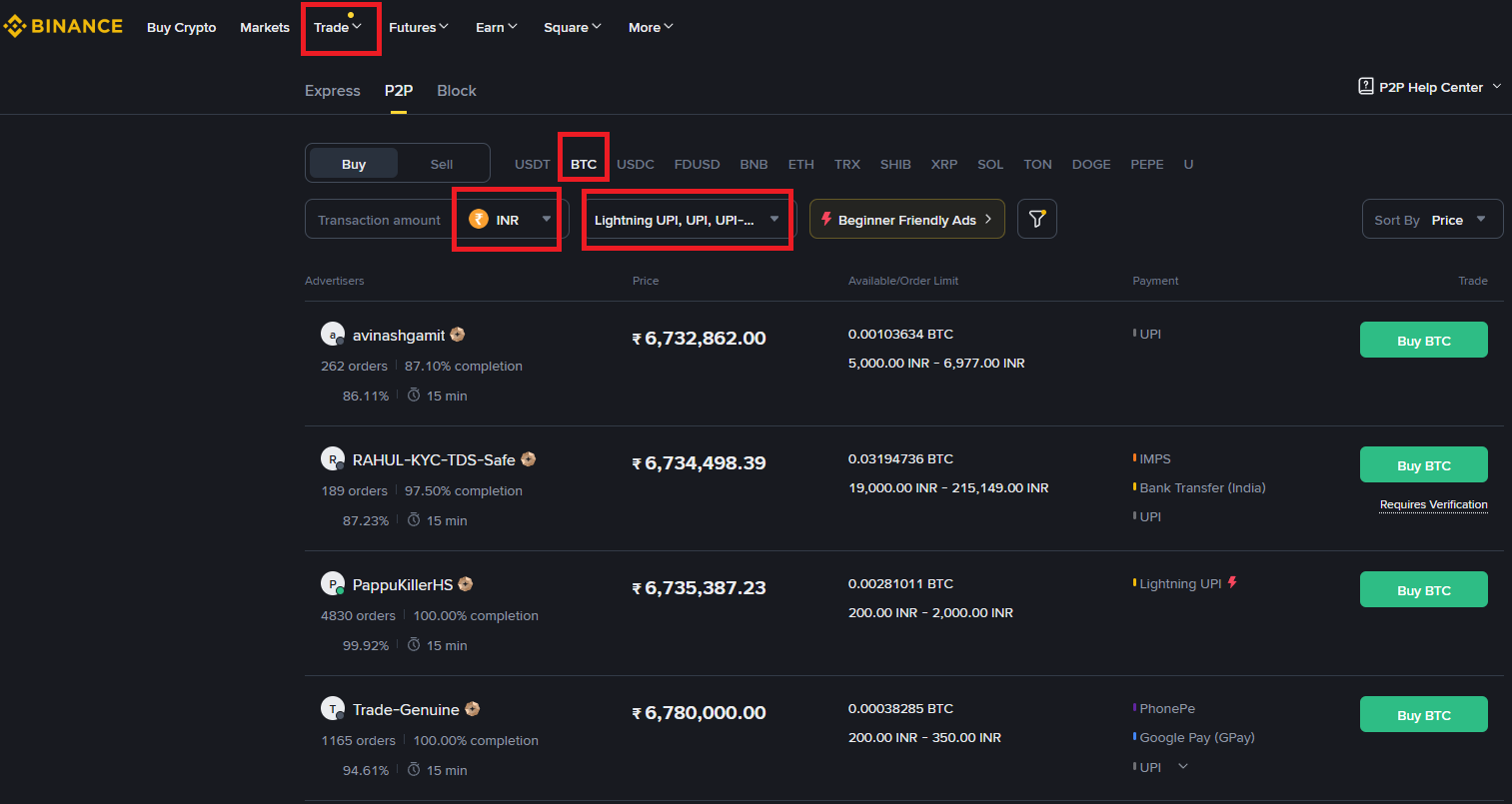
Once you do that, you'll see sellers offering Bitcoin against rupees through UPI payment.
Don't just automatically grab the first offer because it's on top. Compare the seller's price, completed trades, completion rate, and account age. A seller with hundreds or thousands of completed trades and a strong completion rate is usually a safer pick than a brand-new account with a tempting price.
Read the seller's terms before you place the order. Some ask for payment from a bank account that matches your verified name. Others may require you to use a certain UPI app or add a short payment note.
If the terms feel odd or too restrictive, move on to the next offer.
Pay through UPI and wait for the crypto to be released
After you enter the INR amount or the BTC amount you want, place the order and follow the payment instructions on screen. Send the exact amount through your UPI app to the UPI ID or account details shown in the order. I
If the seller asks for a reference in the official order instructions, enter it exactly as shown.
Only tap "Transferred, Notify Seller" after you've actually paid. Not before, not "almost done," andnot because the countdown is running low. Once the transfer is sent, keep the receipt or screenshot until the BTC lands in your funding wallet.
Then wait for the seller to confirm payment and release the crypto from escrow. Most trades are quick, but if the seller delays, don't panic and don't cancel after you've paid.
Use the order chat, stay inside the platform, and open a dispute if something doesn't look right. Your proof of payment matters there.
Other platforms that may let you buy crypto with UPI
Binance isn't the only path. Some Indian exchanges, wallet partners, and broker-style apps may also show UPI as a payment option for INR purchases.
Here’s a potential issue: availability changes often. One app may support UPI for Bitcoin today, then switch users to bank transfer, card, or a third-party payment route later.
This quick comparison shows what matters more than the marketing banner.
| Platform style | What to look for |
| P2P marketplace | Escrow, seller ratings, dispute support, UPI filters |
| Direct buy app | Total fees, spread, purchase limits, withdrawal rules |
| Broker or wallet partner | Coin support, INR support, KYC rules, payout delays |
A clean app doesn't always mean a cheap trade. Sometimes the easiest-looking flow hides a wide spread or a withdrawal lock.
What to check before using any UPI-supported app
Before funding anything, check whether the platform supports Bitcoin, INR, and UPI on the same screen. Then look at the exchange fee picture as a whole, not only the visible fee. A "zero fee" buy can still cost more if the spread is wide.
Also check purchase limits, withdrawal rules, and how disputes are handled. If it's P2P, find out whether the platform holds crypto in escrow. If it's a direct buy option, see whether your coins are available to withdraw right away or held for a cooling period.
When a direct buy option makes sense, and when P2P is better
A direct buy flow is simpler. You choose the coin, enter the amount, pay, and receive the asset. That's useful if the app clearly supports UPI, the price is fair, and the fees are easy to understand.
P2P is better when UPI is the only practical payment method you can find, or when direct-buy options are unavailable. It asks for a little more attention, but it can also give you more payment flexibility.
For Indian users trying to buy Bitcoin with UPI right now, that often makes P2P the more reliable route.
How to stay safe when you buy crypto with UPI
Crypto scams usually don't arrive wearing a villain costume. They show up as urgency, shortcuts, and "trust me" messages. That's why safe buying habits matter more than clever trading tricks.
On UPI-based P2P trades, the main risks are fake payment proof, wrong UPI details, off-platform chats, and pressure to confirm something before you've checked it. The fix is boring, but it works. Slow down, verify each step, and keep the whole trade inside the platform.
If a seller asks you to move the conversation to WhatsApp or Telegram, leave the trade.
No questions, no apologies. Just leave.
Red flags that should make you leave the trade
A few warning signs should stop you cold:
- The seller has little or no trade history.
- The completion rate is weak for a supposedly active account.
- The payment instructions change after the order opens.
- You're asked to send money to a different UPI ID than the one shown in the order.
- The seller wants to chat outside the platform.
- The offer price looks far better than everyone else's.
- The messages tell you to ignore platform rules or release early.
Any one of those can be enough reason to walk away and pick another offer.
Good habits that protect your money and account
Use UPI accounts and bank accounts that match your verified name whenever possible. Pay the exact amount shown in the order. Double-check the UPI ID before you send anything. Save screenshots and transaction references until the crypto is released.
Never share your Binance password, OTP, or two-factor codes. Never mark a payment as sent if you haven't sent it. And if you paid but the seller goes silent, don't cancel the order on your own. Use platform support and let the escrow process do its job.
The bottom line
If you want the simplest current route to buy Bitcoin with UPI in India, Binance P2P is the one most people will probably understand the fastest. It works because UPI handles the rupee payment while Binance holds the crypto in escrow until the seller confirms receipt.
Other apps may support UPI too, but that can change by coin, country, and payment partner.
Before you buy, check the live payment options, compare the real cost, and stick with platform protection whenever it's available. That's how you keep a simple purchase from becoming an expensive mistake.
Next, if you’re looking for alternative ways to buy crypto, feel free to check out our guide on:
How to buy USDT with Google Play
FAQ
Which crypto app allows UPI payment?
Zengo is one example of a crypto app that says it supports buying crypto with UPI in India. For example, Zengo has pages for buying Bitcoin and USDT with UPI, although users still need to complete identity verification before buying crypto.
That said, UPI availability can change. Before you sign up or place an order, check the live payment screen inside the app and make sure the platform supports your coin, INR, and UPI at the same time.
Does Coinbase accept UPI?
Not at the moment. Coinbase doesn’t support UPI as a standard direct payment method for Indian users. Coinbase previously launched UPI support in India in 2022, but suspended it shortly after.
Coinbase has since returned to India with INR deposits and withdrawals through IMPS, not UPI.
How to buy crypto with UPI no KYC?
To buy crypto with UPI without KYC, you need to use P2P (peer-to-peer) platforms or Non-Custodial Swap Aggregators that support UPI. RoboSats is an example of such a platform.
But buying crypto with UPI without KYC can be risky. Most serious exchanges, broker apps, and wallet partners require identity verification before allowing crypto purchases.


You May Also Like

The changing face of elder care in Malaysia — Sayed Mohammad Reza Yamani Sayed Umar

Not a loophole: Singapore AI export controls let China tap US AI legally

CoreWeave (CRWV) Stock Surges 12% on $8.5B GPU-Backed Financing Deal — Here’s the Full Picture