

Must Read
POWER LINE. A MORE Power lineman conducts maintenance on an electric pole under the firm’s five-year plan to upgrade Iloilo City’s power network.POWER LINE. A MORE Power lineman conducts maintenance on an electric pole under the firm’s five-year plan to upgrade Iloilo City’s power network.
[Vantage Point] Who turns the lights on in Passi City?
For feedback or concerns regarding this content, please contact us at crypto.news@mexc.com
A businessman from Passi City — let’s call him Mr. Reyes — constructs a commercial building on a busy highway. The permits are complete, construction has been finished for months, and potential tenants are already discussing lease terms.
After taking on a lot of capital and being forced to wade through the lengthy process of development, he hits what should be the last and easiest step: getting electricity. But what should have been an ordinary customer application process soon exposes a critical issue confronting the transforming power sector in Iloilo.
Who, exactly, is responsible for serving Mr. Reyes?
MORE Electric and Power Corporation (MORE Power) currently has a congressional franchise covering Passi City and several municipalities in Iloilo Province under Republic Act No. 11918. Meanwhile, in the same territory, Iloilo II Electric Cooperative Inc. (ILECO II) continues to operate under its own valid franchise. The legal controversy surrounding that overlap has largely been resolved.
When it decided to uphold Republic Act No. 11918, the Supreme Court reiterated a longstanding principle of Philippine public utility law: a legislative franchise is a privilege conferred by Congress, not a vested property right. Unless that exclusivity is explicitly provided, Congress may authorize overlapping franchises if it thinks doing so benefits the general public.
Practical concerns
The Court resolved an important constitutional question, but it did not answer the practical questions that inevitably ensued. Electricity distribution differs from most industries where competition can be introduced simply by allowing another company to enter the market.
A franchise may confer authority to operate, but it does not instantly create the infrastructure necessary to provide service. If MORE Power does not have facilities in the area where Mr. Reyes is located, does the franchise impose an obligation to make the service available to him, or does this remain on the incumbent utility until the completion of new infrastructure?
Philippine jurisprudence has consistently treated public utilities as enterprises involving public interest, a classification that subjects them to obligations not imposed upon ordinary businesses.
That principle is baked into the Electric Power Industry Reform Act of 2001 (also known as EPIRA). Distribution utilities are considered in the law as entities that provide electric service to people living in the distribution company’s franchise communities. The Energy Regulatory Commission (ERC) also recognizes the right of qualified customers to have electricity, subject to reasonable technical and commercial requirements.
The challenge is when laws and technical capacity do not align. Consumer choice is a valid policy goal, and no one can criticize the importance of seeking premium service delivery and accountability. The question is not so much whether competition exists, but whether clear parameters have been established before the expansion of franchise territories.
Republic Act No. 11918 anticipates a gradual, realistic rollout of infrastructure because a distribution network cannot be constructed overnight. Utility systems require rigorous engineering studies, substantial capital investment, permitting, procurement, and several years of physical construction.
A phased implementation is entirely reasonable. What deserves closer examination is the framework governing the period between the granting of a franchise and the completion of the infrastructure needed to fully exercise that franchise.
MORE Power’s support in Congress
If the businessman in Passi City submits his application tomorrow and his preferred utility’s facilities are unavailable, who bears the obligation to connect him? If the rollout extends over several years, which utility carries the continuing responsibility to serve consumers during the transition?
Asking these questions today has become even more important.
Congress is already considering legislation that would deepen MORE Power’s franchise in municipalities currently served by Iloilo I Electric Cooperative Inc. (ILECO I). The justification given includes modernization, competition, and consumer choice.
But what does a franchise mean operationally if service cannot yet be rendered throughout the territory covered by that franchise? Before any more territories are granted, what benchmarks should be met? What obligations accompany expansion beyond the promise of future infrastructure development?
The answers matter because utility regulation has always relied on a core principle that enjoys far less public attention than competition does: universal service. Distribution utilities do not simply serve profitable customers. They maintain lines in sparsely populated communities, restore power after storms, and provide service in areas where revenues may not fully justify investment.
If competition allows one utility to focus initially on large commercial and industrial loads while another continues carrying the obligation to maintain remote lines and serve geographically challenging areas, regulators must determine how those responsibilities will be allocated. Otherwise, competition may alter revenue streams without altering service obligations, creating imbalances that ultimately affect reliability, cost recovery, and consumer rates.
And this is precisely why Congress has the power to not only authorize the granting of utility franchises, but also to impose conditions to ensure the protection of public interest. Rollout schedules, performance measures, reporting requirements, service standards, and universal service obligations are not anti-business policies. They are the very mechanisms that ensure a franchise becomes a commitment to public service rather than a passive territorial entitlement.
In the end, the discussion should extend beyond the competition between MORE Power and electric cooperatives. What truly matters is ensuring that the regulatory framework keeps pace with the expansion of utility franchise areas.
Every jurisdiction that has brought competition into network industries has faced that same set of issues in terms of service obligations, infrastructure deployment, and universal access.
The Philippines will have to answer them, too — long before, and not after, the next franchise expansion.
Mr. Reyes, a businessman in Passi City, has completed his building, signed on prospective tenants, and submitted an application request for electricity. Who, exactly, is responsible for turning the lights on in his building?
I welcome your views on these and other issues where decisions made in power shape the country’s economic future.
Below are previous Vantage Point pieces you might have missed:
– Rappler.com
Market Opportunity
Manchester City Fan Price(CITY)
$0.4006
$0.4006$0.4006
USD
Manchester City Fan (CITY) Live Price Chart


Disclaimer: The articles reposted on this site are sourced from public platforms and are provided for informational purposes only. They do not necessarily reflect the views of MEXC. All rights remain with the original authors. If you believe any content infringes on third-party rights, please contact crypto.news@mexc.com for removal. MEXC makes no guarantees regarding the accuracy, completeness, or timeliness of the content and is not responsible for any actions taken based on the information provided. The content does not constitute financial, legal, or other professional advice, nor should it be considered a recommendation or endorsement by MEXC.
You May Also Like

Q2 Market Insights: Bitcoin regains dominance in risk-averse environment, ETFs remain critical to market structure
The market will show a downward trend in the short term, and then rebound and set new highs in the second half of the year.
Share
PANews2025/04/28 19:40
Hedera Price Prediction Holds Bullish as Iran Peace Deal Pushes Bitcoin Above $65,000 and Pepeto Presale Passes $10 Million
The hedera price prediction keeps attracting attention even as the broader crypto market recovers from its sharpest correction of 2026, because HBAR sits on enterprise
Share
Captainaltcoin2026/06/17 03:00
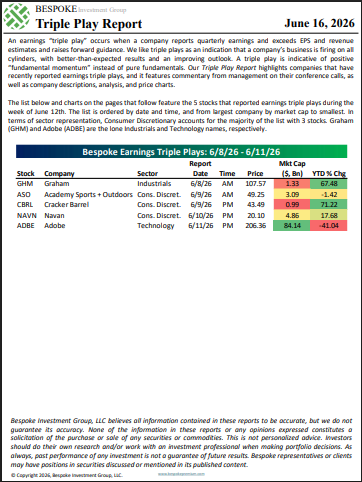
The Triple Play Report: 6/16/26
An earnings triple play is a stock that reports earnings and manages to 1) beat analyst EPS estimates, 2) beat analyst sales estimates
Share
Bespoke Investment Group2026/06/17 03:09



