

How regulatory compliance became the most valuable asset in digital finance
There was a time when the fastest path to scale in digital finance meant outrunning regulators. Move fast, acquire users, and deal with compliance later. That playbook built some of the biggest names in fintech — and destroyed others. In 2026, the calculation has fundamentally shifted. The companies outperforming their sectors are not the ones that avoided regulatory frameworks the longest. They are the ones that embraced them earliest.
Compliance is no longer a cost centre. For a growing number of digital platforms across payments, crypto, lending, and adjacent sectors, it has become the most defensible competitive moat they own.
The old assumption and why it broke down
The early fintech wave operated on a simple premise: regulation was friction, and friction was the enemy of growth. Challenger banks launched without full banking licences, using partner institutions to provide deposit insurance while maintaining the agility of a tech startup. Crypto exchanges expanded into new markets with minimal local authorisation, treating fines as an acceptable line item in the growth budget. Buy Now Pay Later providers scaled consumer credit products for years before formal credit regulation caught up with them.
For a while, it worked. User bases expanded faster than regulators could respond. Capital flooded in. Valuations soared.
Then the reckoning came — and it came quickly. The collapse of several unregulated crypto platforms between 2022 and 2024 wiped out billions in consumer funds and triggered a wave of enforcement action globally. The EU’s Digital Operational Resilience Act (DORA), which came into force in early 2025, imposed binding IT risk management and third-party oversight obligations on financial entities that had previously operated with minimal structural scrutiny. In the United States, the FTC reported consumers lost more than $12.5 billion to fraud in 2024 alone — a figure that accelerated regulatory demands for tighter consumer protection across digital financial services.
The consequences for non-compliant operators became existential, not merely expensive. And the consequence for compliant operators was something few had predicted: a structural advantage that was increasingly difficult for competitors to replicate.
What compliance actually buys you now
The argument for compliance as competitive advantage is not primarily moral — though the moral case is clear enough. It is structural. Licensed, compliant operators gain access to a set of capabilities that unlicensed competitors simply cannot purchase.
Access to institutional infrastructure. Sponsor banks, payment processors, card networks, and correspondent banking relationships all increasingly require compliance documentation as a condition of partnership. Deloitte’s 2024 Fintech Industry Benchmark Survey found that compliant fintechs consistently reported faster access to banking infrastructure than non-compliant peers. In 2026, as BDO noted in its annual fintech predictions, sponsor banks are expected to become materially more demanding of their fintech partners on AML controls specifically — tightening the screws further on those who have delayed compliance investment.
Lower customer acquisition cost. Trust is expensive to manufacture and cheap to destroy. Platforms operating under clear regulatory frameworks consistently outperform peers in customer satisfaction surveys, according to KYC Chain’s analysis of neobank performance data. When consumers choose where to deposit their savings or place their investments, a visible licence and a regulatory safety net are not abstract features — they are concrete buying decisions, particularly among older demographics and institutional clients.
Regulatory reciprocity. Regulators favour institutions that make their job easier. Well-documented compliance processes accelerate licensing in new jurisdictions, enable faster approval for new products, and reduce the intensity of ongoing supervisory engagement. In the EU, the passporting mechanism under PSD2 means that a fintech operating compliantly in one member state can extend services across the bloc with significantly reduced friction — a geographic expansion advantage that only exists for those inside the regulated perimeter.
Reduced cost of capital. Investor appetite for compliance-first fintech has grown substantially. The shift from “growth at all costs” to “growth with accountability” — documented across the sector in 2025 — has made ESG-aligned, regulated platforms more attractive to institutional investors managing their own regulatory exposure. Regulatory fines dropped 35% in 2025 for fintech companies using regtech solutions, according to fintech trend analysis, a metric that directly affects risk-adjusted return calculations.
The Netherlands as a case study in regulated market design
The Dutch online financial services market offers a useful lens through which to examine what happens when a regulator draws a hard line and enforces it.
When the Netherlands introduced its Remote Gambling Act (KOA) in October 2021, it created one of the most demanding licensing frameworks in Europe for digital platforms operating in the consumer entertainment sector. Operators seeking a KSA licence from the Kansspelautoriteit — the Dutch Gaming Authority — were required to demonstrate AML and KYC compliance, integrate with the national CRUKS self-exclusion register, and meet stringent age verification and player protection standards. The application process carried a non-refundable €48,000 fee and a €50,000 financial security deposit. Advertising restrictions, including a ban on celebrity and athlete endorsements introduced in 2022, further narrowed what compliant operators could do.
The barrier to entry was intentional. And it had a predictable market effect: operators who had invested in compliance infrastructure from day one occupied a structural position that late entrants could not quickly replicate. BetCity.nl, one of the first platforms to receive a KSA licence and operate on day one of the market opening, is a clear example of how early compliance investment translates into durable market positioning — the brand has since been acquired by Entain, one of the largest regulated operators globally, precisely because its compliance infrastructure was acquisition-ready.
The Dutch experience also illustrates the downside of regulatory instability. Subsequent waves of restriction — including advertising bans and channelisation challenges — pushed unlicensed offshore operators to capture an estimated 50% or more of Dutch consumer spend by early 2025, according to industry reporting. The lesson for regulators is as important as the lesson for operators: the most effective licensed markets are those where compliance is rewarded consistently, not just demanded.
The regtech layer: compliance at scale
One practical barrier to the “compliance as strategy” argument has historically been cost. For early-stage fintechs, the expense of building compliance functions — legal teams, KYC pipelines, transaction monitoring systems, reporting infrastructure — could consume capital that competitors were deploying directly into growth.
That calculation is changing. The regtech sector — technology built specifically to make compliance faster, cheaper, and more automated — has matured significantly. Real-time AML systems are now operational across more than 75 countries. Automated KYC verification reduces onboarding friction while meeting regulatory requirements. AI-assisted transaction monitoring can flag suspicious activity at a scale and speed no human compliance team can match.
The result is that the cost of being compliant has fallen substantially, while the cost of not being compliant has risen dramatically. The inflection point — where compliance becomes cheaper than non-compliance at most meaningful scales of operation — has already passed for most fintech verticals.
The strategic reframe
The most important shift in how successful digital finance companies now think about regulation is not operational — it is strategic. Compliance is no longer treated as a legal obstacle to navigate around. It is treated as a product feature, a sales asset, and a growth mechanism.
This is visible in how regulated platforms market themselves. Transparency about licensing, regulatory standing, and consumer protection mechanisms has moved from fine-print disclosures to front-page positioning. It is visible in hiring: chief compliance officers now report directly to CEOs at leading fintechs, a structural signal of how seriously the function is taken at board level. And it is visible in M&A activity, where compliant platforms command acquisition premiums over unlicensed competitors that have to be “cleaned up” before they can operate in regulated markets.
The companies that understood this earliest are, by 2026, the ones with the most defensible positions in their respective markets. The companies still treating compliance as overhead are competing in an environment that is increasingly hostile to that approach — and losing ground to rivals who are not.
For any digital platform operating in financial services, the strategic question is no longer whether to invest in compliance. It is how quickly the investment can be completed before the competitive window closes.
The post How regulatory compliance became the most valuable asset in digital finance appeared first on FintechZoom IO.


You May Also Like
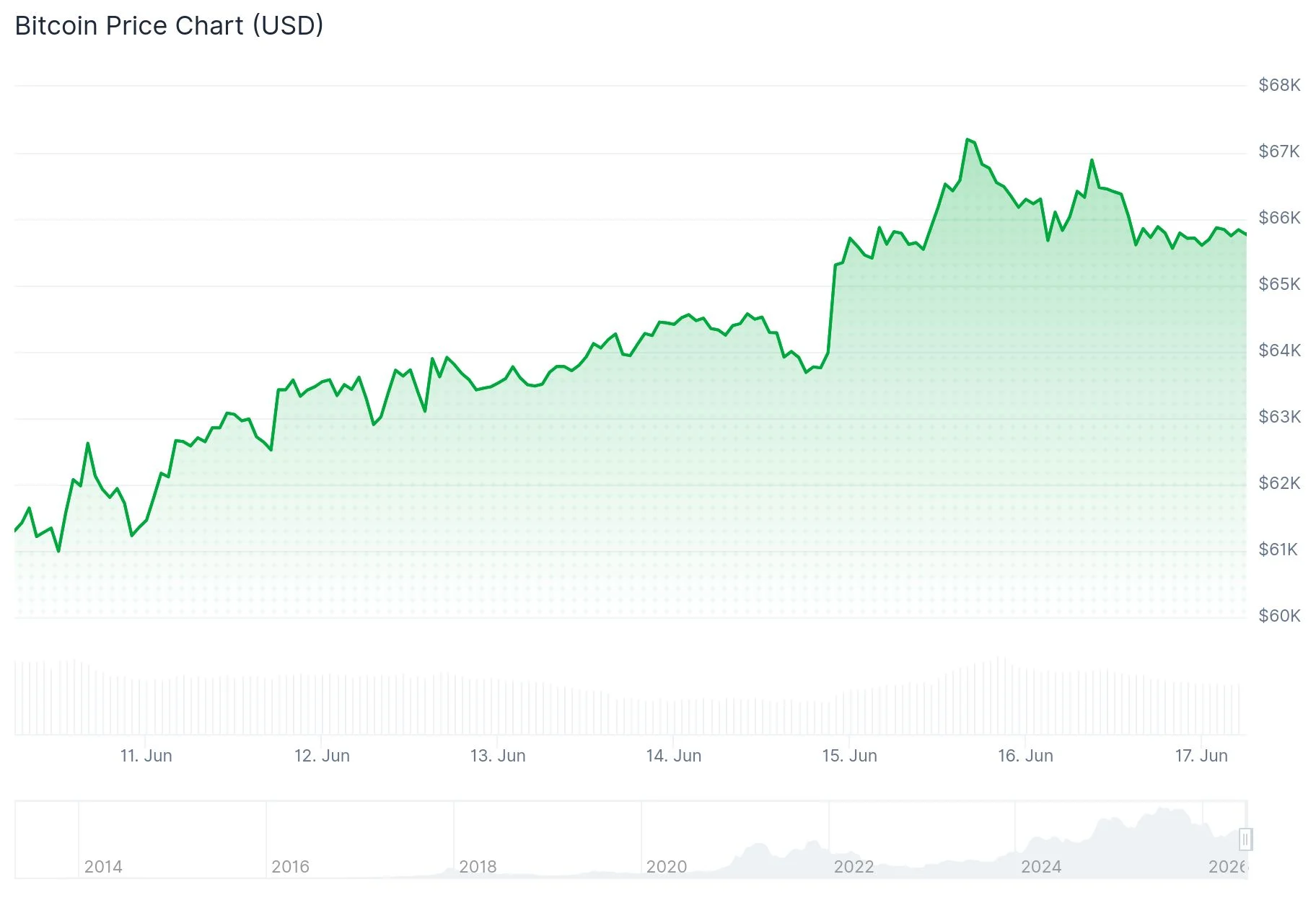
Bitcoin (BTC) Steady at $65K as BlackRock Reveals $9 Trillion Capital Shift Coming

Placeholder Partner Chris Burniske Begins Buying, Calls October a ‘Critical Turning Point’ for Crypto

SpaceX Options Surge: Turning IPO Momentum Into a Volatility Test



