

Craydel co-founder Manish Sardana quit a high-flying job to start from zero
The offices of Craydel, a Kenyan edtech connecting African students to global universities, occupy a glass-partitioned floor at The Pavilion on Lower Kabete Road, away from Nairobi’s perpetual traffic and construction noise. Through the transparent walls, almost nothing is hidden. Student counsellors are fielding anxious calls from parents and students, while product managers huddle over laptops.
Manish Sardana’s office sits in the middle of it all, deliberately so. On one side is the operations team; on the other, the engineers building the artificial intelligence (AI) engine that powers Craydel’s study abroad matchmaking tool. There is no imposing corner office separating the co-founder and CEO from the very people helping him build the company.
He asks whether I would like tea. He orders coffee for himself.
Sardana has the calm confidence of someone comfortable with uncertainty. He says he has spent his life restless, suspicious of comfort, and constantly searching for purpose. Raised in a modest household in India, he abandoned a place at the prestigious Delhi School of Economics before, over a decade later, walking away from a high-flying career at WPP Scangroup, a marketing and communications company, to build Craydel from scratch.
Five years on, he says he has no regrets.
He imagines himself still building, still searching for the next problem to solve, until his deathbed. That restlessness has not come cheaply. His family, he acknowledges, has carried part of that burden.
“I’ve been married for 18 years now,” he says with a laugh. “So I must have done something right.”
When pressed on what success ultimately looks like, he says it is whether his children, his parents, and the people closest to him feel proud of the life he chose to build.
This interview has been edited for length and clarity.
You grew up in India, built businesses across continents, and eventually chose Africa. What part of yourself were you looking for that you couldn’t find elsewhere?
A few things. First, all three co-founders were based in Kenya, so that anchored us here. But personally, I had the option to go back to India and start something there. I chose not to because this continent has been incredibly generous to me. I had sold my company in India and was at a loose end when I got the opportunity to come to Kenya. I built a successful career here, gained a lot, and felt I needed to give back.
That was important to me because I see so many expats come, work a few years, make money, and leave. Very few actually stay and contribute to building something lasting. For me, that commitment was real—I invested almost everything I earned and saved here into my venture in Kenya. That was critical.
Second, I’m genuinely happy here. Kenyans are warm, and the continent has massive human potential. Yet the number of people solving problems here is very small. In India, there are so many entrepreneurs building so many things—they didn’t need another Manish to start something there. But here, especially in higher education and study abroad, not much was happening.
Nobody was disrupting the market; everyone was maintaining the status quo. So we saw an opportunity to do something interesting. I also built startups during my time with ScanGroup on the continent, and I’d turned those ventures into successes. That gave me the confidence to build something here and succeed.
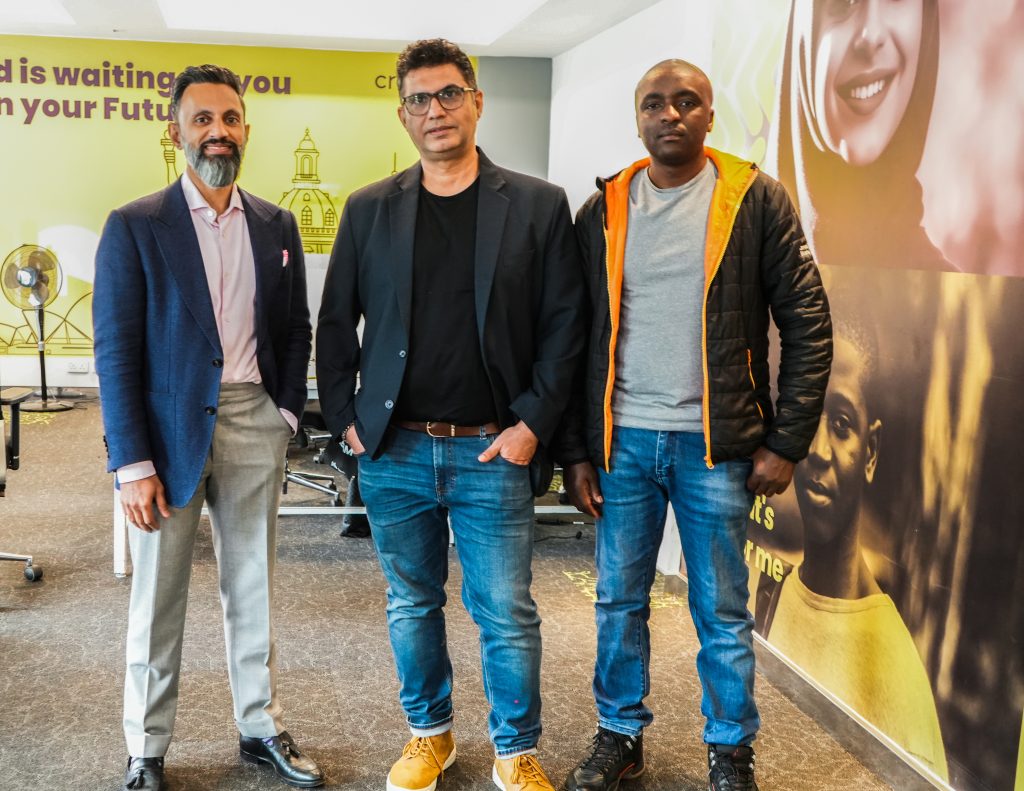 Manish (centre), Shayne Aman Premji, co-founder and CFO, and John Nguru, co-founder and CTO. Image source: Craydel
Looking back at your twenties, what kind of man were you when nobody was watching? And what parts of that younger man are still alive today?
I’m the same person whether someone is watching or not. That doesn’t change how I behave. I’m known for being authentic—for better or worse. In my twenties, I displayed traits like incredible risk-taking. I quit a top college I’d gotten into, in a fiercely competitive environment, and walked away from economics. I had a massive risk appetite then, and I still have it today.
I love a challenge. I push myself into corners where I’m really tested. When I’m comfortable, it irritates me; I get bored and seek out new challenges. So, risk-taking, seeking challenges, always looking to build something that creates value—those were the traits I displayed in my twenties, and there’s plenty of evidence of them. I still have them today.
When people introduce you, they list your achievements. What do the people who know you best say about you?
The people who know me best would say a few things. First, Manish is never easily satisfied—no matter what he’s achieved or received, he wants more; he doesn’t stop. Second, they’d say I have a lot of grit and courage; I’m unshakable. No matter what life throws at me, I stay resilient. Third, they’d say I’m not someone seeking a “chill life.” That’s not me. I don’t seek a life of just joy and ease. And finally, they’d always tell you that Manish needs a very strong purpose to feel satisfied. Without purpose, I feel shallow.
Most founders tell a story of opportunity. Yours often sounds like a story of conviction. What is the most expensive belief you’ve ever held onto?
The belief that “good is not good enough.” That’s cost me a lot. You achieve something, you feel good, but I never feel it’s enough. So I keep pushing harder, and sometimes it comes at a personal cost; my family has to bear with me. For context, when I quit my job at Scan Group to start Craydel, I was at the peak of my career. I had a great reputation, I was making good money, in a strong position, growing fast. I’d worked incredibly hard to get there. Then I gave it all up to start from zero again. That’s an example of a belief that costs me a lot of money, hardships, and relationships. It just never feels enough.
Do you regret it?
No, not at all. But I’ve become better at being more empathetic and supportive of the people around me who’ve borne that cost. As I pursue my purpose, I make sure those who depend on me, emotionally and financially, are cared for. I don’t become so obsessed with my own drive that I ignore anyone around me. One good testament: I’ve been married for 18 years now, so I must have done something right.
Craydel was founded to simplify access to higher education. Looking back, what problem did you underestimate the most?
Manish: We started with the conviction that digitising the entire process—searching, finding, applying to universities—is more optimal, more learner-centric, and creates better outcomes. We assumed that because our conviction was so strong, people would buy into it. I underestimated how much resistance to change there is in human behaviour. Even if you believe this is a better way, changing people from old habits to new ones is incredibly difficult. That resistance to adopting technology was bigger than I anticipated.
Craydel sits between students and universities. Which side has been harder to convince?
Initially, universities were really hard to convince. Every university we approached wanted credentials—our experience in study abroad, how many students we’d sent, how many universities we worked with, references from other institutions. It’s a classic chicken-and-egg problem. You need universities to attract students, but universities won’t come without students, and students won’t come without universities. We had to solve the university side first because without them, you have no platform. That was really hard at the time.
Today, it’s the opposite: universities are easier to partner with because we’ve demonstrated credentials and success. The hard part now is driving behavioural change among students and parents. Our focus is on building product-market fit, improving user experience so that searching, matching, and applying becomes joyful and convenient. We’ve built trust in our brand, but we’re not yet at the point where people fully trust that the entire process can be done online without human intervention. That’s our biggest challenge today.
What have your co-founders taught you about leadership, and how have they helped shape the company?
Patience. I can be extremely impatient, and with Shayne and John, I’ve learned to be more patient with people, employees, investors, and with things that take their own time. Also, being more measured. I used to trust my instincts more—if it made sense, let’s do it—and I’d have a sense of whether it worked or not. Today, I draw a better balance between instincts and data. We look at data a lot more now, and that’s something I’ve learned from my co-founders.
How has AI changed the way students discover, compare, and choose universities?
There are two parts of the problem that only AI could solve. First, when you have hundreds of universities, each with its own strengths, how do you choose the best fit? AI helps us process enormous amounts of information about universities, study destinations, visa processes and success rates, student preferences, and campus experiences. All that data is ingested, and AI generates recommendations. Humanly, it’s impossible to find the best fit out of 600 universities without bias. AI removes that bias and creates objective, unfiltered recommendations based on student preferences. That’s a complex problem only AI can solve.
Second, once students get recommendations, we need to check if they’re eligible to apply based on their grades. We’re looking at multiple curricula within Africa, the Kenya Certificate of Secondary School Education (KCSE) in Kenya, the Uganda Certificate of Secondary Education (USCE) in Uganda, and others. How do you figure out, based on a student’s curriculum and grades, which universities and courses they’re eligible for?
Today, we have over 50,000 courses on our platform. In real time, when you tell me your grades, I’d need to check eligibility across all those courses. Humanly impossible. AI does it in seconds. You just take a picture of your final academic results, upload it, and within five to seven seconds, our system checks 50,000 courses and their requirements, and tells you which ones you’re eligible for. Only AI could have solved that.
You’ve spent years trying to fix access to higher education. Do you ever worry that technology could be making inequality more efficient instead of eliminating it?
We’re looking at a segment of students who have the financial means to study abroad. What technology does is make information more accessible so people can make better decisions. But there’s more. One way we’re reducing inequality is through scholarships and discounts; most universities offer them, but agents would withhold that information to earn higher commissions. On our platform, that information is freely available.
Also, universities in Europe offer higher education for as low as $2,000 a year, 50-60% cheaper than private colleges in Kenya. No agent wanted to work with them because commissions were too low. Since we intend to make education inclusive and accessible, we partner with them. That wouldn’t have been possible without our platform.
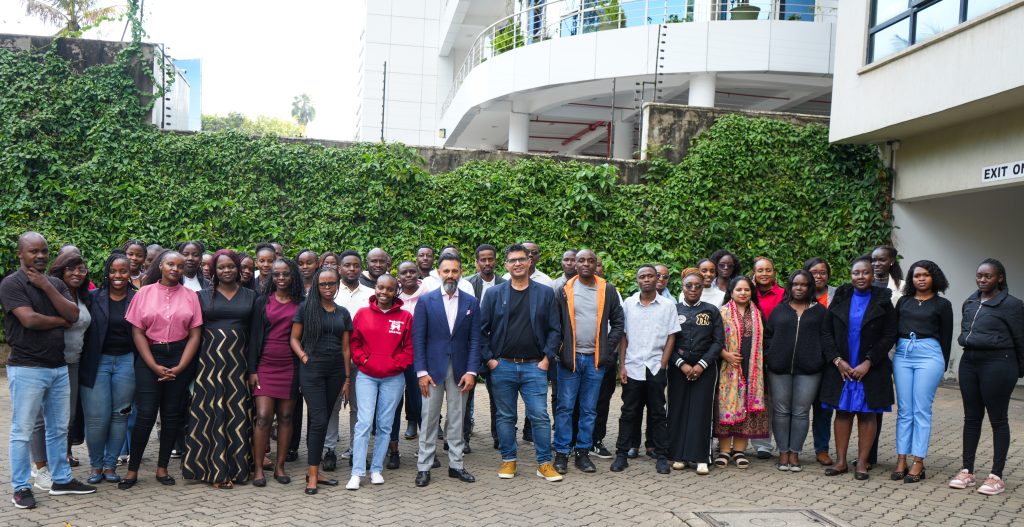 Craydel co-founder and staff. Image source: Craydel
If you were starting Craydel today, knowing everything you know now, what would you build differently?
In retrospect, we’re all wiser. But honestly, I’d probably make the same mistakes; mistakes are part of growth. However, there are things we know today that we didn’t know earlier. If I started today with all that knowledge, I’d have bootstrapped the company for much longer before taking investor money. I wouldn’t have scaled investments in technology and marketing as early as I did. I’d have run the business more offline first, understood the model properly, before investing heavily. We jumped into that too early.
What is the biggest thing investors misunderstand about building businesses in Africa? And what do African founders misunderstand about investors?
From my experience, most investors—angel or institutional—follow a US-style model: find the best founders, give them all the money, and trust them to figure it out. What they don’t understand is that internet- and technology-led businesses in Africa are still in very early stages. The ecosystem isn’t mature. Investors need to be more involved, help founders figure things out, share best practices, and connect them to other portfolio companies, especially those in the West that have already solved problems we’re trying to solve. The success rate of being a passive investor on this continent is very low. I wish investors would engage more, ask where we’re stuck, and thought-partner with us. That’s not happening enough, even with our own investors. They’ll get involved occasionally when we reach out, but mostly it’s passive.
Founders are wrong to celebrate fundraising as an achievement. It’s not. Raising money should actually pinch you; you’re giving away equity. The achievement is accomplishing the mission, not getting funding. A lot of founders feel validated just because someone put in money. Real validation comes from consumers, not investors.
When did you last feel genuinely insecure about your own abilities?
Never. I don’t feel insecure about my ability to push myself harder. I’m 47, married with kids, more responsibilities, but I have a massive capacity to learn and learn fast. Whatever I lack, I can learn from others, from reading, and overcome it. So I never feel insecure.
What is the loneliest part of being a founder that employees never see?
At the end of the day, the CEO or founder has to make the final call. You live with the weight of those decisions. When they don’t work out, you have no one else to blame, no one else to go to, no shoulder to cry on. You have to own it. Making calls, especially when they can cost thousands of dollars or people’s jobs, is the hardest thing. You have to live with the weight of your own decisions. That’s lonely. Even with co-founders, the final decision has to come from me. And making that call, knowing there’s a great probability it could go wrong, is really hard.
You work in an industry built on hope—parents hoping their children will have better lives, students hoping education changes everything. How do you carry the weight of those expectations when business realities demand difficult decisions?
I tell my team all the time: the stakes are extremely high. Someone’s entire future depends on the decisions we enable them to make. We take that very seriously. My team understands the pressure behind every recommendation we give. But our core job is to convert that hope into conviction. We don’t want parents to send their kids abroad on a hope; we want them to go on conviction.
We do that by giving them access to adequate resources, through human counselling and our platform, so that by the time they decide, they’re extremely well-informed and sure it’s the best decision. That’s our most important work.
You’ve lived through economic booms and downturns. What personal habit has saved you more often than intelligence ever has?
Intelligence is very low down the pyramid. I’d say unwavering conviction in the problem we’re solving, and absolute obsession with solving it. Things don’t always go your way; almost everything can go against you, but that deep-rooted conviction carries you through.
Second, I have an extremely high threshold for pain and suffering. I can endure massive levels and not feel emotionally low or disturbed. I just fixate on the mission. I see every challenge as a roadblock to be overcome, and my mind switches from the problem to solving it very quickly.
When you retire, what would make you feel that you didn’t merely build a company, but lived a worthwhile life?
Manish: I’m not sure I’ll ever retire, but let’s say I’m on my deathbed looking back. I see it from different perspectives. First, the company’s mission will evolve, maybe shift entirely. Whatever it becomes, that mission needs to achieve enough scale to create real change. It’s not about a few thousand students—can we get a million-plus to trust our platform?
Just before you came, a girl visited us. She participated in our Craydel Cup competition—like Shark Tank for high school students in Kenya—won a scholarship, and is now going to Ireland on a 50% scholarship to study abroad. Moments like that make us happy. Education is a pathway to achieving goals. If I can help a really large number of students achieve theirs, that’s great. But I’ll never feel fully satisfied. Even if we become the biggest platform in Africa, I’ll ask: what’s beyond Africa? Southeast Asia? South America? We want to be a global company.
Second, I see my role as a CEO and coach. We have many young people working with us. Am I inspiring them to become the best versions of themselves? If my team does well—whether at Craydel or elsewhere—and I was part of their growth, that means a lot.
Third, personally, if my kids, my wife, my parents, or anyone close to me feels proud of what I’ve done, that validation matters immensely. Do my kids feel great talking about my work in public? That would mean a lot to me. So, it’s about our consumers, students, and parents trusting our platform to help them achieve their goals. It’s about helping my team grow. And it’s about making my family proud.


You May Also Like

Ethereum koers toont zeldzaam dubbel koopsignaal en richt zich op $4.550

UK Gilt Yields Spike As Burnham Win Opens Door To Oust Starmer

HashKey Capital’s Strategic $540K STO Deposit to Binance Reveals Institutional Crypto Moves Amid Market Turmoil



