

CFTC, SEC Launch Derivatives Rule Review amid CME Group's Legal Challenge
Key highlights:
- The US SEC and CFTC have launched a review of derivatives market regulations.
- The regulators are seeking public opinion on the definition of certain products.
- The move comes following the CME Group’s decision to sue the CFTC over their approval of perpetual futures products.
US regulators are advancing efforts to update derivatives market regulation as the Commodity Futures Trading Commission (CFTC) is facing legal challenges from CME Group. As per the latest reports, the CFTC and SEC have launched a fresh review of derivatives regulations, seeking public opinion on key product definitions.
It is worth noting that the move comes following CME Group’s decision to sue CFTC over its approval of Kalshi’s Bitcoin perpetual futures. Consequently, the regulators are taking efforts to clarify rules that have become contentious amid the significant expansion of the derivatives market.
CFTC and SEC seek public opinion on derivatives rules
In the latest development within the ongoing friction between US regulators and the traditional financial market, the CFTC and SEC have opened a public consultation. The regulators are reportedly seeking public feedback as they intend to update and clarify key derivatives market rules. The SEC and CFTC are taking public input on how certain financial products should be classified and regulated.
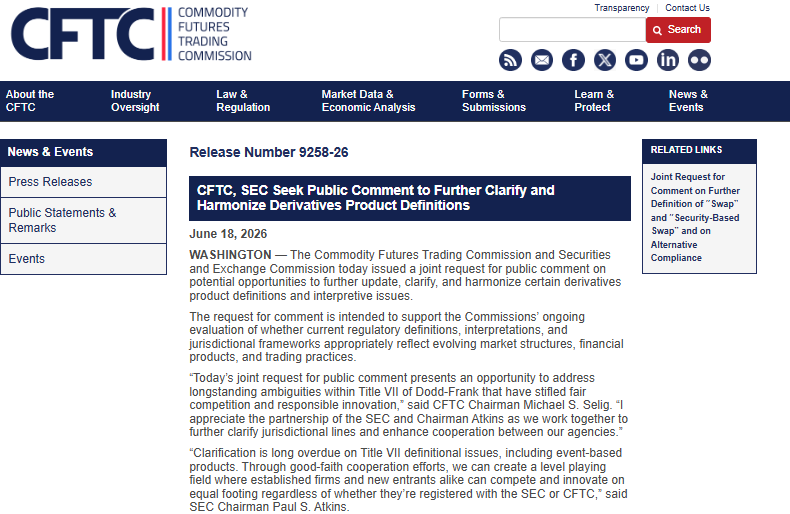
Source: CFTC
CFTC Chairman Michael S. Selig stated,
Most importantly, the move focuses on swaps. This is a key area that has become the center of regulatory and legal debates in the regulatory market. The agencies are now asking opinions from industry participants, legal experts, and the public on how swaps and security-based swaps should be defined under current rules. They are also looking for comments on the existing exemptions and regulatory framework.
In addition to swaps, the review is also focusing on newer financial instruments. These include event contracts offered by prediction markets and perpetual futures contracts.
CME Group’s legal challenge puts perpetual futures in focus
Notably, the regulator’s review comes hot on the heels of CME Group’s recent criticism of the CFTC’s perpetual futures approval. As reported by CoinCodex, CME has announced plans to file a lawsuit against CFTC, questioning the agency’s approval of Kalshi’s Bitcoin perpetual futures products. According to CME, such products should be considered as swaps rather than traditional futures contracts.
CME Group argued that the CFTC’s move has opened doors for perpetual futures products to enter the market without following the swap framework established under the Dodd-Frank Act. This could give an unfair regulatory advantage to newer market participants.
SEC Chair calls for clearer rules
Significantly, the latest development highlights the US regulators’ growing efforts to bring regulatory clarity to the US crypto market. Following many key initiatives, the SEC and CFTC are now checking issues in the securities and derivatives markets.
SEC Chair Paul Atkins stated that the review intends to resolve the long-standing ambiguities surrounding key provisions of the Dodd-Frank Act. He noted,
Atkins also stated that the joint efforts by the two regulatory agencies could provide a more favourable space. This could allow companies and institutions to innovate under clearer and consistent rules.


You May Also Like

Solana price confirms bearish crossover following Drift exploit, will it crash?

Pinterest (PINS) Stock Plunges 69%: Why Wall Street Still Sees Recovery Potential

EDX Markets Applies for OCC Trust Bank to Expand Crypto Services



