

Miserable K-shaped economy might actually be fading, as lower-income families bounce back, says Bank of America
Green shoots are appearing in the spending patterns of lower-income earners, with their consumption tracking up in recent days on goods and services excluding gas. The trend could signal the beginning of the end of the so-called a ‘K-shaped’ economy in which the spending and fortunes of upper-income earners rise, while those of lower earners fall.
Bank of America says card data over the past week is showing rays of optimism that the lopsided K-shaped economy is on its way out: the gap in spending between upper and lower income earners has closed significantly. Wealthier households’ consumption is holding at the same level established in March this year, while poorer consumers are beginning to spend more.
The second-largest bank in the U.S. said the K-shaped economy has been persistent in its data since late 2024 and early 2025, but recent headlines may have helped alleviate fears about the trajectory of the economy.
First, the U.S. and Iran have agreed to a deal to cease military conflict in the Middle East, despite the two sides abruptly calling off talks this morning. The conflict has triggered price hikes on gas, airfares, and groceries (given disruptions to food supply chains). A resolution of the upheaval could cause these elevated costs to return to more normal levels.
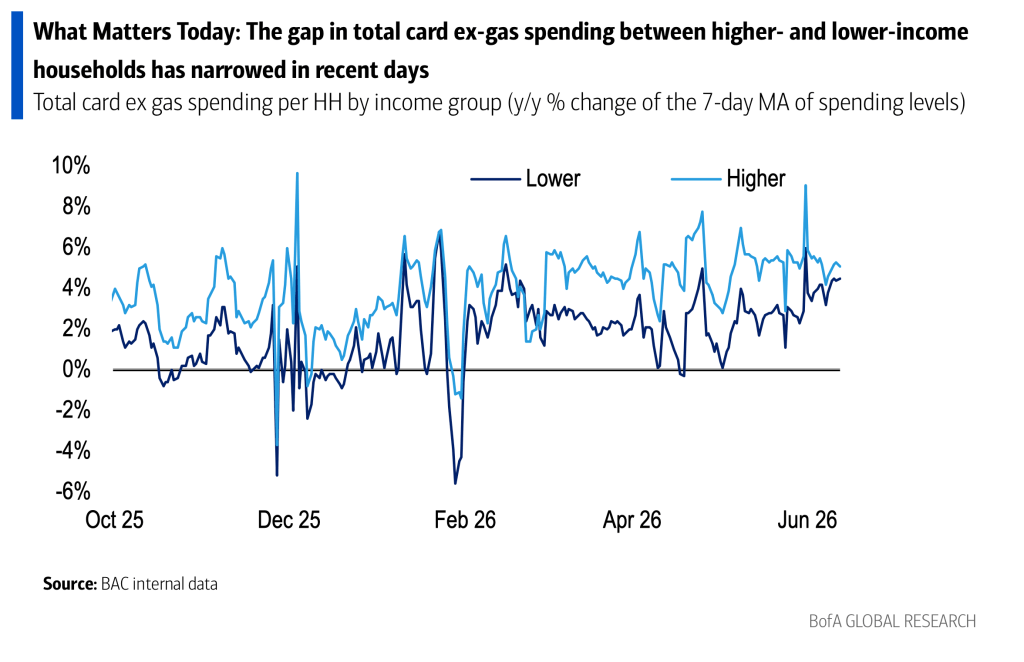
Oil prices already reflect the draw-down effect. At the height of the geopolitical tension, crude oil hit a little over $113 a barrel; at the time of writing, it sits at $79, having dropped steeply in the past week.
Bank of America’s Shruti Mishra has another theory for the optimism: “A recent Bank of America Institute report showed a rise in after-tax wage growth for lower- and middle-income households. It is still too early to confirm a sustained shift, as the recent improvement could partly reflect tax relief, but the data bear watching.”
The jobs outlook
Improved job prospects would meaningfully boost the outlook for consumers, and here things seem to be looking up. The unemployment rate is holding steady (4.3%, according to the latest Bureau of Labor Statistics report), with payroll giant ADP reporting private employers added 122,000 jobs in May.
“Hiring was more broad-based in May than we’ve seen in the last few years. The labor market continues to show sustained momentum going into the summer hiring season,” Dr. Nela Richardson, ADP’s chief economist, said of the latest report.
Mishra noted that if K-shaped spending keeps narrowing, it could be due to job growth broadening into blue-collar sectors such as leisure and hospitality, and construction and manufacturing. The economist wrote: “Recent data provide some tentative evidence of this, alongside an improvement in professional and business services hiring after job losses throughout ’25, which disproportionately affected younger, lower-income workers.”
“Potential drivers could be reduced tariff uncertainty, ongoing equity market strength, and consequently robust higher-income spending.”
Indeed, the New York Fed has already discovered evidence that blue-collar workers are faring better at present than some counterparts. The regional Fed’s latest wage inflation report found that most, but not all, industries have seen a synchronized decline in wage growth since October 2022, with the notable exceptions of two sectors: public administration and mining and construction.
The mining and construction sector has been more consistent and persistently stronger than the rest of the economy, the report adds, which could be related to the construction of AI data centers, with sustained demand fueling wage growth.
This story was originally featured on Fortune.com


You May Also Like
Japanese Yen Recovers Ground as US Dollar Rally Loses Steam Despite Hawkish Fed
Republican Lawmaker Pushes Prediction Markets Insider Trading Ban
Charles Schwab Enters Prediction Markets With S&P 500 Event-Based Options



