

How Mindanao’s coffee farmers reclaimed their place on the world stage
At the end of May, on a ranch in Valencia City, Bukidnon, I learned what years sound like. They sound like nothing. They sound like the half-second after an emcee says “first place” and before he says a name.
For a week, judges at the SEA Green Coffee Competition — the Philippines National Round — had tasted every coffee blind, knowing no farmer’s name. Now the names were all that was left, and everyone in the room had wagered years of their lives on what would fill the silence.
Boy Javier heard his first: first place, Liberica. Then Manolito “Lito” Garces of Pangantucan, called for second in Robusta; he turned to go back to his seat and was told to stay, because first was his too. Then Fu-Chun Lin — the Taiwanese farmer who found home in the Philippines, the one everyone calls Acuii — first place, Arabica, in the first competition he had ever entered.
I work in coffee, and I have known these three for years — cupped their lots, walked their farms, sat at their tables. So I knew what those silences contained.
Begin with what makes the silence heavy. A century ago, Philippine coffee sold across the world; then disease all but wiped it out, and the country never recovered.
Today, it is one of the world’s biggest coffee drinkers, importing most of what fills the cup. The reason lives at the start of the supply chain.
The average farmer earns about ₱72.92 per kilogram of beans. The average coffee farmer is 57. The second number explains the first. In the years before this story, farmers around Mount Apo were cutting down their coffee to plant vegetables — not because they stopped loving it, but because coffee could no longer sustain them.
Yet some kept planting anyway.
Acuii
Acuii’s story begins in Taiwan, long before coffee. He sold phones in the Nokia era, moved into real estate, and reached the age when most people stop chasing hard things. Instead he became obsessed with Gesha, one of the world’s most demanding varieties. He says it took more than two hundred messages before a Panama producer replied. He chose Mount Apo, where his farm sits at 1,700 meters.
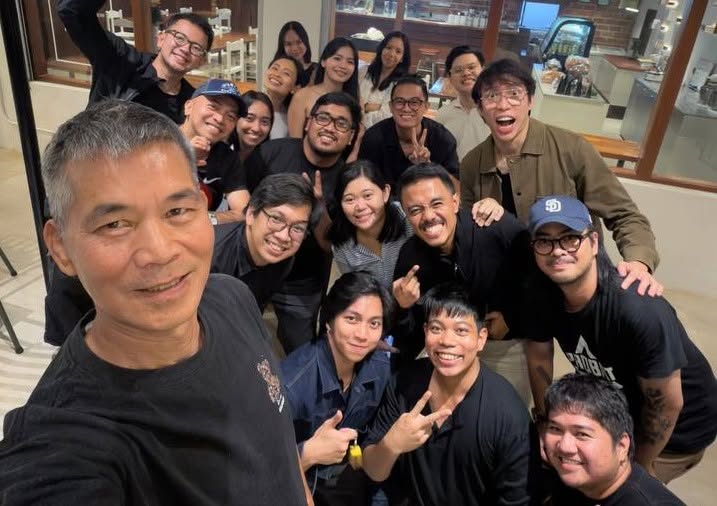 JUBILANT. Fu-Chun ‘Acuii’ Lin with the author and roasters and café owners from across the country before the awarding ceremony. courtesy of Xandro Ysagani Zarate
The first trees died. Then more died. Then entire batches, seedlings starving in the soil. Gesha punishes every lapse the same way. Too little water: dead. Too much sun, too little sun, wind too strong: dead. And his trees grow where attention is hardest to give: to reach them you cross a river, climb a steep mountainside, and walk through forest. He makes that trip to keep a tree alive.
He borrowed from a family in Taiwan to keep going, while neighbors were pulling their own coffee out of the ground. Today, his farm is believed to be the first in the country to grow Green Tip Gesha. I once asked why he never stopped. He answered the way he answers most things, half laughing: “Always patay (dead), always planting. Hope.”
The Garces family
The Garces family planted in a different kind of storm. In 2020, during the COVID-19 pandemic, Lito Garces tasted a Colombian coffee unlike anything he knew, and the question lodged: if that cup could come from Colombian soil, why not ours? He and his wife Gemma planted their first trees in Pangantucan. It began as a family project, a way to stay close when everything else had stopped. There was no buyer waiting, no proof it would work.
Eighteen months later, the trees bore fruit, and the cup was strange in the best way. Locals had called the variety sweet coffee, because next to every other Arabica in the area, it was. Cupped blind, it carried the florality and fruit of an Ethiopian. Samples went to World Coffee Research, and the DNA came back Ethiopian Landrace: wild genetics from the birthplace of Arabica, on a Bukidnon mountainside.
What stays with me is not the awards but the children. This year, Finca de Garces placed first and second in Robusta; fourth went to Granja Alegre, run by their son Bords and his wife Maycee.
In a country whose defining loss is that farmers’ children leave, the Garces children are planting. This season they are even skipping the national competition to help neighboring farmers improve their own farms — the same way others once helped them. For the Garces family, success is not a circle drawn around themselves. It is a radius that keeps expanding.
Manong Boy
Then there is Manong Boy. Wilfredo “Boy” Javier is 74. He has farmed most of his life — lettuce, back when supplying a fast-food giant was the opportunity everyone chased, then 13 years of bell peppers until disease took the crop.
A friend brought him to a coffee farm, and another encouraged him to plant. So he planted, on his land in Baungon, at about 400 meters. His farm, Kape Kumaykay, takes its name from the river that runs through it. Only 200 of his first trees survived.
He grows Liberica, the coffee Filipinos know as barako. Your lola brewed it. For decades, it was dismissed as inferior: too big, too rough, too bitter. But much of what people disliked was never the bean — it was how the bean was treated by an industry built around other varieties.
Handled with care, Liberica turns out to be sweet, spiced, and complex.
Boy’s friends knew the reputation. The fruit’s thick skin fought him through his whole first harvest, and the processing failed every way it can: lots over-fermented, lots dried too wet, lots dried too dry. They told him to switch to something easier. His reasoning was simple: the trees were already in the ground. “Sige gihapon,” he says. He kept going anyway.
At the competition, he won both first and third places in Liberica. The best Liberica in the room came from a smallholder at 400 meters, growing the species everyone had written off. In the cup, his coffee is sweet and floral. Flowers, in the coffee the country called harsh. The disappointment, it turns out, was never in the bean. It was in the expectation.
The same has been true of the farmer. He doesn’t talk about the trophy when you ask. He tells you he is still learning. “I’m a simple person,” he told me, “pero nalipay ko nga nailhan ko ug akong kape.” (But I’m happy that my coffee and I are finally known.)
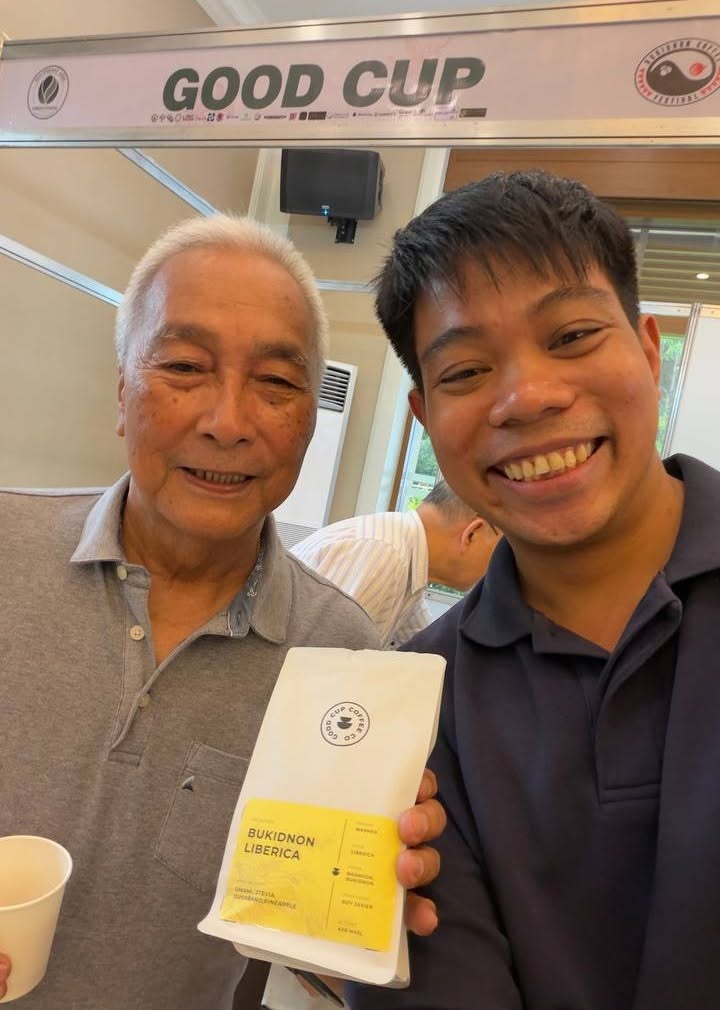 WINNER. Wilfredo ‘Boy’ Javier of Kape Kumaykay farm in Baungon, Bukidnon, poses with his winning Liberica lot. photo courtesy of Xandro Ysagani Zarate
Three farms. Three mountains. Three species. From 400 to 1,700 meters, named on one stage.
Something is changing: green coffee that once sold for ₱72.92 now commonly fetches at least ₱300, and exceptional lots far more. But prices are not the deepest change. The deepest change is that coffee now carries the farmer’s name — on the bag, on the scoresheet, in the silence before the emcee speaks.
The challenges remain — typhoons, instant coffee, an aging generation of farmers — and one competition cannot repair a century. But I keep returning to that room, and to the half-second before each name. I once thought those silences were empty. Now I know they are full: of trees replanted after failure, of money borrowed from family, of a household betting on a mountainside during a pandemic, of a farmer named Boy proving the worth of a bean others had abandoned.
We drink the cup in five minutes. The silence took years. The least we can do is learn the names that fill it. – Rappler.com
Xandro Ysagani Zarate, a Mindanaoan, is the head roaster and R&D lead at Good Cup Coffee Co., a specialty coffee roastery in Cebu. He has worked for years with the Mindanao farms in this story, cupping, scoring, and roasting their harvests season after season. He writes about the people behind Philippine coffee.


You May Also Like

BITCOIN ASIA 2026 ANNOUNCES FIRST WAVE OF SPEAKERS FOR AUGUST HONG KONG EVENT

Eltropy Named to Inc. Regionals Pacific 2026 List of Fastest-Growing Private Companies

Lite Strategy announced $1 million investment in LitecoinVM for smart contract development



