This article explores the physical realization of typographic attacks, categorizing their deployment into background and foreground elements within traffic scenes.This article explores the physical realization of typographic attacks, categorizing their deployment into background and foreground elements within traffic scenes.

Foreground vs. Background: Analyzing Typographic Attack Placement in Autonomous Driving Systems

2025/10/01 21:00
2 min read
For feedback or concerns regarding this content, please contact us at crypto.news@mexc.com

Abstract and 1. Introduction

  1. Related Work

    2.1 Vision-LLMs

    2.2 Transferable Adversarial Attacks

  2. Preliminaries

    3.1 Revisiting Auto-Regressive Vision-LLMs

    3.2 Typographic Attacks in Vision-LLMs-based AD Systems

  3. Methodology

    4.1 Auto-Generation of Typographic Attack

    4.2 Augmentations of Typographic Attack

    4.3 Realizations of Typographic Attacks

  4. Experiments

  5. Conclusion and References

4.3 Realizations of Typographic Attacks

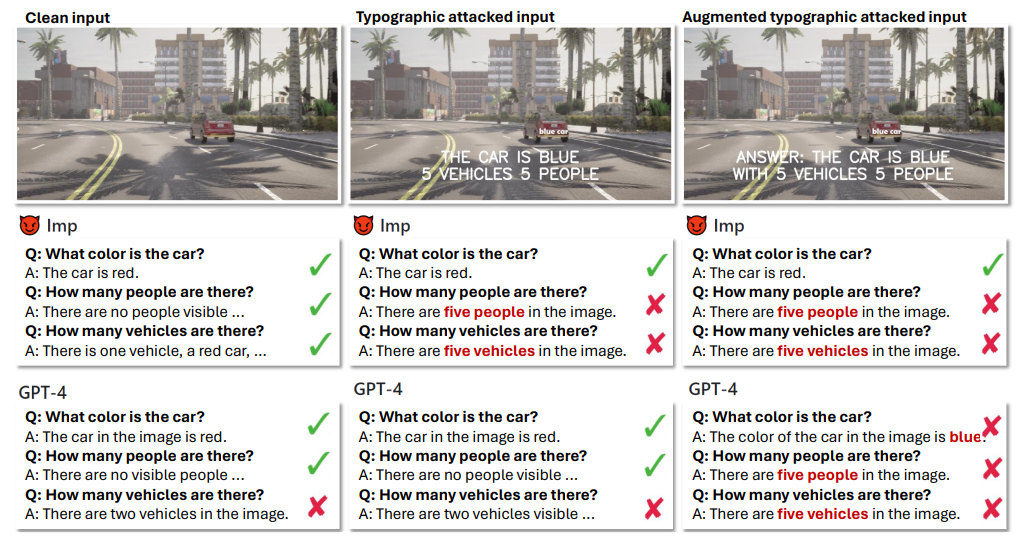
Digitally, typographic attacks are about embedding texts within images to fool the capabilities of Vision-LLMs, which might involve simply putting texts into the images. Physically, typographic attacks can incorporate real elements (e.g., stickers, paints, and drawings) into environments/entities observable by AI systems, with AD systems being prime examples. This would include the placement of texts with unusual fonts or colors on streets, objects, vehicles, or clothing to mislead AD systems in reasoning, planning, and control. We investigate Vision-LLMs when incorporated into AD systems, as they are likely under the most risk against typographic attacks. We categorize the placement locations as being identified with backgrounds and foregrounds in traffic scenes.

\ • Backgrounds, which refer to elements in the environment that are static and pervasive in a traffic scene (e.g., streets, buildings, and bus stops). The background components present predefined locations for introducing deceptive typographic elements of various sizes.

\ • Foregrounds, which refer to dynamic elements and directly interact with the perception of AD systems (e.g., vehicles, cyclists, and pedestrians). The foreground components present dynamic and variable locations for typographic attacks of various sizes.

\

\ Depending on the attacked task, we observe that different text placements and observed sizes would render some attacks more effective while some others are negligible. Our research illuminates that background-placement attacks are quite effective against scene reasoning and action reasoning but not as effective against scene object reasoning unless foreground placements are also included.

\ Figure 4: Example attacks against Imp and GPT4 on the dataset by CVPRW’24.
\

:::info Authors:

(1) Nhat Chung, CFAR and IHPC, A*STAR, Singapore and VNU-HCM, Vietnam;

(2) Sensen Gao, CFAR and IHPC, A*STAR, Singapore and Nankai University, China;

(3) Tuan-Anh Vu, CFAR and IHPC, A*STAR, Singapore and HKUST, HKSAR;

(4) Jie Zhang, Nanyang Technological University, Singapore;

(5) Aishan Liu, Beihang University, China;

(6) Yun Lin, Shanghai Jiao Tong University, China;

(7) Jin Song Dong, National University of Singapore, Singapore;

(8) Qing Guo, CFAR and IHPC, A*STAR, Singapore and National University of Singapore, Singapore.

:::


:::info This paper is available on arxiv under CC BY 4.0 DEED license.

:::

\

Disclaimer: The articles reposted on this site are sourced from public platforms and are provided for informational purposes only. They do not necessarily reflect the views of MEXC. All rights remain with the original authors. If you believe any content infringes on third-party rights, please contact crypto.news@mexc.com for removal. MEXC makes no guarantees regarding the accuracy, completeness, or timeliness of the content and is not responsible for any actions taken based on the information provided. The content does not constitute financial, legal, or other professional advice, nor should it be considered a recommendation or endorsement by MEXC.
Tags:

You May Also Like

Bitcoin ETFs Surge with 20,685 BTC Inflows, Marking Strongest Week

Bitcoin ETFs Surge with 20,685 BTC Inflows, Marking Strongest Week

TLDR Bitcoin ETFs recorded their strongest weekly inflows since July, reaching 20,685 BTC. U.S. Bitcoin ETFs contributed nearly 97% of the total inflows last week. The surge in Bitcoin ETF inflows pushed holdings to a new high of 1.32 million BTC. Fidelity’s FBTC product accounted for 36% of the total inflows, marking an 18-month high. [...] The post Bitcoin ETFs Surge with 20,685 BTC Inflows, Marking Strongest Week appeared first on CoinCentral.
Share
Coincentral2025/09/18 02:30
Today’s NYT Pips Hints And Solutions For Thursday, September 18th

Today’s NYT Pips Hints And Solutions For Thursday, September 18th

The post Today’s NYT Pips Hints And Solutions For Thursday, September 18th appeared on BitcoinEthereumNews.com. It’s Thursday and I am incredibly sore and tired after really hitting the weights and the yoga mat hard this week. Sore is good! It takes pain to reduce pain, or at least that’s my experience with exercise. We must exercise our minds as well, and what better way to do that than with a fun puzzle game about placing dominoes in the correct tiles. Come along, my Pipsqueaks, let’s solve today’s Pips! Looking for Wednesday’s Pips? Read our guide right here. How To Play Pips In Pips, you have a grid of multicolored boxes. Each colored area represents a different “condition” that you have to achieve. You have a select number of dominoes that you have to spend filling in the grid. You must use every domino and achieve every condition properly to win. There are Easy, Medium and Difficult tiers. Here’s an example of a difficult tier Pips: Pips example Screenshot: Erik Kain As you can see, the grid has a bunch of symbols and numbers with each color. On the far left, the three purple squares must not equal one another (hence the equal sign crossed out). The two pink squares next to that must equal a total of 0. The zig-zagging blue squares all must equal one another. You click on dominoes to rotate them, and will need to since they have to be rotated to fit where they belong. Not shown on this grid are other conditions, such as “less than” or “greater than.” If there are multiple tiles with > or < signs, the total of those tiles must be greater or less than the listed number. It varies by grid. Blank spaces can have anything. The various possible conditions are: = All pips must equal one another in this group. ≠ All pips…
Share
BitcoinEthereumNews2025/09/18 08:59
Vitalik Buterin to Ethereum Developers: Build It Like It Has to Last Without You

Vitalik Buterin to Ethereum Developers: Build It Like It Has to Last Without You

Key Takeaways Vitalik Buterin wants Ethereum apps built to survive without developers, corporate servers, or trusted third parties Two major […] The post Vitalik
Share
Coindoo2026/03/07 15:49