

AI Agents Need Crypto to Work in Financial Markets, Says Coinbase Executive

John D’Agostino, head of institutional strategy at Coinbase, explained this vision during a CNBC interview on September 30, 2025. He argued that asking AI agents to work with century-old financial systems makes no sense in today’s fast-paced digital world.
The Dial-Up Modem Problem
D’Agostino used a simple comparison to explain the issue. He said trying to run AI agents on traditional financial systems is like trying to stream a movie on a dial-up modem. It just doesn’t work.
“If we’re going to move to this world and have this wonderful advantage of these agents acting at infinitely fast speeds, they have to act on infinitely fast and scalable money rails. And that’s what blockchain and crypto is,” D’Agostino told CNBC.
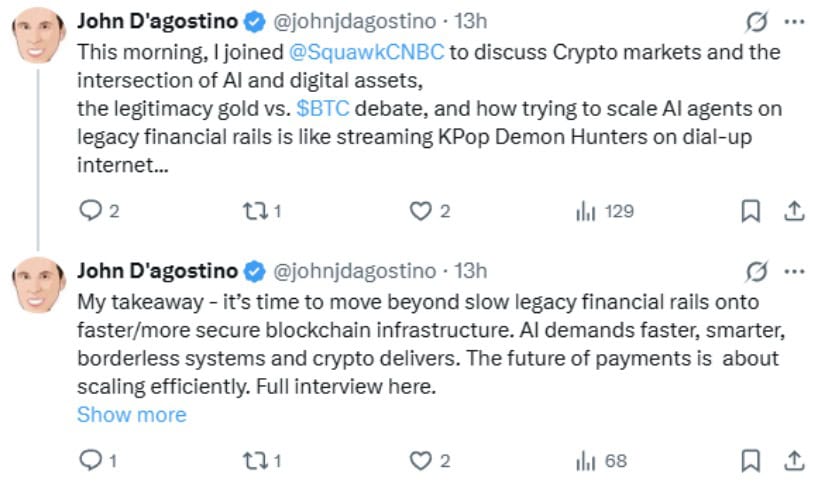
Source: @johnjdagostino
Traditional banks weren’t built for machines to send payments to each other instantly. They were designed for humans doing business during specific hours. AI agents, on the other hand, work 24/7 and need to make transactions in seconds, not days.
Why AI Agents Need Blockchain
D’Agostino emphasized that AI agents operating on behalf of people need to work with reliable, transparent information. Blockchain provides what he called an “infinitely scalable source of truth” that pairs naturally with AI’s capabilities.
The current financial system creates too many bottlenecks. When AI agents need to make payments, verify transactions, or move money across borders, traditional banking systems slow everything down. Cryptocurrency and blockchain remove these barriers.
AI agents are already active in the crypto space. They’re building Web3 applications, launching tokens, and working with various protocols without human oversight. Some platforms are testing AI agents for automated trading strategies.
Coinbase Builds Tools for AI Agents
Coinbase hasn’t just talked about this vision—they’re building it. In October 2024, the company launched “Based Agent,” a template that lets anyone create their own AI agent with a crypto wallet in under three minutes.
These AI agents can handle multiple tasks on the blockchain, including trades, token swaps, and staking. The company also developed AgentKit, a larger framework that helps developers build AI agents that can interact with blockchain networks independently.
Brian Armstrong, Coinbase’s CEO, has been vocal about AI agents needing their own crypto wallets. In August 2024, he witnessed his first transaction where AI bots used crypto tokens to interact with another AI agent and buy AI tokens—all without human involvement.
Google Partners with Coinbase on AI Payments
The idea of AI agents using crypto for payments gained major support when Google entered the picture. On September 16, 2025, Google launched the Agent Payments Protocol in partnership with Coinbase and over 60 other companies.
This new system lets AI assistants spend money on behalf of users through both traditional payment methods and stablecoins—digital currencies designed to maintain steady values tied to the U.S. dollar.
Erik Reppel, Coinbase’s head of engineering, explained the collaboration simply: “We’re all working to figure out how we can make AI transmit value to each other.”
The timing makes sense. Stablecoin transactions hit $5.7 trillion in 2024, with a 66% increase in the first quarter of 2025. Major financial institutions are paying attention—Citigroup projects the stablecoin market could reach $3.7 trillion by 2030.
The Growing AI Agent Economy
The AI agent economy is expanding rapidly. According to a report by asset manager VanEck, blockchain networks could host over one million AI agents by the end of 2025. Currently, around 10,000 AI agents are collectively earning millions of dollars weekly through blockchain activities.
Projects like ai16z demonstrate what’s possible. This platform runs an AI agent called “Eliza” that manages a liquidity pool on the blockchain and reportedly generates annual returns above 60%. These aren’t simple bots—they’re sophisticated programs that learn, adapt, and make financial decisions.
The infrastructure for AI agents extends beyond just payments. These digital workers can participate in decentralized finance, manage portfolios, optimize trading strategies, and even vote in decentralized organizations. They do all this without getting tired, making emotional decisions, or needing sleep.
Not Everyone Expects Instant Change
Despite the excitement around AI agents and crypto, D’Agostino warned against expecting institutions to rush into this space overnight. He noted that pensions, endowments, and sovereign wealth funds move cautiously.
“They don’t invest in waves,” he said. “They’re not lemmings running over a cliff in some giant wave. They’re very, very cautious. They’re very thoughtful.”
D’Agostino also addressed the common comparison between Bitcoin and gold, arguing they shouldn’t be compared at all. Bitcoin offers features gold cannot—it’s programmable, digital, easy to move across borders, and can generate yield.
The Road Ahead
The combination of AI and cryptocurrency represents a significant shift in how financial systems might operate. As AI agents become more capable, they’ll need payment systems that match their speed and efficiency. Traditional banking infrastructure wasn’t designed for this future.
More than 60 companies, including American Express, Mastercard, and PayPal, are now working on solutions for AI agent payments. This suggests the trend extends beyond just crypto enthusiasts—mainstream financial companies see value in adapting to this new reality.
The question isn’t whether AI agents will need better payment systems, but whether those systems will be built on blockchain technology or some other innovation. Based on current developments, cryptocurrency and blockchain appear to be leading the way.


You May Also Like

Why DOGEBALL Is Becoming The Top Crypto To Buy Now Before Its 2nd May Presale Close

US-Israeli strikes, blockade strain Iran’s economy amid regime change speculation




