

Silver Price Prediction: Can the Metal Hold Above $60 as Supply Deficits Clash With Hawkish Fed Risks?

Silver has returned to the spotlight after rebounding toward $66 per ounce, ending a three-day losing streak despite growing uncertainty surrounding US-Iran negotiations and renewed concerns about higher interest rates. The precious metal remains one of the most volatile assets in the commodities market, balancing a persistent structural supply deficit against macroeconomic headwinds that continue to pressure non-yielding assets.
With silver currently trading at $66.35, investors are weighing whether the metal can resume its long-term uptrend or if a stronger US dollar and hawkish Federal Reserve will trigger another leg lower. The debate has intensified as analysts publish dramatically different forecasts, ranging from bearish targets near $44 to bullish projections as high as $150.
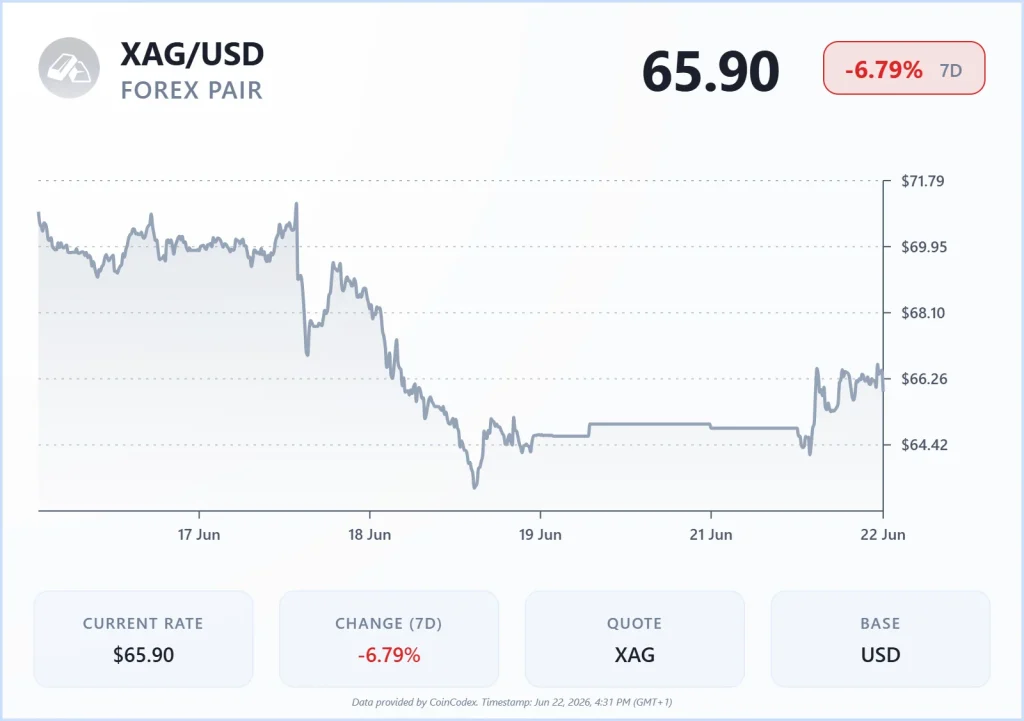
Silver Rebounds as Geopolitical Risks Return
Silver prices recovered toward the $66 level after sentiment surrounding a potential US-Iran agreement deteriorated over the weekend. President Donald Trump warned of direct military action against Iran if Hezbollah continues attacks on Israel, raising doubts about diplomatic progress between Washington and Tehran.
The renewed tensions come at a sensitive moment for commodity markets. Iran’s reported closure of the Strait of Hormuz has reignited concerns about global energy supplies, creating fresh inflation risks that could influence monetary policy expectations.
While geopolitical uncertainty often supports precious metals, silver faces a more complicated backdrop than gold. Rising oil prices can fuel inflation concerns, potentially encouraging the Federal Reserve to maintain restrictive policy settings for longer. Higher interest rates generally strengthen the US dollar and reduce the appeal of non-yielding assets such as silver.
The Federal Reserve’s latest meeting reinforced that challenge. Although policymakers left rates unchanged, the central bank maintained a hawkish stance. Several officials continue to project additional rate increases this year, with financial markets increasingly pricing in the possibility of a hike later in 2026.
That combination of geopolitical uncertainty and restrictive monetary policy has left silver caught between competing forces.
Supply Deficit Supports Long-Term Bullish Outlook
Despite recent volatility, silver’s fundamental backdrop remains supportive. According to the World Silver Survey 2026, the market is expected to record its sixth consecutive annual supply deficit, with demand exceeding supply by approximately 46.3 million ounces.
Even more significant is the longer-term inventory picture. Since 2020, more than 760 million ounces have been removed from above-ground stockpiles, steadily reducing the market’s available buffer against demand shocks.
Silver’s industrial role continues to expand beyond its traditional applications. While solar panel manufacturers have reduced silver usage per cell through efficiency improvements, demand from electric vehicles, grid infrastructure, advanced electronics, and AI-related data center equipment remains strong.
This diversified demand profile has helped offset weakness in individual sectors and reinforces silver’s position as both a precious metal and industrial commodity.
Physical investment demand is also recovering. Forecasts suggest physical silver investment could rise approximately 20% this year to a three-year high of 227 million ounces. Exchange-traded funds have already recorded substantial inflows as investors seek exposure to hard assets amid ongoing concerns about inflation, fiscal sustainability, and geopolitical instability.
However, the same tight market structure that supports the bullish case also increases volatility. Silver’s sharp 44% correction from its record high earlier this year demonstrated that supply deficits alone do not guarantee higher prices.
Thin Inventories Create Potential for Explosive Moves
One of the most important developments in the silver market remains the limited availability of physical metal.
During the second half of 2025, freely available silver in London vaults reportedly fell to historic lows, helping trigger a physical market squeeze that contributed to silver’s surge toward record highs.
When inventories become constrained, price movements can accelerate rapidly in either direction. Rising investment demand can trigger sharp rallies, while macroeconomic pressure can force leveraged investors to exit positions quickly, amplifying downside moves.
Analysts continue to monitor ETF holdings and lease rates closely. Rising lease rates often signal increasing scarcity in the physical market and can provide an early indication of tightening conditions before spot prices respond.
As long as above-ground inventories remain limited, silver may continue experiencing periods of extreme volatility.
CoinCodex Silver Price Prediction
According to the latest CoinCodex silver price prediction, the metal may face additional downside pressure through the remainder of 2026 before stabilizing in 2027.
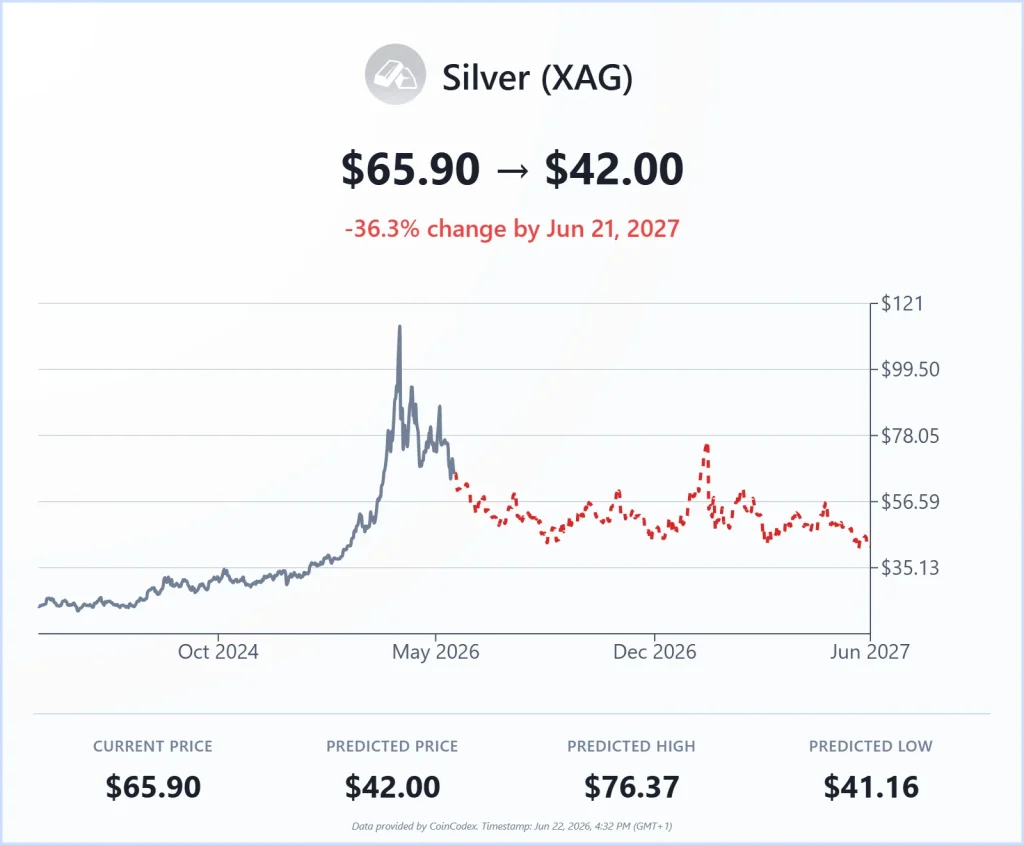
The model projects average silver prices near $62 during June before weakening throughout the second half of the year. Forecasts suggest average prices could decline toward the mid-$50 range in July and August, with the weakest period expected during September when average prices fall toward $47.
October and November show modest stabilization, with average prices recovering into the low-$50 range. However, projections remain cautious through year-end, with December averages hovering near $47 and downside targets extending into the low-$40s.
The forecast becomes more constructive entering 2027. January represents the strongest projected month, with average prices near $58 and upside targets reaching approximately $76. While momentum appears to improve temporarily, the broader model continues to anticipate range-bound trading rather than an immediate return to record highs.


You May Also Like
Critical threshold reached as Bitcoin holds strong above $65,000! What does this mean for investors?
H100 Group shareholders approve acquisition of two firms holding 2,449 BTC

Susquehanna flags SpaceX valuation risk despite $170 target



