

Silver Just Flashed a Major Warning Sign: Is a Bigger Reset Ahead?
Silver spent much of the first half of the year at the center of one of the strongest commodity stories in the market. Tight supply, growing solar demand, AI infrastructure expansion, and electrification projects all helped fuel a powerful rally that pushed silver price above $120 earlier this year.
That optimism has faded considerably over recent months. Silver price has fallen back toward the low $60 region, and some analysts now believe the decline could be sending a broader message about the health of the economy. One of those voices is EndGame Macro, known on X as @onechancefreedm, who recently argued that silver may be warning about weaknesses that are not yet fully visible in headline economic data.
Silver Price Decline May Be Revealing Growing Economic Fragility
EndGame Macro believes the silver price correction is about much more than simple profit taking.
The analyst argues that silver’s rally above $100 included a large speculative premium. Tight supply conditions, ETF demand, persistent deficits, solar installations, and electrification projects all contributed to the rally. Extreme prices also reflected scarcity fears, leverage, and aggressive positioning that pushed the metal beyond levels supported by the real economy.
That premium appears to be disappearing. Silver occupies a unique position because it functions as both a monetary metal and an industrial metal. Gold often responds primarily to monetary conditions. Silver reacts to those same conditions while also responding to industrial demand trends.
That distinction becomes important during periods of economic uncertainty. Recent weakness across technology stocks and semiconductor companies has created fresh concerns about the AI investment cycle. The Nasdaq lost more than 2% during the latest selloff, while the S&P 500 declined more than 1%. South Korea’s KOSPI also came under pressure due to its large exposure to chipmakers.
Those developments matter because AI data centers, semiconductor production, power grid upgrades, and electrification projects became major pillars of the silver demand story.
Questions about future AI profitability naturally create questions about the industrial demand assumptions attached to that narrative.
EndGame Macro also points to a stronger US dollar, elevated Treasury yields, fading expectations for rate cuts, and continued Federal Reserve caution. Those factors typically create a difficult environment for silver because they pressure both monetary demand and industrial demand at the same time.
Industrial demand still accounts for roughly 50% to 60% of total silver demand. Demand has not collapsed, but buyers appear less willing to absorb extremely high prices than they were earlier in the year.
Additional Fundamental Signals Could Push Silver Price Lower
Recent macroeconomic developments present additional challenges for silver. Federal Reserve officials have repeatedly reinforced expectations that interest rates could remain elevated for longer than many investors anticipated. Higher rates increase the opportunity cost of holding non yielding assets such as silver. A stronger dollar also tends to place pressure on commodity prices across global markets.
Geopolitical developments have also altered the outlook. Progress toward a potential US Iran peace agreement has improved confidence surrounding commercial traffic through the Strait of Hormuz. Lower geopolitical tension has eased pressure on energy markets and reduced demand for traditional inflation hedges, including precious metals.
Another factor deserves attention. Periods of stock market weakness often force investors to liquidate positions across multiple asset classes. Precious metals sometimes become a source of liquidity during broader market stress. That process can create additional downward pressure even when long term fundamentals remain intact.
Read Also: Robert Kiyosaki’s Gold and Silver Warning: Price Drop Doesn’t Change His Mind
EndGame Macro notes that physical market conditions remain relatively tight. Mine supply has not suddenly exploded, and recycling activity has not eliminated existing supply deficits. Futures market activity, however, can overwhelm physical fundamentals when leveraged capital begins leaving the market.
Silver Price Support at $61 Remains Critical for What Happens Next
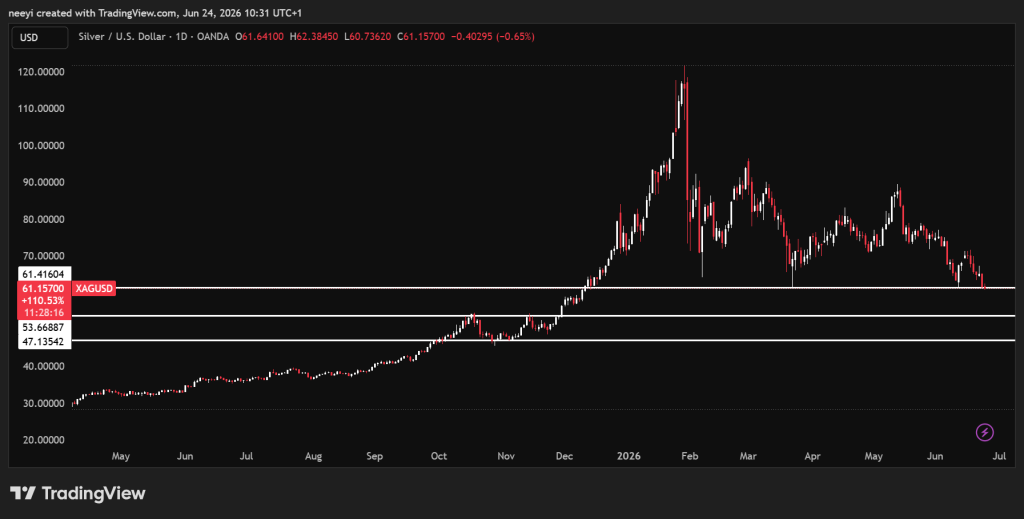
Our latest silver analysis identified the $61 level as one of the most important support zones on the chart.
A look at the silver price structure shows why this area matters so much. Several rebounds have developed from the same region over recent months. Repeated defenses of support often indicate that buyers remain active and willing to absorb selling pressure.
Another successful defense could help stabilize silver price and support a short term recovery after months of weakness. Conditions become considerably more bearish if that support fails.
 Silver Price Chart / TradingView.com
A sustained break below $61 could expose silver to a decline toward $53. Price action beneath $53 would strengthen the bearish outlook significantly and could create conditions for a move closer to $47 during the weeks ahead.
Current market conditions still favor sellers. Silver remains below several important resistance levels, and the broader trend continues pointing lower. A rebound from $61 may provide temporary relief, but that move would still need to overcome multiple resistance zones before the larger correction can be considered complete.
Read Also: Silver Price Prediction: Clive Thompson Says $300-$500 Possible, But Not This Year
A wider market perspective also supports the possibility of additional weakness.
Silver entered this correction after an extraordinary rally that carried prices to record highs earlier this year. Markets rarely travel in one direction indefinitely. Powerful advances are often followed by extended periods of consolidation and retracement before the next major trend emerges.
FAQs
Subscribe to our YouTube channel for daily crypto updates, market insights, and expert analysis.
The post Silver Just Flashed a Major Warning Sign: Is a Bigger Reset Ahead? appeared first on CaptainAltcoin.


You May Also Like

Meta Enters Prediction Markets With New “Arena” App

Top Altcoins to Buy During the Current Crypto Market Crash

CFTC sues Kentucky over Kalshi and Polymarket crackdown, breaking the blue-state-only pattern



