

US Treasury’s $10B scam warning shows why crypto is racing to police itself
On June 23, the US Treasury sanctioned nine individuals and 26 entities linked to the Prince Group transnational criminal organization and proposed expanding its Huione Group rule to include H-Pay Service PLC and any successor entity, tying both actions to Southeast Asia scam networks that cost Americans at least $10 billion in 2024.
OPSeC, announced by the DeFi Education Fund in partnership with Security Alliance (SEAL) and Asymmetric Research, frames itself as the credible internal answer to that convergence.
The same day, OPSeC went public with a pledge to harden the industry's protocols, signing practices, and infrastructure.
In Washington's legislative vocabulary, crypto fraud, DeFi exploits, stablecoin rails, and laundering infrastructure collapse into a single risk category the moment a bill is being drafted.
Treasury described digital asset investment fraud as one of the most common and lucrative schemes run by these operations, and its 2026 National Money Laundering Risk Assessment explicitly flags the sector.
FinCEN described Huione Group as a key node for laundering proceeds from cyber heists and virtual currency investment scams, and policymakers writing broad illicit finance rules have consistently grouped under-secured protocols alongside the scam operators that exploit them.
The coalition's pledge positions operational security as both an engineering discipline and a policy-facing standard.
Its stated workstreams include a shared security resource hub, regular convenings of protocol teams and security firms, and a direct bridge to policy through lawmaker-facing educational events as crypto legislation moves through Congress.
OPSeC is trying to make DeFi's security posture legible to policymakers before those policymakers define it for them.
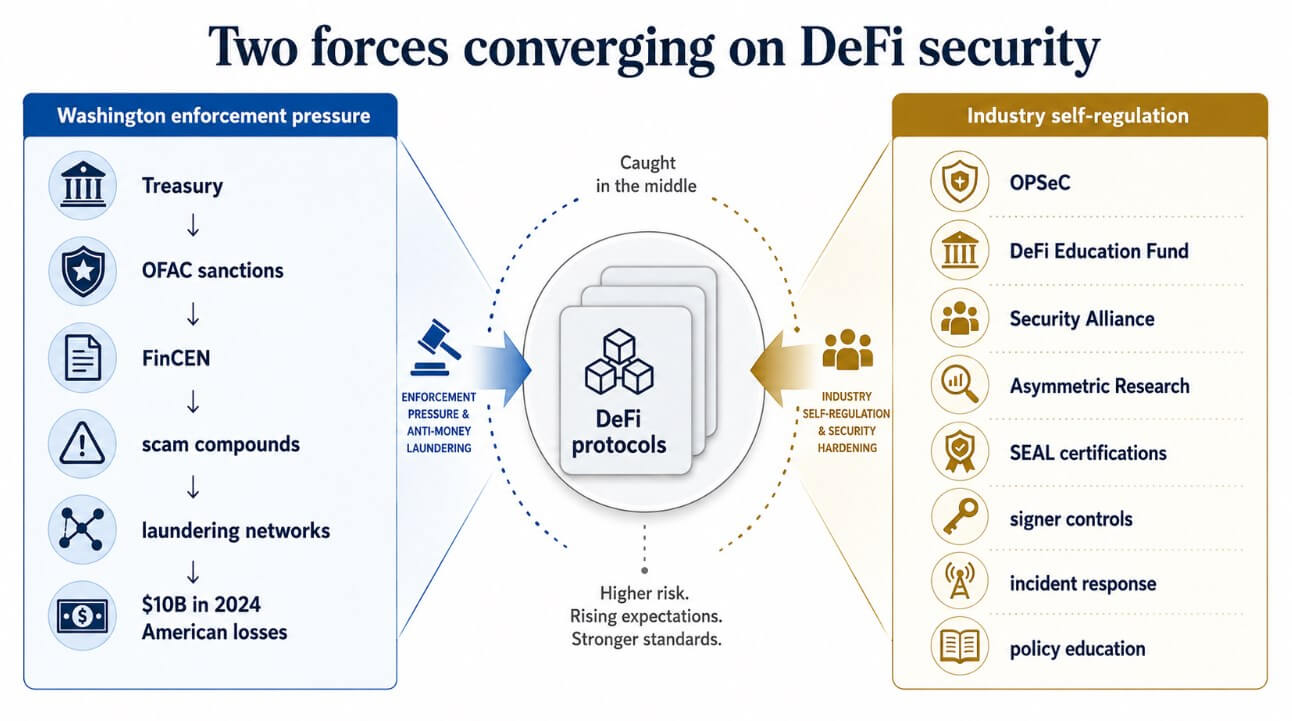 A diagram shows Treasury enforcement actions and industry-led security initiatives converging on DeFi protocols from opposite sides.
The threat model expanded
April 2026 made it harder to argue against a coalition like OPSeC, with nearly $630 million drained across at least 27 reported DeFi exploits, led by Drift and KelpDAO and concentrated in signer, bridge, and infrastructure failure points.
The $285 million Drift Protocol hack, the largest DeFi exploit of 2026, grew out of a six-month social engineering operation that took just 12 minutes to execute once the groundwork was in place.
Attackers attributed with medium-high confidence to the North Korean state-sponsored group UNC4736 attended crypto conferences in person, built genuine professional relationships with Drift contributors, and manipulated real Security Council members into pre-signing hidden authorizations.
A zero-time-lock governance migration three days before the drain eliminated the protocol's last intervention window.
The forensic review identified three intrusion vectors: a malicious code repository cloned by a contributor, a fake TestFlight application, and a VSCode/Cursor vulnerability that executed arbitrary code silently when the repository was opened, all operating entirely outside the scope of smart contract audits.
| Old DeFi security frame | New threat vector | Example from article | Why traditional audits miss it |
|---|---|---|---|
| Smart-contract bugs | Social engineering | Drift attackers built relationships with contributors and council members | Human trust exploitation occurs outside contract logic |
| Smart-contract bugs | Compromised signers | Hidden authorizations were allegedly pre-signed | Valid signatures can execute malicious outcomes |
| Smart-contract bugs | Malicious developer tooling | Fake TestFlight app, malicious repo, VSCode/Cursor execution path | The exploit path begins on contributor devices |
| Smart-contract bugs | Governance/timelock failures | Drift’s zero-timelock migration removed intervention window | Governance configuration is operational architecture |
| Smart-contract bugs | Bridge verifier weakness | KelpDAO’s single-verifier LayerZero bridge route | Cross-chain validation risk sits above individual contract audits |
| Smart-contract bugs | RPC / infrastructure compromise | KelpDAO manipulation of validation logic through infrastructure | Infrastructure trust assumptions are not always audited like code |
TRM Labs attributed roughly $577 million in stolen crypto through April 2026 to North Korean hackers, equivalent to 76% of all global cryptocurrency hack losses in that period, concentrated in just two attacks.
The $292 million KelpDAO breach took a different technical route, exploiting a single-verifier design in a LayerZero bridge by compromising RPC infrastructure and manipulating cross-chain validation logic, but it operated on the same human and infrastructural layer that code audits were never built to reach.
OpenZeppelin’s own analysis argues that recent losses increasingly originate in the operational layers around protocols, including signing infrastructure, governance, cross-chain dependencies, and human controls, rather than contract code alone.
SEAL's certification framework, launched in 2026 through accredited auditors, was built around that breakdown. It evaluates whether a protocol can defend itself, detect incidents, and respond when things go wrong by covering multisig operations, treasury management, incident response, DNS security, DevOps infrastructure, and identity and account controls.
OPSeC's policy function provides a venue for those standards to become legible to legislators rather than remain internal industry infrastructure.
The AI complication
Two credible, opposing readings of DeFi's defensibility have been running through the security community since late May.
On May 26, Manuel Aráoz, co-founder and former CTO of OpenZeppelin, declared that he considers all of DeFi unsafe, citing AI coding agents that are “superhuman at finding vulnerabilities,” and advised friends and family to exit positions in Aave, MakerDAO, and Compound.
He argues that defenders must close every exploitable flaw, while attackers need only one, and that AI agents have made that asymmetry unmanageable by running vulnerability searches in parallel, around the clock, across thousands of contracts simultaneously.
OpenZeppelin's current CEO, Demian Brener, publicly distanced the company from Aráoz's exit thesis, framing AI as a defensive capability alongside an offensive one, and reaffirming the firm's commitment to continuous, AI-augmented security.
OpenZeppelin's own analysis similarly argues that the most significant losses of the past two years increasingly originated in operational layers around protocols, including social engineering, signing infrastructure, governance, and cross-chain dependencies.
AI agents are nonetheless moving the remaining technical attack surface toward attackers, and Aráoz's directional read holds even if his conclusion overstates it.
An AI-accelerated code exploitation environment adds a layer that certification programs covering DNS security and multisig operations cannot close on their own; together, these two framings define the outer boundaries of what OPSeC can and cannot accomplish.
The enforcement test
SEAL Certifications set a deliberately demanding standard of six domains covering multisig governance, treasury architecture, incident response playbooks, DNS registry controls, DevOps infrastructure, and identity management, assessed by accredited auditors and recorded as on-chain attestations.
Most protocols undergoing certification will identify gaps that require remediation before they pass. A certification framework that demands a signer registry, tested incident response drills, and DNS configuration records is an enforceable bar.
OPSeC's value over the next twelve months will be determined by whether that bar gets enforced.
The bull case is that OPSeC connects with SEAL Certifications to build a security-premium market. Protocols demonstrating operational discipline through phishing-resistant signer controls, time-locked governance, 24/7 incident monitoring, and DNS registry locks trade at a lower risk discount than protocols that rely solely on code audits.
Capital follows attestation, and the standard becomes self-enforcing because it becomes economically meaningful.
| Scenario over next 12 months | What would confirm it | Market implication | Policy implication |
|---|---|---|---|
| Bull case: security premium forms | OPSeC signers adopt SEAL-style certification, publish attestations, and remediate gaps | Certified protocols trade at lower risk discounts; capital favors verifiable security | Industry gets evidence that self-regulation can work |
| Base case: coordination improves, but enforcement stays soft | OPSeC becomes a policy and education hub, but compliance data remains limited | Security becomes a narrative differentiator, not a pricing standard | Lawmakers still view DeFi risk through mixed evidence |
| Bear case: pledgeware narrative wins | Another nine-figure signer, bridge, or social-engineering exploit lands before measurable standards emerge | DeFi risk premium widens; BTC and simpler exposures outperform complex protocols | Treasury/FinCEN framing dominates legislative debate |
| Black swan: AI-assisted exploit links to sanctioned laundering rails | Major exploit is tied to state actors, scam-compound infrastructure, or sanctioned payment networks | Broad crypto selloff; exchanges and stablecoin issuers de-risk aggressively | Washington folds DeFi security, AML, and sanctions into one enforcement category |
The bear case is that a fresh nine-figure signer exploit lands before OPSeC produces measurable compliance data, policymakers treat the coalition as pledge language, and the illicit-finance legislative debate hardens around the worst-case assumptions Treasury's June 23 action put back on the table.
The contest is over who defines what “securing DeFi” means: the industry through verifiable operational standards, or Washington through enforcement categories that fold a compromised multisig signer and a scam compound in Cambodia into a single regulatory risk class.
Treasury has stated that it will continue to take aggressive steps against illicit abuse in the digital asset industry. OPSeC's window to answer with evidence is open, and it has a closing time.
The post US Treasury’s $10B scam warning shows why crypto is racing to police itself appeared first on CryptoSlate.


You May Also Like
Web3 Marketing Isn’t Broken -Most Projects Are Using It Wrong

U.S. Manufacturing Activity Surges to 49-Month High, Signaling Strong Economic

Custom Silicon and Scalable Ledgers



