Ateneo Rockwell cats lose longtime shelter; volunteers seek help and answers
For the past two years, Jamie Fournier has spent her mornings feeding community cats around West Block in Rockwell, Makati. She knew them by name. Some waited for her at regular feeding spots, while others became familiar faces to students, guards, and residents.
“They were part of our lives every single day,” she says.
For years, volunteers quietly cared for the community cats that lingered around the Ateneo Professional Schools campus in Rockwell. They fed them twice daily, brought sick animals to veterinarians, organized trap-neuter-vaccinate-return (TNVR) drives, rescued kittens, and raised funds out of their own pockets to manage the colony.
Now, many of those cats are gone.
Some have been adopted into homes. Others are in the process of being relocated. The feeding stations, shelters, cages, and makeshift safe spaces that once stood near the campus have been dismantled.
What remains, according to volunteers, is a lingering question: Why?
A community built around care
Fournier, who runs the Instagram page Cats of West Block Rockwell Makati (@catsofrockwellmakati), began feeding the cats alongside another longtime feeder known as Kuya Roy.
What started as a personal effort grew into a network of residents who pooled resources to care for the animals. Beyond feeding, volunteers rescued kittens, funded veterinary care, and organized sterilization efforts. Earlier this year, they also responded to a parvovirus outbreak that affected several cats in the area.
“We realized it wasn’t enough to just feed them,” Fournier says. “We had to make sure they were healthy and that the population was managed responsibly.”
Many of the cats had lived around Rockwell for years and became familiar to people passing through the area.
 A CAT house found in the tent provided by volunteers.
  PIPER and her kittens before the accident.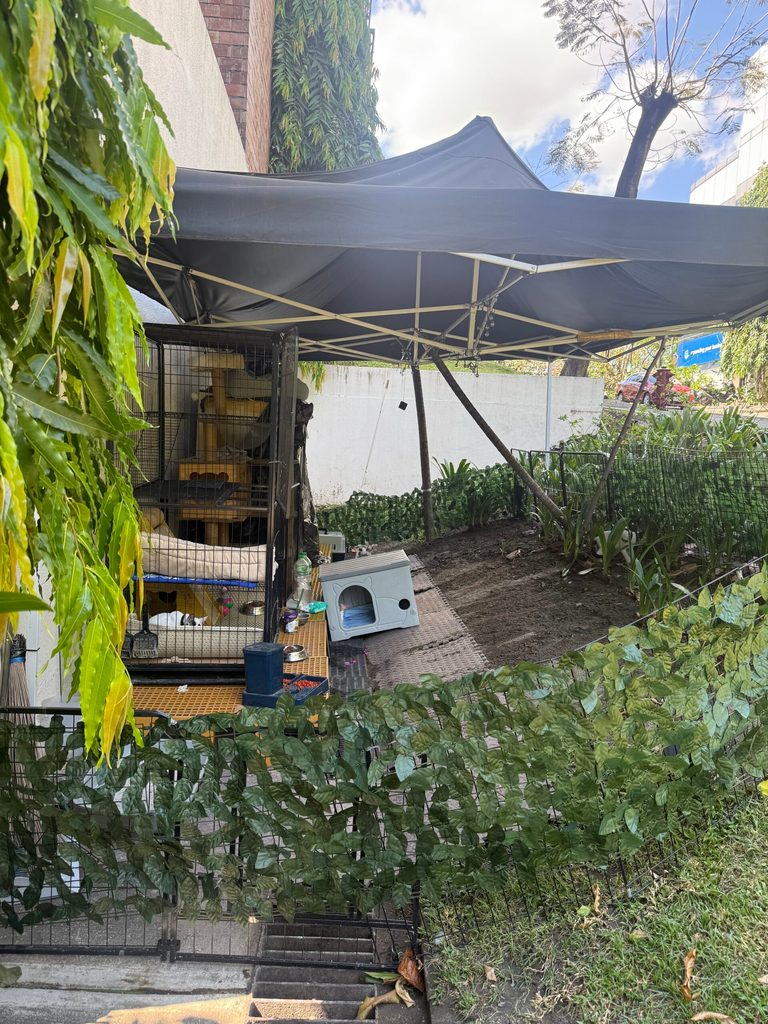
 THE safe space created under the stairs of the Ateneo Professional Schools campus.
  PIPER, one of the cats who stayed in the tent of the Ateneo Law School campus.
  ONE of the Ateneo cats, Piper.
How the conflicts began
Volunteers trace the dispute to August 2025, when they found a community cat named Henry confined in a cage near garbage bins. According to Fournier, the volunteers had received reports about the cat’s whereabouts. It remains unclear who placed Henry in the cage.
The incident led to discussions between residents, animal welfare advocates, and Ateneo representatives. According to volunteers, the meeting, set up by a fellow volunteer, resulted in a compromise: a designated feeding area would be set up outside the building to encourage cats to stay away from campus activity.
The arrangement remained in place for months.
Another turning point came in March 2026, when a community cat named Piper was accidentally run over by a law student, according to volunteers.
Piper survived after receiving veterinary treatment, but the incident raised concerns among volunteers about how community cats were being protected.
Fournier says she repeatedly asked for updates regarding the school’s investigation into the incident, but was told information could not be shared due to data privacy concerns.
“What happened to Piper made us feel like there was no transparency,” she says.
An abrupt directive
On May 18, volunteers attended a meeting with Ateneo representatives to discuss cat management. According to Fournier, the discussion appeared productive. Volunteers even proposed building a more permanent enclosure on the Ateneo Professional Schools campus, near the existing feeding area, for the cats at their own expense.
A week later, however, volunteers received emails from the Campus Safety and Mobility Office directing them to stop feeding cats in designated areas and remove all cat-related structures, including shelters, cages, and feeding stations. The deadline was later extended to June 18.
“It felt like an eviction notice,” Fournier says.
Volunteers say they repeatedly asked what would happen to the cats afterward and whether there was a long-term management plan in place. While neither Ateneo nor Rockwell is specifically required under Philippine law to maintain a community-cat management program, Republic Act 8485, or the Animal Welfare Act of 1998, prohibits cruelty and neglect toward animals. Meanwhile, a 2024 memorandum from the Department of the Interior and Local Government directs local government units to strengthen animal welfare programs and coordinate efforts involving stray and community animals.
Volunteers say that their primary concern was what would happen to the cats once the feeding stations and shelters were removed. They say they sought clarity on who would feed the cats, where they would stay, and whether there was a plan in place to ensure their continued care and welfare after the transition.
According to them, those questions remained unanswered.
Response from Ateneo
Rappler reached out to the Campus Safety and Mobility Office, which said the area had originally been set up by Ateneo management on September 8, 2025, with a blue tent intended exclusively as a feeding station for Ateneo community cats.
The office said that, after the tent was accidentally damaged, volunteer feeders from the Rockwell community installed a replacement black tent around December 2025 to January 2026, and added cat shelters, cages, and other paraphernalia in the same location.
According to the office, Rockwell Estate Management identified the setup as an eyesore within the estate. Ateneo said it took that concern into account as a responsible property owner within the Rockwell community.
The university also said a review later determined that the tent was not being used to feed Ateneo community cats, but instead to support Rockwell community cats.
Ateneo said it originally communicated a June 4 deadline for the removal of the tent and related materials, but extended this to June 18 to allow time for alternative logistical arrangements.
Following an appeal from volunteer feeders, the Campus Safety and Mobility Office said it conducted another inspection on June 17, 2026. During that evaluation, Ateneo said the black tent — along with cat shelters, cages, and related materials — was obstructing the emergency exit of the Ateneo Rockwell campus.
The office said this posed significant safety concerns and did not comply with applicable safety standards, particularly those governing access to emergency egress routes.
‘Work with us through this transition’
For volunteers, the issue goes beyond feeding stations. Many of the cats had already been vaccinated, sterilized, and integrated into a care system maintained by residents.
“It would have helped if Ateneo sought to understand the level of care we have for these community cats,” Fournier says. “It would have been better if they worked with us through this transition rather than just shutting us down and out.”
Despite the setback, volunteers say they remain committed to caring for the remaining cats and finding them homes.
Ateneo, for its part, said university management approved the implementation of the Ateneo Community Cat Program (ACCaP) and the measures needed to support it. These include the designation of authorized feeders, the relocation of feeding activities, the removal of the tent and related paraphernalia, and the decision not to proceed with the proposed cat shelter outside the building.
The university also said all identified Ateneo community cats are registered and have been issued Certificates of Rabies Vaccination by the Veterinary Services Department of Makati City. Ateneo said it is coordinating closely with the department for check-ups, vaccination, and neutering or spaying.
On the question of who feeds the cats now, the university revealed that an administrator has volunteered to act as the designated feeder for the Ateneo community cats. When that person is unavailable, trained security personnel are tasked with continuing feeding duties.
The university also said a designated feeding area has been established on the ground floor garden near the St. Ignatius statue.
Ateneo said it has maintained open communication with volunteer groups from the outset. The office said that during a meeting on May 19, 2026, volunteers were formally presented with the university’s existing Cat Management Policy and informed of concerns raised by Rockwell Estate Management regarding the structures adjacent to the building.
Additionally, the Campus Safety and Mobility Office said that email communication between the parties has continued, and that the groups are coordinating on the adoption of some of the Ateneo Rockwell cats. The university said it remains committed to balancing animal welfare, campus safety, regulatory compliance, and responsible stewardship of its facilities.
The cats who found homes
One bright spot, Fournier says, is the support shown by students and residents. At least 11 cats have already been adopted, while others continue to receive foster care.
“If there’s any silver lining here, it’s the students,” she says. “A lot of them stepped up.”
Students have reported cats needing help, donated supplies, and even opened their homes to rescued animals.
More than a cat issue
For Fournier, the conversation is about more than cats. She believes community animals are part of the neighborhoods they inhabit and deserve humane, long-term management.
“I think people need to be reminded that community cats matter too,” she says. “They’ve been here for years. They’re part of the community.”
As volunteers continue searching for homes for the remaining cats, they say the shelters may be gone, but their responsibility to the animals remains. – Rappler.com
HOW TO HELP
Volunteers are still looking for adopters, foster homes, and donors to support ongoing rescue and veterinary efforts.
For inquiries, visit Cats of West Block Rockwell Makati on Instagram: @catsofrockwellmakati.
You May Also Like

Aurora Ventures launches to target funding gaps for women founders
Between Floors Launches Request-Only Conversation Series for Independent Elevator Contractors

High power costs, corruption scandal to affect PHL role in global supply chain