

Galaxy Lowers CLARITY Act Chances to 50% as Senate Time Tightens
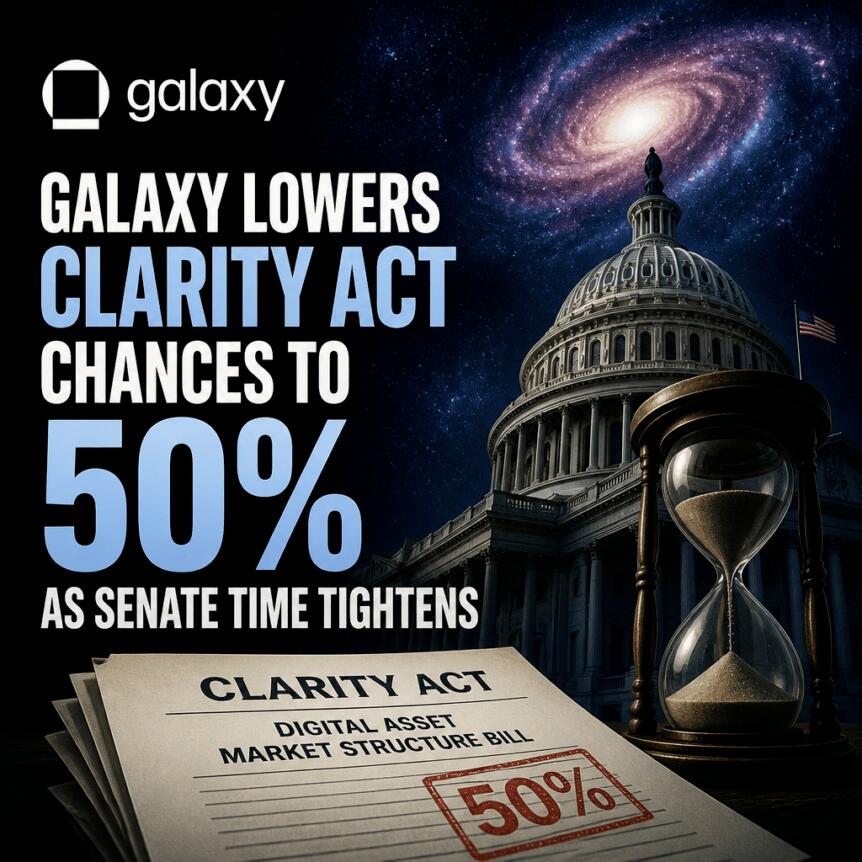
Galaxy Digital has cut its probability estimate for the US Senate passing the CLARITY Act in 2026 to a 50-50 proposition, arguing that lawmakers have less time than before to secure a floor vote before the Senate’s August recess. The adjustment underscores how procedural calendar constraints—rather than broad political debate—may ultimately decide whether the bill reaches the finish line.
Galaxy’s chief firmwide research officer, Alex Thorn, said the downgrade is primarily about timing and Senate logistics, including the absence of a single, unified Senate Banking-Agriculture text and the lack of a set schedule for floor consideration. In a separate comment, Thorn also pointed to intensified competition for agenda time in Washington after President Donald Trump cancelled the signing of a bipartisan housing bill and linked a potential path forward to passage of the SAVE Act.
Key takeaways
- Galaxy Digital now assigns a 50% chance the CLARITY Act will clear the US Senate in 2026, down from 60% (June 9) and 75% (May 22).
- Alex Thorn attributed the latest cut mainly to timing: no unified Senate Banking-Agriculture bill text, no confirmed floor schedule, and a narrowing legislative window before August recess.
- The Senate’s work period runs until July 10, followed by the traditional August recess beginning Aug. 8 and resuming Sept. 14, tightening the window for action.
- Thorn said political and procedural fights elsewhere—particularly debate connected to the SAVE Act—are further crowding the Senate’s legislative queue.
- CLARITY has already cleared the Senate Banking Committee in May, but critics have argued it could allow crypto firms to pay yields on stablecoins without the same constraints as traditional financial institutions.
Galaxy halves the odds, citing Senate timing
In the update shared by Galaxy’s research head, Alex Thorn, the firm reduced its estimate for the CLARITY Act’s passage in 2026 to 50-50. The reasoning is grounded in process: Thorn highlighted that the Senate Banking-Agriculture committee work does not appear to have converged into a single consolidated text, and lawmakers have not established a clear floor timetable.
That uncertainty matters to market participants because the practical path for a major crypto regulatory framework depends on whether a bill can be scheduled for debate and voting when the chamber is already managing a crowded docket. Thorn emphasized that Galaxy’s recalibration concerns the bill’s timeline rather than changes in the underlying policy direction.
The downgrade also arrives after Galaxy previously lowered its estimate in stages. According to Galaxy’s own prior positioning, it cut the odds from 75% to 60% on June 9, after raising them to 75% earlier on May 22.
The legislative calendar is narrowing before the August recess
Thorn’s remarks place the CLARITY Act’s prospects in the context of the Senate’s near-term schedule. The US Senate has entered a work period from Monday until July 10. The chamber is then expected to start its traditional five-week August recess on Aug. 8, returning to Washington on Sept. 14, according to the Senate’s legislative schedule posted at Senate.gov.
With that timeline in mind, Thorn argued that even bipartisan bills can struggle when leadership has to balance multiple items for floor consideration. He said the debate over the SAVE Act has “inject[ed] another contentious, leadership-consuming fight into an already crowded queue,” suggesting that calendar pressure is compounding political complexity.
Thorn also pointed to other “unfinished developments” that could compete for attention, including Section 702 of the Foreign Intelligence Surveillance Act (FISA) and the National Defense Authorization Act (NDAA) for fiscal year 2027, which he characterized as must-pass legislation and a frequent focus of political negotiation. In practical terms, that means CLARITY may need to secure a narrow slot in a pipeline already filled with issues that leadership may treat as higher priority.
House progress and the debate over stablecoin yield rules
The CLARITY Act is designed to create what proponents describe as the first comprehensive US regulatory framework for digital assets. The bill is scheduled for a House hearing on July 17, and it already advanced in the Senate when it cleared the Senate Banking Committee in May.
However, the bill’s political reception has not been uniform. The measure faced criticism from within the debate in the Senate Banking process, with many Democrats and representatives of the banking industry arguing that the legislation could allow crypto firms to offer yields on stablecoins without meeting the same regulatory requirements imposed on traditional financial institutions.
That critique highlights a central tension in US digital-asset policymaking: whether regulators should treat stablecoin-linked financial products similarly to conventional banking and securities activities, or whether the crypto sector’s unique architecture calls for a distinct framework. While the bill has moved past one legislative checkpoint, those substantive concerns could still influence how quickly—or whether—leadership is willing to allocate floor time.
Outside pressure and competing concerns
The CLARITY Act has attracted significant outside engagement, including industry lobbying and law-enforcement concerns that the measure could create oversight gaps.
Earlier in June, more than 200 crypto companies and organizations urged the Senate to pass the CLARITY Act in a letter shared by the crypto lobby group Stand With Crypto, according to earlier coverage at Cointelegraph. Later in June, reporting referenced that a coalition involving law enforcement organizations and Catholic groups reached out to White House officials raising concerns about potential weaknesses in how illicit activity might be supervised under the bill. Earlier coverage at Cointelegraph described those concerns.
While these competing positions do not by themselves determine the bill’s fate, they can affect whether leadership believes a floor vote is politically manageable—particularly when, as Thorn argues, the Senate is already squeezed for time.
For traders and long-term investors, the key question now is whether CLARITY can secure the procedural steps needed for a floor schedule before the Senate’s August recess begins. Galaxy’s revised odds suggest that even a bill with committee momentum may stall if leadership cannot find room in the calendar—so readers should watch closely for any sign of a unified Senate bill text and for whether floor timing becomes more concrete after July 10.
This article was originally published as Galaxy Lowers CLARITY Act Chances to 50% as Senate Time Tightens on Crypto Breaking News – your trusted source for crypto news, Bitcoin news, and blockchain updates.


You May Also Like

Solana Decoupling From Crypto Market as Tokenized Stock Hype Intensifies
Comcast Shares Jump Most Since 2008 On Plans To Separate Units


