Azerbaijan Crypto Regulation Bill Targets Year-End Passage
Azerbaijan Crypto Regulation Bill: What the Draft Law Requires
Should crypto be banned or built into the financial system? Azerbaijan just answered that question.
The Azerbaijan crypto regulation bill has cleared its final drafting stage and is now sitting with government bodies for review. The Central Bank of Azerbaijan confirmed the framework law is complete and expects it to be adopted by the end of 2026. For a country that has operated with no specific digital asset legislation for nearly a decade, that's a meaningful shift from caution to active regulation.
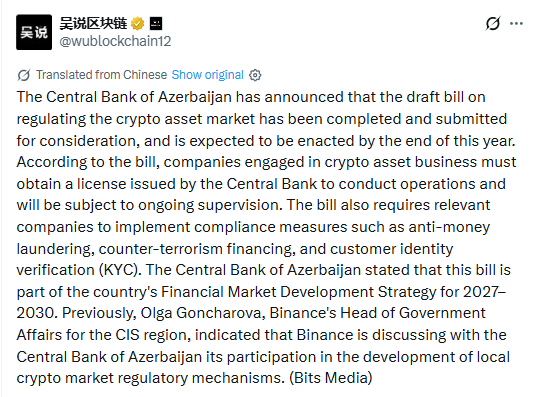 Source: X(formerly Twitter)
Until now, Azerbaijan's approach to digital assets has lived in a legal gray zone — not banned, not formally regulated, and governed only loosely by existing banking and currency laws never written with digital asset in mind. This bill changes that structure entirely.
Azerbaijan Crypto Regulation Bill: What the Draft Law Requires
The Azerbaijan crypto regulation bill introduces a licensing system that didn't exist before. Any company engaged in digital asset business will need a license issued directly by the Central Bank before it can legally operate inside the country.
Licensing isn't a one-time approval under this framework. Once granted, licensed firms fall under ongoing Central Bank supervision — meaning regulators retain continuous oversight rather than issuing a license and stepping back. That structure mirrors how the country already regulates traditional banking and currency exchange businesses, extending the same supervisory model into digital assets for the first time.
Three compliance pillars sit at the center of the Azerbaijan:
-
Anti-money laundering (AML) measures — digital asset firms must build systems to detect and report suspicious financial activity
-
Counter-terrorism financing (CTF) controls — companies must screen transactions to prevent vitual asset from funding illicit activity
-
Customer identity verification (KYC) — platforms must confirm the real identity of users before allowing them to transact
These three requirements are now standard across most regulated digital asset markets globally, and Azerbaijan's bill brings the country in line with that international baseline rather than inventing a unique framework from scratch.
A Central Bank representative confirmed the legislative process is moving as planned, stating that the latest version of the law on virtual assets has already been developed and submitted to government bodies, with adoption expected by year-end if the process proceeds on schedule.
Azerbaijan Crypto Regulation Bill and Binance's Role
The Azerbaijan crypto regulation bill didn't emerge in isolation. Major global exchanges have had a seat at the table during its development.
Binance's regional government affairs leadership has confirmed ongoing discussions with the Central Bank around building local market regulatory mechanisms. That involvement reflects a broader pattern across the wider CIS region, where Binance has positioned itself as a willing technical partner to central banks shaping crypto policy rather than treating regulation purely as an external constraint.
The reasoning behind that approach is straightforward from an industry perspective: clear regulation tends to increase both public confidence in markets and foreign direct investment into the sector, compared to the alternative of leaving the space legally ambiguous indefinitely. Azerbaijan's neighbors have moved on similar timelines — Kazakhstan signed its own cryptocurrency law in January 2026 and launched its first exchange-traded fund just six months later, giving regional regulators a recent, comparable case study to reference.
The Azerbaijan crypto framework sits inside a broader digitalization push at the Central Bank. A sandbox program launched in 2024 has already received 35 applications for new financial products, and regulators are now considering whether to open that sandbox model more broadly. A parallel open banking initiative — which all banks in the country have already joined — aims to let residents manage every financial account from a single app, signaling that digital asset licensing is one piece of a larger financial modernization strategy rather than a standalone policy.
Azerbaijan Crypto Regulation Bill Outlook: What Comes Next
The Azerbaijan crypto regulation bill is explicitly framed as part of the country's Financial Market Development Strategy covering 2027 through 2030 — meaning this legislation is a foundational piece of a much longer regulatory roadmap, not a one-off response to market pressure.
Three things to watch as the framework moves through the remaining legislative steps, based on public statements and assumption basis only — no guaranteed outcomes:
-
Whether the year-end 2026 timeline holds. Government review processes can extend beyond initial regulator expectations, and the Central Bank itself has framed adoption as conditional on the legislative process proceeding as planned.
-
What licensing thresholds and fees get finalized. The current public summary outlines licensing and compliance obligations broadly; the specific capital requirements, application costs, and approval timelines for firms have not yet been published in detail.
-
How quickly exchanges like Binance apply once the law takes effect. Given Binance's documented involvement in shaping the framework, the exchange is positioned to be among the first global platforms to seek formal licensing once the crypto framework becomes law.
All projections are speculative and based on public statements only.
Conclusion
The Azerbaijan crypto regulation bill moves the country from a decade of regulatory silence to a structured licensing and supervision framework, with adoption targeted before the end of 2026. Licensing, AML, CTF, and KYC requirements all point toward a market designed for legitimate, accountable operators rather than continued ambiguity. Watch for the bill's passage through government review — that vote will confirm whether Azerbaijan's digital asset market formally opens for licensed business this year.
YMYL Disclaimer
This article is for informational and educational purposes only. It does not constitute legal, financial, or investment advice. All details regarding the regulation bill are based on publicly available statements from the Central Bank and regional reporting as of June 30, 2026. The bill remains under government review and has not yet been formally adopted into law. Licensing requirements, fees, and exact implementation timelines may change before final passage. Always consult official government sources and a licensed legal adviser before making business or compliance decisions related to digital asset operations in the nation.


You May Also Like

Critical USDT0 Response to Drift Hack Exposes Stark Contrast in Stablecoin Security Protocols

Can Hyperliquid (HYPE) Turn Momentum Into a $70 Breakout? Bulls Face a Big Test