Ethereum (ETH) Price Analysis: New Institutional Push Amid Record Staking Activity
Key Highlights
- New non-profit organization Ethereum Institutional debuts to accelerate institutional ETH adoption
- BitMine, Sharplink, and Ethereum co-founder Joseph Lubin provide funding for the initiative
- Beacon Chain staking deposits surge to unprecedented levels, reducing available liquid supply
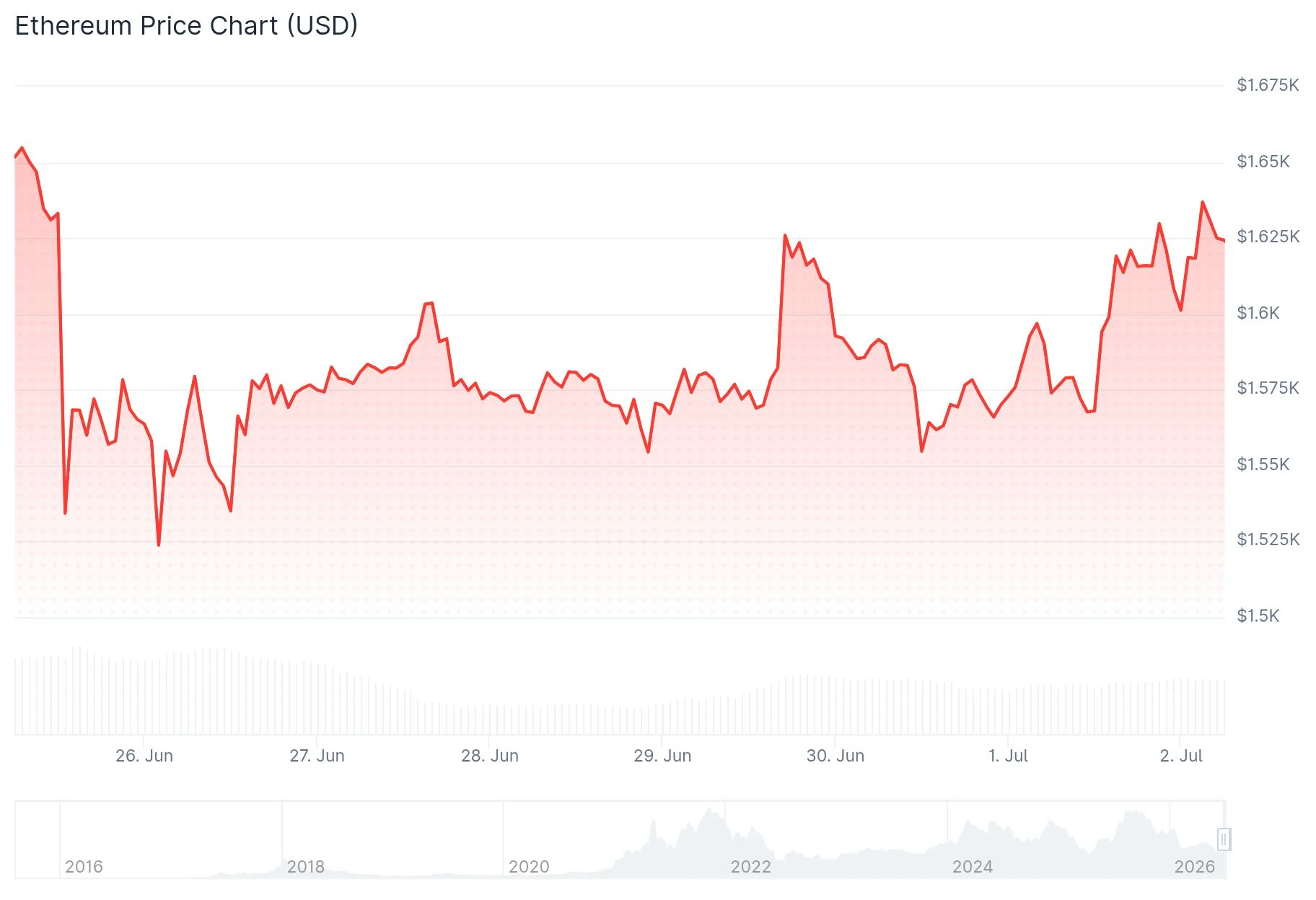
- ETH price action confined to $1,500–$1,610 range, struggling below critical moving average resistance
- Technical analyst Ali Charts identifies $1,100 as crucial historical support with potential targets at $3,000 and $5,000
Ethereum is experiencing renewed institutional interest even as its price continues to face downward pressure. The digital asset is currently confined within a $1,500 to $1,610 trading range, struggling to break through multiple moving average resistance zones.
 Ethereum (ETH) Price
This week marked the debut of Ethereum Institutional, a newly established non-profit organization. The initiative originated from the Enterprise team within the Ethereum Foundation and received financial backing from BitMine and Sharplink—both Bitcoin treasury firms—alongside Ethereum co-founder Joseph Lubin.
The mission of this organization centers on bridging the gap between Ethereum’s ecosystem builders—including developers and infrastructure providers—and traditional financial institutions such as banks and asset management firms. The non-profit operates across five strategic pillars: education initiatives, institutional intelligence gathering, marketing campaigns, industry discovery programs, and event coordination.
This development follows closely behind the recent introduction of Ethlabs, another non-profit entity dedicated to advancing research and development efforts aimed at expanding Ethereum’s institutional capabilities. Both organizations share the same funding sources.
These launches arrive amid a period of significant personnel changes at the Ethereum Foundation. Notable departures include former executive directors Hsiao-Wei Wang and Tomasz Stańczak, along with Tim Beiko and several other key figures. The Foundation has also implemented substantial restructuring, reducing its workforce by 20% and slashing its budget by 40%.
Beacon Chain Staking Reaches Unprecedented Heights
While price performance remains subdued, on-chain metrics paint a more optimistic picture. ETH staking deposits flowing into the Beacon Chain continue their upward trajectory, approaching all-time high levels. Increased staking activity directly translates to reduced liquid supply circulating on exchanges.
This dynamic carries significant implications, as liquid supply represents the most accessible pool for sellers during periods of market volatility. Should demand strengthen while liquid supply remains constrained, any subsequent price recovery could demonstrate greater intensity than typical market movements.
Recent liquidation data reveals ETH generated $100.3 million in total liquidations during a 24-hour trading window. Short position liquidations accounted for $67.2 million of this figure following a 3.5% price increase.
Technical Analysis and Critical Price Zones
Examining the daily timeframe, Ethereum managed to break above a descending trendline in the vicinity of $1,601. Despite this technical achievement, the asset remains trapped beneath its 20-, 50-, and 100-day exponential moving averages, which form a resistance cluster spanning from $1,665 to $1,994.
The Relative Strength Index currently registers approximately 42. Near-term resistance barriers are positioned at $1,665, $1,741, and $1,806. Conversely, support zones beneath the current price level can be found at $1,524 and $1,405.
Cryptocurrency analyst Ali Charts drew attention to the $1,100 price zone as a historically robust support area. In a recent analysis, Ali Charts observed that each test of this level dating back to 2021 has triggered substantial buying pressure. The analyst outlined potential upside objectives, identifying $3,000 as an intermediate target and $5,000 as the upper boundary of Ethereum’s long-term price channel, contingent upon the $1,100 support level maintaining its strength.
ETH was last quoted near $1,610, with the $1,741 resistance level representing the critical short-term milestone for traders to monitor.
The post Ethereum (ETH) Price Analysis: New Institutional Push Amid Record Staking Activity appeared first on Blockonomi.


You May Also Like

Mizuho’s $130 Robinhood Price Target Says Crypto Is Underpriced

China Nabs Another Huione Group Core Member in Cambodia Extradition