Asia’s Hottest Stocks Just Had Their Worst Day of 2026 — Here’s Why
TLDR
- South Korea’s KOSPI fell more than 6% at the open on Thursday, triggering a five-minute trading halt.
- Samsung Electronics and SK Hynix both dropped around 10% after reports suggested AI software advances could reduce demand for chips.
- Japan’s Kioxia fell more than 15%, dragging the Nikkei 225 down over 2%.
- Morningstar raised its fair value estimates for Samsung and SK Hynix, citing strong AI demand and tight supply.
- Analysts expect a memory supply surge over the next two years to cause a downturn in 2029-2030.
South Korea’s stock market was briefly halted on Thursday after heavy losses in chipmaking stocks triggered a circuit breaker at the open. The selloff spread across Asia, hitting major semiconductor names in Japan too.
Why Chip Stocks Fell
The KOSPI dropped more than 6% shortly after opening, triggering a sell-side sidecar that stopped trading for five minutes. Samsung Electronics fell 7.3% and SK Hynix lost nearly 9%.
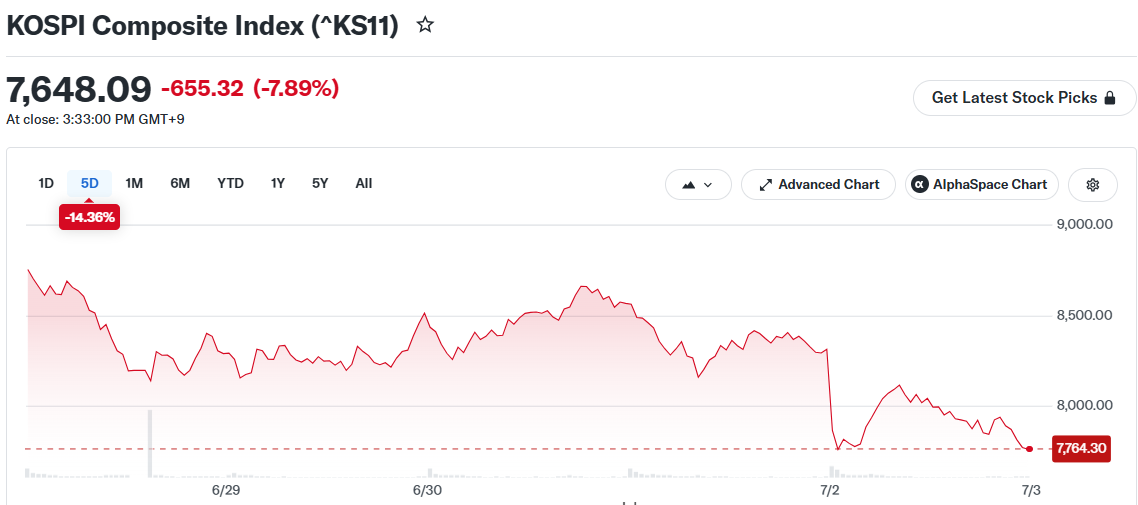 KOSPI Composite Index (^KS11)
The drop came after a report from The Information said OpenAI had developed software that could cut AI inference requirements in half. That raised fears that companies might need fewer chips to run their AI models.
Reports that Meta Platforms plans to sell excess cloud computing capacity also spooked investors. The idea being that companies could squeeze more out of existing hardware instead of buying new chips.
There were also reports that Apple was in talks to buy memory chips from blacklisted Chinese producers, adding pressure to established chip suppliers.
Despite the sharp fall, SK Hynix is still up more than 200% this year. Kioxia, Japan’s most valuable company, has gained around 600%. The KOSPI itself is up nearly 83% in 2026.
Market analyst Fabien Yip of IG said profit-taking appears to be a key driver of Thursday’s move.
What Analysts Are Saying
Despite Thursday’s volatility, Morningstar raised its fair value estimates for both Samsung and SK Hynix on Wednesday.
Morningstar analyst Jing Jie Yu said the current memory upcycle is “tracking substantially stronger than expected,” pointing to tight supply, strong AI demand, and long-term supply agreements.
But Yu also flagged a longer-term concern. He said he expects a large increase in memory supply over the next two years to lead to a downturn in 2029 and 2030, as long-term pricing agreements expire.
Thursday’s selloff is the latest in a series of trading halts on the KOSPI this year. Heavyweight chip stocks have driven big intraday swings in the index throughout 2026.
Yip said volatility is expected to increase further ahead of Thursday’s US nonfarm payrolls report. He also flagged that speculative short positions in the Japanese yen have climbed back to July 2024 levels, which previously triggered a sharp carry-trade unwind.
AI demand remains solid for now, but investors are increasingly asking how long the current chip pricing environment can last.
The post Asia’s Hottest Stocks Just Had Their Worst Day of 2026 — Here’s Why appeared first on CoinCentral.


You May Also Like

ETH Enters High-Stakes Decision Zone

Ethereum is splitting into three power centers and ETH treasury firms are paying for two