

Gold Surges Above $4,100 Amid Rising U.S.-Iran Tensions and Fed Rate Confusion
Key Highlights
- Precious metal rebounded more than 1%, recovering above $4,100 per ounce following a three-session decline
- Fresh military confrontations between Washington and Tehran sparked renewed safe-haven appetite
- Federal Reserve meeting minutes revealed division among policymakers regarding future rate adjustments
- Rising energy costs are fueling inflation concerns that may compel authorities to maintain elevated rates
- Resilient dollar strength and hawkish Federal Reserve rhetoric remain limiting factors for gold’s advance
The yellow metal staged a significant recovery on Thursday, posting gains exceeding 1% after experiencing three consecutive sessions of declines. Spot gold advanced 1.14% to reach $4,123.91 per ounce, while futures contracts for gold increased 1.25% to settle at $4,132.95 per ounce.
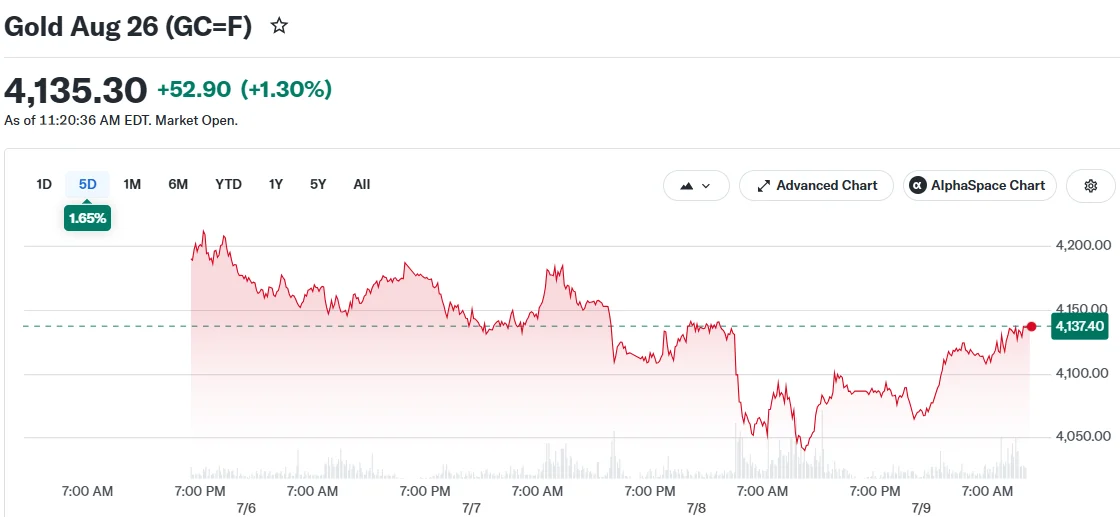 Gold Aug 26 (GC=F)
The recovery emerged as market participants returned to the precious metal seeking protection following another round of military confrontations between Washington and Tehran.
Middle East Military Tensions Fuel Safe-Haven Buying
Washington conducted additional military operations against Iran on Thursday, coming just hours after President Donald Trump announced the breakdown of ceasefire negotiations with Tehran. Hostilities between the two nations have been intensifying since late February when the confrontation initially erupted.
Tehran’s armed forces retaliated with strikes targeting what Iranian officials identified as American military installations in Kuwait and Bahrain. The Islamic Revolutionary Guards Corps issued warnings of additional attacks against American military facilities throughout the Gulf region should Washington persist with its offensive operations.
These recent developments have caused significant disruption in energy markets. Iranian strikes on vessels attempting transit through the Strait of Hormuz pushed crude oil prices upward, subsequently amplifying concerns regarding energy-related inflation pressures.
Higher oil prices complicate the Federal Reserve’s ability to implement interest rate reductions. This creates a challenging environment for gold, as reduced rates typically favor the non-interest-bearing asset while elevated rates diminish its attractiveness.
Federal Reserve Minutes Reveal Policy Division
Documentation from the Federal Reserve’s June policy meeting provided markets with additional considerations. Officials demonstrated disagreement regarding the necessity of further interest rate increases, offering some encouragement to bullion markets.
The prospect that rate increases might be suspended later this year helped improve sentiment surrounding the precious metal. Reduced borrowing costs decrease the opportunity cost associated with holding gold, which generates no yield.
However, the same documentation also revealed that Fed policymakers are becoming increasingly troubled by continuing inflation pressures. American price increases have remained substantially above the central bank’s 2% objective since the confrontation with Iran commenced.
The U.S. dollar remained relatively unchanged at 100.98 on Thursday but continues hovering near 13-month peaks achieved in June. A robust dollar can make gold more costly for international buyers using alternative currencies, which typically constrains demand.
Gold had faced downward pressure earlier during the week as the dollar gained strength on inflation anxieties connected to the conflict. Thursday’s rally pushed gold back above the $4,100 threshold after Wednesday’s decline drove it beneath that benchmark.
The post Gold Surges Above $4,100 Amid Rising U.S.-Iran Tensions and Fed Rate Confusion appeared first on Blockonomi.


You May Also Like

Vertiport Infrastructure, Not Aircraft Certification, Seen as Primary Barrier to eVTOL Deployment

Solana (SOL) FUD Hits 2026 High: Why It Could Be a Bullish Twist

British Pound Recovery Tests Key Resistance Against US Dollar, Scotiabank Says



