The post Bank of England governor sees potential in stablecoins appeared on BitcoinEthereumNews.com. Homepage > News > Finance > Bank of England governor sees potential in stablecoins Bank of England (BoE) Governor Andrew Bailey has said he recognizes the potential of stablecoins for payment system innovation and to reduce the United Kingdom’s reliance on commercial banks, as long as the digital assets satisfy the conditions for public trust. In an article written for the Financial Times, Bailey said that it “should be possible to have innovation in the form of money” and that “it would therefore be wrong to be against stablecoins as a matter of principle.” The BoE governor also said he recognized stablecoin’s potential for “driving innovation in payments systems both at home and across borders.” When talking about the potential of stablecoins, Bailey said his focus was on using them like traditional currency, i.e., “at scale for payments and settlement in the real economy.” This contrasts with their main use today, as a way to enter and exit digital asset markets. For this reason, digital assets not pegged to a fiat currency, such as Bitcoin and Ethereum, do not meet his definition of money. Bailey’s apparent enthusiasm for using stablecoins at scale for day-to-day settlements in the real economy demonstrates a departure from previous BoE thinking on stablecoins. Specifically, in a November 2023 discussion paper, the bank proposed setting individual caps on digital pounds between £10,000 ($13,472) and £20,000 ($26,944), while asking for feedback on a possible lower limit of £5,000 ($6,736). Such limits would make scaling up a British pound denominated stablecoin for everyday use extremely difficult, if not completely unworkable. The BoE governor’s comments this week suggest that this may have been a point well made in the consultation feedback. However, while Bailey may have indicated a U-turn from the bank on stablecoins, he was also keen to… The post Bank of England governor sees potential in stablecoins appeared on BitcoinEthereumNews.com. Homepage > News > Finance > Bank of England governor sees potential in stablecoins Bank of England (BoE) Governor Andrew Bailey has said he recognizes the potential of stablecoins for payment system innovation and to reduce the United Kingdom’s reliance on commercial banks, as long as the digital assets satisfy the conditions for public trust. In an article written for the Financial Times, Bailey said that it “should be possible to have innovation in the form of money” and that “it would therefore be wrong to be against stablecoins as a matter of principle.” The BoE governor also said he recognized stablecoin’s potential for “driving innovation in payments systems both at home and across borders.” When talking about the potential of stablecoins, Bailey said his focus was on using them like traditional currency, i.e., “at scale for payments and settlement in the real economy.” This contrasts with their main use today, as a way to enter and exit digital asset markets. For this reason, digital assets not pegged to a fiat currency, such as Bitcoin and Ethereum, do not meet his definition of money. Bailey’s apparent enthusiasm for using stablecoins at scale for day-to-day settlements in the real economy demonstrates a departure from previous BoE thinking on stablecoins. Specifically, in a November 2023 discussion paper, the bank proposed setting individual caps on digital pounds between £10,000 ($13,472) and £20,000 ($26,944), while asking for feedback on a possible lower limit of £5,000 ($6,736). Such limits would make scaling up a British pound denominated stablecoin for everyday use extremely difficult, if not completely unworkable. The BoE governor’s comments this week suggest that this may have been a point well made in the consultation feedback. However, while Bailey may have indicated a U-turn from the bank on stablecoins, he was also keen to…

Bank of England governor sees potential in stablecoins

Bank of England (BoE) Governor Andrew Bailey has said he recognizes the potential of stablecoins for payment system innovation and to reduce the United Kingdom’s reliance on commercial banks, as long as the digital assets satisfy the conditions for public trust.

In an article written for the Financial Times, Bailey said that it “should be possible to have innovation in the form of money” and that “it would therefore be wrong to be against stablecoins as a matter of principle.”

The BoE governor also said he recognized stablecoin’s potential for “driving innovation in payments systems both at home and across borders.”

When talking about the potential of stablecoins, Bailey said his focus was on using them like traditional currency, i.e., “at scale for payments and settlement in the real economy.” This contrasts with their main use today, as a way to enter and exit digital asset markets. For this reason, digital assets not pegged to a fiat currency, such as Bitcoin and Ethereum, do not meet his definition of money.

Bailey’s apparent enthusiasm for using stablecoins at scale for day-to-day settlements in the real economy demonstrates a departure from previous BoE thinking on stablecoins.

Specifically, in a November 2023 discussion paper, the bank proposed setting individual caps on digital pounds between £10,000 ($13,472) and £20,000 ($26,944), while asking for feedback on a possible lower limit of £5,000 ($6,736).

Such limits would make scaling up a British pound denominated stablecoin for everyday use extremely difficult, if not completely unworkable. The BoE governor’s comments this week suggest that this may have been a point well made in the consultation feedback.

However, while Bailey may have indicated a U-turn from the bank on stablecoins, he was also keen to emphasize that “trust in money is critical to economies.” Therefore, it is critical that any stablecoins satisfy the conditions that enable public trust in money.

Trust in money

Bailey said that for stablecoins to be trusted, they would need to satisfy three criteria.

First, the backing assets should be “free of financial risk in terms of credit, interest and exchange rate.” This ensures that the value of a coin truly can be stable.

Second, even if the backing of the asset could be relied upon, there would remain ‘operational risks,’ for instance, in the case of a successful cyberattack. Thus, trust in stablecoins would also require an insurance scheme (as with bank deposits), and a statutory resolution arrangement that would ensures the holders are “preferred creditors,” i.e. the first in line to be paid in a bankruptcy or insolvency.

Finally, Bailey argued that the terms of exchange of stablecoins must be “known, consistent and enduring.” In other words, they must be the same for all holders (one person’s stablecoin should always be worth exactly the same as anyone else’s); must be “direct into other forms of money” (easily convertible); and not dependent on a digital asset exchange and its terms of business.

“As presently set up, not all stablecoins satisfy this condition,” said Bailey.

With these three factors in place — solid backing/reserve assets, insurance schemes, and clear, consistent exchange — stablecoins could be trusted by the public enough to become a widely used form of money.

If such stablecoins could be trusted, then Bailey would see further benefits in adopting the technology.

Back to the top ↑

Reducing reliance on banks

The BoE governor noted that another issue raised by stablecoins becoming more integrated into the financial system would be reducing the reliance and dependence on banks, whose lending and credit activities add an element of risk to traditional money.

“Through banks, the system has combined the holding of money with the provision of credit, meaning that deposits directly support lending that underpins economic activity. This has come to be known as fractional reserve banking,” explained Bailey. “In other words, most of the assets backing commercial bank money are not risk free: they are loans to individuals and to companies.”

As previously outlined, trust in money is essential, with one of the three key factors in maintaining that trust being that the money is supported by risk-free assets. The fact that, through lending, banks introduce an element of risk into their reserves/asset backing has meant regulation has had to pick up the slack to ensure trust. One example of this is mandated deposit insurance.

Bailey suggested that the system does not have to be organized like this: “It is possible, at least partially, to separate money from credit provision, with banks and stablecoins coexisting and non-banks carrying out more of the credit provision role.”

However, he also cautioned that “it is important to consider the implications of such a change thoroughly before going ahead.”

Back to the top ↑

Consultation paper

Bailey’s FT article was timed to precede the BoE’s publication of a consultation paper on the U.K.’s systemic stablecoin regime.

According to Bailey, the regime would apply to stablecoins used on a large scale as money (for everyday payments) and consider what standards they would need to meet.

“We will set out that widely used UK stablecoins should have access to accounts at the BoE in order to reinforce their status as money,” he said. “This will be a critical part of creating an advanced regime for stablecoins, one that ensures the U.K. can reap the benefits while maintaining a stable financial system.”

Stablecoins holding accounts at the BoE would go some way toward the bank’s goal of tokenizing deposits, rather than issuing stablecoins itself.

Bailey didn’t give an exact date for the consultation, other than to say it would be published in the coming months.

Back to the top ↑

Watch: Richard Baker on engineering a smarter financial world with blockchain

title=”YouTube video player” frameborder=”0″ allow=”accelerometer; autoplay; clipboard-write; encrypted-media; gyroscope; picture-in-picture; web-share” referrerpolicy=”strict-origin-when-cross-origin” allowfullscreen=””>

Source: https://coingeek.com/bank-of-england-governor-sees-potential-in-stablecoins/

Market Opportunity
Lorenzo Protocol Logo
Lorenzo Protocol Price(BANK)
$0.02959
$0.02959$0.02959
+0.03%
USD
Lorenzo Protocol (BANK) Live Price Chart
Disclaimer: The articles reposted on this site are sourced from public platforms and are provided for informational purposes only. They do not necessarily reflect the views of MEXC. All rights remain with the original authors. If you believe any content infringes on third-party rights, please contact service@support.mexc.com for removal. MEXC makes no guarantees regarding the accuracy, completeness, or timeliness of the content and is not responsible for any actions taken based on the information provided. The content does not constitute financial, legal, or other professional advice, nor should it be considered a recommendation or endorsement by MEXC.

You May Also Like

Young Republicans were more proud to be American under Obama than under Trump: data analyst

Young Republicans were more proud to be American under Obama than under Trump: data analyst

CNN data analyst Harry Enten sorts through revealing polls and surveys of American attitudes, looking for shifts, and his latest finding is an indictment of President
Share
Alternet2026/02/10 22:18
Vitalik Buterin Outlines Ethereum’s AI Framework, Pushes Back Against Solana’s Acceleration Thesis

Vitalik Buterin Outlines Ethereum’s AI Framework, Pushes Back Against Solana’s Acceleration Thesis

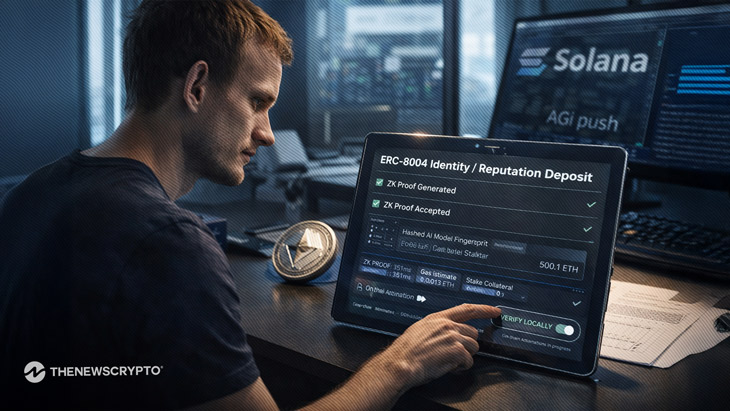
Ethereum co-founder Vitalik Buterin has reacted to Solana’s artificial general intelligence acceleration initiative. He did this through the establishment of his
Share
Thenewscrypto2026/02/10 18:40
Vitalik Buterin Reveals Ethereum’s Bold Plan to Stay Quantum-Secure and Simple!

Vitalik Buterin Reveals Ethereum’s Bold Plan to Stay Quantum-Secure and Simple!

Buterin unveils Ethereum’s strategy to tackle quantum security challenges ahead. Ethereum focuses on simplifying architecture while boosting security for users. Ethereum’s market stability grows as Buterin’s roadmap gains investor confidence. Ethereum founder Vitalik Buterin has unveiled his long-term vision for the blockchain, focusing on making Ethereum quantum-secure while maintaining its simplicity for users. Buterin presented his roadmap at the Japanese Developer Conference, and splits the future of Ethereum into three phases: short-term, mid-term, and long-term. Buterin’s most ambitious goal for Ethereum is to safeguard the blockchain against the threats posed by quantum computing.  The danger of such future developments is that the future may call into question the cryptographic security of most blockchain systems, and Ethereum will be able to remain ahead thanks to more sophisticated mathematical techniques to ensure the safety and integrity of its protocols. Buterin is committed to ensuring that Ethereum evolves in a way that not only meets today’s security challenges but also prepares for the unknowns of tomorrow. Also Read: Ethereum Giant The Ether Machine Takes Major Step Toward Going Public! However, in spite of such high ambitions, Buterin insisted that Ethereum also needed to simplify its architecture. An important aspect of this vision is to remove unnecessary complexity and make Ethereum more accessible and maintainable without losing its strong security capabilities. Security and simplicity form the core of Buterin’s strategy, as they guarantee that the users of Ethereum experience both security and smooth processes. Focus on Speed and Efficiency in the Short-Term In the short term, Buterin aims to enhance Ethereum’s transaction efficiency, a crucial step toward improving scalability and reducing transaction costs. These advantages are attributed to the fact that, within the mid-term, Ethereum is planning to enhance the speed of transactions in layer-2 networks. According to Butterin, this is part of Ethereum’s expansion, particularly because there is still more need to use blockchain technology to date. The other important aspect of Ethereum’s development is the layer-2 solutions. Buterin supports an approach in which the layer-2 networks are dependent on layer-1 to perform some essential tasks like data security, proof, and censorship resistance. This will enable the layer-2 systems of Ethereum to be concerned with verifying and sequencing transactions, which will improve the overall speed and efficiency of the network. Ethereum’s Market Stability Reflects Confidence in Long-Term Strategy Ethereum’s market performance has remained solid, with the cryptocurrency holding steady above $4,000. Currently priced at $4,492.15, Ethereum has experienced a slight 0.93% increase over the last 24 hours, while its trading volume surged by 8.72%, reaching $34.14 billion. These figures point to growing investor confidence in Ethereum’s long-term vision. The crypto community remains optimistic about Ethereum’s future, with many predicting the price could rise to $5,500 by mid-October. Buterin’s clear, forward-thinking strategy continues to build trust in Ethereum as one of the most secure and scalable blockchain platforms in the market. Also Read: Whales Dump 200 Million XRP in Just 2 Weeks – Is XRP’s Price on the Verge of Collapse? The post Vitalik Buterin Reveals Ethereum’s Bold Plan to Stay Quantum-Secure and Simple! appeared first on 36Crypto.
Share
Coinstats2025/09/18 01:22