The post Grayscale Turns Ethereum ETFs Into Staking Machines appeared on BitcoinEthereumNews.com. Grayscale, the world’s largest digital asset investment platform, has taken a big step toward reshaping crypto investment in traditional markets. The firm has enabled staking for its U.S.-listed Ethereum Trust ETF (ETHE) and Ethereum Mini Trust ETF (ETH), making them the first spot crypto exchange-traded products (ETPs) in the country to do so. Alongside Ethereum, Grayscale’s Solana Trust (GSOL) has also activated staking, opening a rare pathway for traditional brokerage investors to gain rewards from Solana without holding tokens directly. What Did Grayscale Announce? Grayscale confirmed that both ETHE and ETH ETFs now support staking, which allows investors to earn network rewards while maintaining exposure to Ether through regulated market structures. Meanwhile, GSOL, currently a closed-end fund quoted on OTC Markets, has also begun staking its holdings. Pending regulatory approval, GSOL could become one of the first spot Solana ETPs with staking enabled. Why Is This Important for Investors? Ethereum Staking allows investors to earn passive rewards by helping secure blockchain networks like Ethereum and Solana. Until now, this was mostly available to crypto-native users managing their own wallets and validators. By integrating staking into ETFs and trusts, Grayscale bridges the gap, letting traditional market participants benefit from blockchain economics without leaving their brokerage accounts. How Will the Staking Work? Grayscale clarified that Ethereum staking will be handled passively through institutional custodians and validator partners. This means investors don’t need to run nodes or handle technical operations. The setup not only ensures participation in network security but also reduces risks associated with self-custody, making the process more accessible for mainstream investors. Risks and Considerations Grayscale noted that ETHE and ETH are not registered under the Investment Company Act of 1940, which means they lack certain protections that traditional ETFs and mutual funds provide. Investments still carry high risk, including the… The post Grayscale Turns Ethereum ETFs Into Staking Machines appeared on BitcoinEthereumNews.com. Grayscale, the world’s largest digital asset investment platform, has taken a big step toward reshaping crypto investment in traditional markets. The firm has enabled staking for its U.S.-listed Ethereum Trust ETF (ETHE) and Ethereum Mini Trust ETF (ETH), making them the first spot crypto exchange-traded products (ETPs) in the country to do so. Alongside Ethereum, Grayscale’s Solana Trust (GSOL) has also activated staking, opening a rare pathway for traditional brokerage investors to gain rewards from Solana without holding tokens directly. What Did Grayscale Announce? Grayscale confirmed that both ETHE and ETH ETFs now support staking, which allows investors to earn network rewards while maintaining exposure to Ether through regulated market structures. Meanwhile, GSOL, currently a closed-end fund quoted on OTC Markets, has also begun staking its holdings. Pending regulatory approval, GSOL could become one of the first spot Solana ETPs with staking enabled. Why Is This Important for Investors? Ethereum Staking allows investors to earn passive rewards by helping secure blockchain networks like Ethereum and Solana. Until now, this was mostly available to crypto-native users managing their own wallets and validators. By integrating staking into ETFs and trusts, Grayscale bridges the gap, letting traditional market participants benefit from blockchain economics without leaving their brokerage accounts. How Will the Staking Work? Grayscale clarified that Ethereum staking will be handled passively through institutional custodians and validator partners. This means investors don’t need to run nodes or handle technical operations. The setup not only ensures participation in network security but also reduces risks associated with self-custody, making the process more accessible for mainstream investors. Risks and Considerations Grayscale noted that ETHE and ETH are not registered under the Investment Company Act of 1940, which means they lack certain protections that traditional ETFs and mutual funds provide. Investments still carry high risk, including the…

Grayscale Turns Ethereum ETFs Into Staking Machines

Grayscale, the world’s largest digital asset investment platform, has taken a big step toward reshaping crypto investment in traditional markets. The firm has enabled staking for its U.S.-listed Ethereum Trust ETF (ETHE) and Ethereum Mini Trust ETF (ETH), making them the first spot crypto exchange-traded products (ETPs) in the country to do so. Alongside Ethereum, Grayscale’s Solana Trust (GSOL) has also activated staking, opening a rare pathway for traditional brokerage investors to gain rewards from Solana without holding tokens directly.

What Did Grayscale Announce?

Grayscale confirmed that both ETHE and ETH ETFs now support staking, which allows investors to earn network rewards while maintaining exposure to Ether through regulated market structures. Meanwhile, GSOL, currently a closed-end fund quoted on OTC Markets, has also begun staking its holdings. Pending regulatory approval, GSOL could become one of the first spot Solana ETPs with staking enabled.

Why Is This Important for Investors?

Ethereum Staking allows investors to earn passive rewards by helping secure blockchain networks like Ethereum and Solana. Until now, this was mostly available to crypto-native users managing their own wallets and validators. By integrating staking into ETFs and trusts, Grayscale bridges the gap, letting traditional market participants benefit from blockchain economics without leaving their brokerage accounts.

How Will the Staking Work?

Grayscale clarified that Ethereum staking will be handled passively through institutional custodians and validator partners. This means investors don’t need to run nodes or handle technical operations. The setup not only ensures participation in network security but also reduces risks associated with self-custody, making the process more accessible for mainstream investors.

Risks and Considerations

Grayscale noted that ETHE and ETH are not registered under the Investment Company Act of 1940, which means they lack certain protections that traditional ETFs and mutual funds provide. Investments still carry high risk, including the possibility of loss of principal. GSOL, on the other hand, is not yet an ETF and remains a closed-end trust until regulators approve its conversion.

Grayscale’s Bigger Vision

Peter Mintzberg, CEO of Grayscale, described the move as a natural extension of the firm’s role as an innovator. By embedding staking into its products, Grayscale seeks to deliver “tangible value potential” for investors while strengthening blockchain resilience. The company also released an educational guide, Staking 101: Secure the Blockchain, Earn Rewards, to help investors understand how staking contributes to security and why it matters for long-term adoption.

What Comes Next?

This staking launch positions Grayscale ahead of competitors and signals a shift in how digital asset ETFs could evolve. If regulators greenlight GSOL’s ETF conversion, it would mark a milestone for Solana-based investment products in U.S. markets. Grayscale has also hinted at expanding staking to more funds, blending innovation with investor-first transparency as the crypto investment ecosystem matures.

Source: https://cryptoticker.io/en/grayscale-turns-ethereum-etfs-into-staking-machines/

Market Opportunity
Union Logo
Union Price(U)
$0,00146
$0,00146$0,00146
+%0,20
USD
Union (U) Live Price Chart
Disclaimer: The articles reposted on this site are sourced from public platforms and are provided for informational purposes only. They do not necessarily reflect the views of MEXC. All rights remain with the original authors. If you believe any content infringes on third-party rights, please contact service@support.mexc.com for removal. MEXC makes no guarantees regarding the accuracy, completeness, or timeliness of the content and is not responsible for any actions taken based on the information provided. The content does not constitute financial, legal, or other professional advice, nor should it be considered a recommendation or endorsement by MEXC.

You May Also Like

Young Republicans were more proud to be American under Obama than under Trump: data analyst

Young Republicans were more proud to be American under Obama than under Trump: data analyst

CNN data analyst Harry Enten sorts through revealing polls and surveys of American attitudes, looking for shifts, and his latest finding is an indictment of President
Share
Alternet2026/02/10 22:18
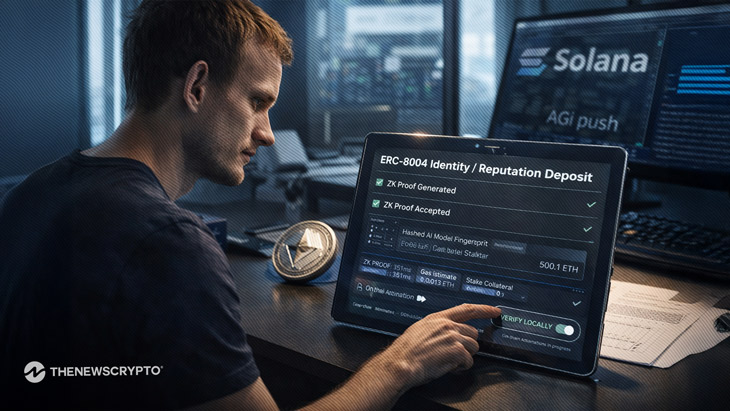
Vitalik Buterin Outlines Ethereum’s AI Framework, Pushes Back Against Solana’s Acceleration Thesis

Vitalik Buterin Outlines Ethereum’s AI Framework, Pushes Back Against Solana’s Acceleration Thesis

Ethereum co-founder Vitalik Buterin has reacted to Solana’s artificial general intelligence acceleration initiative. He did this through the establishment of his
Share
Thenewscrypto2026/02/10 18:40
Vitalik Buterin Reveals Ethereum’s Bold Plan to Stay Quantum-Secure and Simple!

Vitalik Buterin Reveals Ethereum’s Bold Plan to Stay Quantum-Secure and Simple!

Buterin unveils Ethereum’s strategy to tackle quantum security challenges ahead. Ethereum focuses on simplifying architecture while boosting security for users. Ethereum’s market stability grows as Buterin’s roadmap gains investor confidence. Ethereum founder Vitalik Buterin has unveiled his long-term vision for the blockchain, focusing on making Ethereum quantum-secure while maintaining its simplicity for users. Buterin presented his roadmap at the Japanese Developer Conference, and splits the future of Ethereum into three phases: short-term, mid-term, and long-term. Buterin’s most ambitious goal for Ethereum is to safeguard the blockchain against the threats posed by quantum computing.  The danger of such future developments is that the future may call into question the cryptographic security of most blockchain systems, and Ethereum will be able to remain ahead thanks to more sophisticated mathematical techniques to ensure the safety and integrity of its protocols. Buterin is committed to ensuring that Ethereum evolves in a way that not only meets today’s security challenges but also prepares for the unknowns of tomorrow. Also Read: Ethereum Giant The Ether Machine Takes Major Step Toward Going Public! However, in spite of such high ambitions, Buterin insisted that Ethereum also needed to simplify its architecture. An important aspect of this vision is to remove unnecessary complexity and make Ethereum more accessible and maintainable without losing its strong security capabilities. Security and simplicity form the core of Buterin’s strategy, as they guarantee that the users of Ethereum experience both security and smooth processes. Focus on Speed and Efficiency in the Short-Term In the short term, Buterin aims to enhance Ethereum’s transaction efficiency, a crucial step toward improving scalability and reducing transaction costs. These advantages are attributed to the fact that, within the mid-term, Ethereum is planning to enhance the speed of transactions in layer-2 networks. According to Butterin, this is part of Ethereum’s expansion, particularly because there is still more need to use blockchain technology to date. The other important aspect of Ethereum’s development is the layer-2 solutions. Buterin supports an approach in which the layer-2 networks are dependent on layer-1 to perform some essential tasks like data security, proof, and censorship resistance. This will enable the layer-2 systems of Ethereum to be concerned with verifying and sequencing transactions, which will improve the overall speed and efficiency of the network. Ethereum’s Market Stability Reflects Confidence in Long-Term Strategy Ethereum’s market performance has remained solid, with the cryptocurrency holding steady above $4,000. Currently priced at $4,492.15, Ethereum has experienced a slight 0.93% increase over the last 24 hours, while its trading volume surged by 8.72%, reaching $34.14 billion. These figures point to growing investor confidence in Ethereum’s long-term vision. The crypto community remains optimistic about Ethereum’s future, with many predicting the price could rise to $5,500 by mid-October. Buterin’s clear, forward-thinking strategy continues to build trust in Ethereum as one of the most secure and scalable blockchain platforms in the market. Also Read: Whales Dump 200 Million XRP in Just 2 Weeks – Is XRP’s Price on the Verge of Collapse? The post Vitalik Buterin Reveals Ethereum’s Bold Plan to Stay Quantum-Secure and Simple! appeared first on 36Crypto.
Share
Coinstats2025/09/18 01:22