What to Know: Stripe’s stablecoin arm, Bridge, has applied for a US national trust bank charter under the GENIUS Act, joining Circle, Ripple, Paxos, and Coinbase. The GENIUS Act introduces federal oversight for stablecoin issuers, requiring 100% cash or Treasury reserves and monthly public disclosures. This could mark the start of ‘Stablecoin Season,’ as regulated issuers bridge the gap between banks and blockchain payments. Best Wallet ($BEST) stands to benefit, offering users secure custody, presale access, and up to 80% APY staking rewards. Stablecoins are going legit, and pretty fast. Stripe’s stablecoin arm, Bridge, just filed an application with the US Office of the Comptroller of the Currency (OCC) to form a national trust bank under the newly enacted GENIUS Act. It’s the latest move in what’s shaping up to be ‘Stablecoin Season’: a full-blown regulatory sprint to bring digital dollars under federal oversight. If approved, Bridge’s charter would let Stripe issue, redeem, and custody stablecoins directly under the OCC, instead of juggling dozens of state-level money-transmitter licenses. That means its entire stablecoin business would sit under on federal framework, complete with 100% cash or Treasury-backed reserves and monthly public disclosures, as required by the GENIUS Act. Bridge now joins Circle ($USDC), Ripple ($RLUSD), Paxos ($USDP), and Coinbase ($COIN) in chasing national trust licenses – a race that marks a historic pivot for the US digital asset market. Together, these firms are positioning stablecoins as the regulated backbone of global payments, rather than gray-zone fintech experiments. The timing makes sense. Stablecoins already account for over $315B in circulating value, and Standard Chartered analysts estimate they could pull $1T in deposits away from traditional banks over the next three years. For users and merchants, that shift would make stablecoins the default settlement rail of the internet. They’re faster, cheaper, and now, finally, compliant. For Striple, Bridge isn’t just about compliance; it’s also an infrastructure play. The company recently unveiled Open Issuance, a service that helps apps launch their own stablecoins using Bridge’s back-end. Wallets like Phantom ($CASH), MetaMask ($mUSD), and Hyperliquid ($USDH) already rely on Bridge as their issuance partner. All signs point to a regulated on-chain economy, where digital dollars move under federal supervision and mainstream adoption finally takes hold. So the real question for investors becomes: if stablecoins are about to become the rails of this new system, which tokens will capture user flow at the edge? That’s where Best Wallet Token ($BEST) enters the picture, powering one of the fastest-growing Web3 wallets built to bridge the gap between regulated stablecoins and everyday users. From Stablecoins to Wallet Wars – the New On-Ramp Race The race for federal trust charters isn’t just about who prints the next digital dollar; it’s about who controls the gateway to it. Stripe, Circle, Ripple, and Coinbase are fighting for issuance and compliance. But at the user level, a different war is breaking out… the battle for wallets. Under the new GENIUS framework, stablecoins can finally plug into traditional finance with clear oversight from the OCC. That unlocks direct settlement with banks, cross-chain interoperability, and compliant collateral for lending protocols. This is the pipeline for a regulated DeFi economy. And this is where crypto wallets come in. They’re no longer just storage apps. They’ve become super apps. MetaMask now offers staking, Phantom integrates stablecoin rails, and new players like Best Wallet are going further by blending payments, presales, and rewards inside one secure, Fireblocks-powered interface. Best Wallet Token ($BEST) – The Token Fueling a Web3 Super App Built for the Stablecoin Era As stablecoins edge closer to federal recognition, wallet ecosystems are becoming the frontlines of adoption. Best Wallet is positioning itself at that intersection as a non-custodial wallet app that merges security, yield, and discovery into one seamless platform. Built on Fireblocks’ MPC-CMP framework, the same institutional-grade tech used by major custodians, Best Wallet offers users secure on-chain control without sacrificing usability. It’s a place to store tokens, buy into new crypto presales, stake assets, and soon, spend crypto cash through the Best Card. That card will deliver cashback and fee discounts to anyone staking the native $BEST token. And that token is what powers the entire ecosystem. Holding $BEST unlocks reduced transaction fees, higher staking rewards, and early access to new token launches through the in-app ‘Upcoming Tokens’ feature. Discover how to buy Best Wallet Token in our step-by-step walkthrough. The project has drawn over 57K followers on X and raised $16.5M so far in the presale. Tokens are priced at $0.025795, and with ambitions to capture 40% of the crypto-wallet market by the end of 2026, you can see why we a Best Wallet Token price prediction of $0.05106175 is not unreasonable. As stablecoins come under the OCC’s watch, wallets integrating compliant rails and institutional security will stand out. Best Wallet is built precisely for that world, connecting regulated stablecoin infrastructure with DeFi native opportunities. In that sense, the GENIUS Act sets the stage for wallets like Best Wallet to become the banks of the future, Join the $BEST presale and stake now for up to 80% APY. This article does not constitute financial advice. Crypto carries inherent risks, so please do your own research (DYOR) and never invest more than you are willing to lose. Authored by X, NewsBTC — www.newsbtc.com/news/stablecoin-season-stripe-bridge-impact-best-wallet-tokenWhat to Know: Stripe’s stablecoin arm, Bridge, has applied for a US national trust bank charter under the GENIUS Act, joining Circle, Ripple, Paxos, and Coinbase. The GENIUS Act introduces federal oversight for stablecoin issuers, requiring 100% cash or Treasury reserves and monthly public disclosures. This could mark the start of ‘Stablecoin Season,’ as regulated issuers bridge the gap between banks and blockchain payments. Best Wallet ($BEST) stands to benefit, offering users secure custody, presale access, and up to 80% APY staking rewards. Stablecoins are going legit, and pretty fast. Stripe’s stablecoin arm, Bridge, just filed an application with the US Office of the Comptroller of the Currency (OCC) to form a national trust bank under the newly enacted GENIUS Act. It’s the latest move in what’s shaping up to be ‘Stablecoin Season’: a full-blown regulatory sprint to bring digital dollars under federal oversight. If approved, Bridge’s charter would let Stripe issue, redeem, and custody stablecoins directly under the OCC, instead of juggling dozens of state-level money-transmitter licenses. That means its entire stablecoin business would sit under on federal framework, complete with 100% cash or Treasury-backed reserves and monthly public disclosures, as required by the GENIUS Act. Bridge now joins Circle ($USDC), Ripple ($RLUSD), Paxos ($USDP), and Coinbase ($COIN) in chasing national trust licenses – a race that marks a historic pivot for the US digital asset market. Together, these firms are positioning stablecoins as the regulated backbone of global payments, rather than gray-zone fintech experiments. The timing makes sense. Stablecoins already account for over $315B in circulating value, and Standard Chartered analysts estimate they could pull $1T in deposits away from traditional banks over the next three years. For users and merchants, that shift would make stablecoins the default settlement rail of the internet. They’re faster, cheaper, and now, finally, compliant. For Striple, Bridge isn’t just about compliance; it’s also an infrastructure play. The company recently unveiled Open Issuance, a service that helps apps launch their own stablecoins using Bridge’s back-end. Wallets like Phantom ($CASH), MetaMask ($mUSD), and Hyperliquid ($USDH) already rely on Bridge as their issuance partner. All signs point to a regulated on-chain economy, where digital dollars move under federal supervision and mainstream adoption finally takes hold. So the real question for investors becomes: if stablecoins are about to become the rails of this new system, which tokens will capture user flow at the edge? That’s where Best Wallet Token ($BEST) enters the picture, powering one of the fastest-growing Web3 wallets built to bridge the gap between regulated stablecoins and everyday users. From Stablecoins to Wallet Wars – the New On-Ramp Race The race for federal trust charters isn’t just about who prints the next digital dollar; it’s about who controls the gateway to it. Stripe, Circle, Ripple, and Coinbase are fighting for issuance and compliance. But at the user level, a different war is breaking out… the battle for wallets. Under the new GENIUS framework, stablecoins can finally plug into traditional finance with clear oversight from the OCC. That unlocks direct settlement with banks, cross-chain interoperability, and compliant collateral for lending protocols. This is the pipeline for a regulated DeFi economy. And this is where crypto wallets come in. They’re no longer just storage apps. They’ve become super apps. MetaMask now offers staking, Phantom integrates stablecoin rails, and new players like Best Wallet are going further by blending payments, presales, and rewards inside one secure, Fireblocks-powered interface. Best Wallet Token ($BEST) – The Token Fueling a Web3 Super App Built for the Stablecoin Era As stablecoins edge closer to federal recognition, wallet ecosystems are becoming the frontlines of adoption. Best Wallet is positioning itself at that intersection as a non-custodial wallet app that merges security, yield, and discovery into one seamless platform. Built on Fireblocks’ MPC-CMP framework, the same institutional-grade tech used by major custodians, Best Wallet offers users secure on-chain control without sacrificing usability. It’s a place to store tokens, buy into new crypto presales, stake assets, and soon, spend crypto cash through the Best Card. That card will deliver cashback and fee discounts to anyone staking the native $BEST token. And that token is what powers the entire ecosystem. Holding $BEST unlocks reduced transaction fees, higher staking rewards, and early access to new token launches through the in-app ‘Upcoming Tokens’ feature. Discover how to buy Best Wallet Token in our step-by-step walkthrough. The project has drawn over 57K followers on X and raised $16.5M so far in the presale. Tokens are priced at $0.025795, and with ambitions to capture 40% of the crypto-wallet market by the end of 2026, you can see why we a Best Wallet Token price prediction of $0.05106175 is not unreasonable. As stablecoins come under the OCC’s watch, wallets integrating compliant rails and institutional security will stand out. Best Wallet is built precisely for that world, connecting regulated stablecoin infrastructure with DeFi native opportunities. In that sense, the GENIUS Act sets the stage for wallets like Best Wallet to become the banks of the future, Join the $BEST presale and stake now for up to 80% APY. This article does not constitute financial advice. Crypto carries inherent risks, so please do your own research (DYOR) and never invest more than you are willing to lose. Authored by X, NewsBTC — www.newsbtc.com/news/stablecoin-season-stripe-bridge-impact-best-wallet-token

Stripe’s Bridge Leads the Stablecoin Season, and Could Boost Best Wallet Token

2025/10/15 21:26
5 min read

What to Know:

  • Stripe’s stablecoin arm, Bridge, has applied for a US national trust bank charter under the GENIUS Act, joining Circle, Ripple, Paxos, and Coinbase.
  • The GENIUS Act introduces federal oversight for stablecoin issuers, requiring 100% cash or Treasury reserves and monthly public disclosures.
  • This could mark the start of ‘Stablecoin Season,’ as regulated issuers bridge the gap between banks and blockchain payments.
  • Best Wallet ($BEST) stands to benefit, offering users secure custody, presale access, and up to 80% APY staking rewards.

Stablecoins are going legit, and pretty fast.

Stripe’s stablecoin arm, Bridge, just filed an application with the US Office of the Comptroller of the Currency (OCC) to form a national trust bank under the newly enacted GENIUS Act.
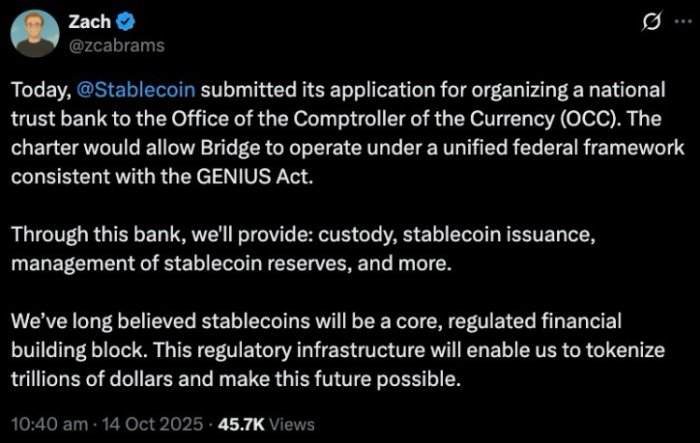
Bridge application to OCC announcement.

It’s the latest move in what’s shaping up to be ‘Stablecoin Season’: a full-blown regulatory sprint to bring digital dollars under federal oversight.

If approved, Bridge’s charter would let Stripe issue, redeem, and custody stablecoins directly under the OCC, instead of juggling dozens of state-level money-transmitter licenses.

That means its entire stablecoin business would sit under on federal framework, complete with 100% cash or Treasury-backed reserves and monthly public disclosures, as required by the GENIUS Act.

Bridge now joins Circle ($USDC), Ripple ($RLUSD), Paxos ($USDP), and Coinbase ($COIN) in chasing national trust licenses – a race that marks a historic pivot for the US digital asset market.

Together, these firms are positioning stablecoins as the regulated backbone of global payments, rather than gray-zone fintech experiments.

The timing makes sense. Stablecoins already account for over $315B in circulating value, and Standard Chartered analysts estimate they could pull $1T in deposits away from traditional banks over the next three years.
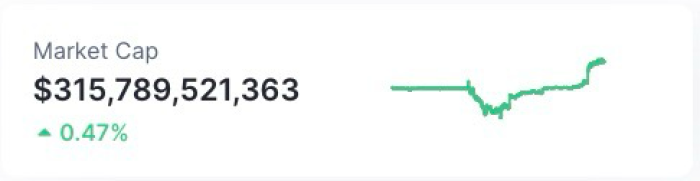
Stablecoins market cap.

For users and merchants, that shift would make stablecoins the default settlement rail of the internet. They’re faster, cheaper, and now, finally, compliant.

For Striple, Bridge isn’t just about compliance; it’s also an infrastructure play.

The company recently unveiled Open Issuance, a service that helps apps launch their own stablecoins using Bridge’s back-end. Wallets like Phantom ($CASH), MetaMask ($mUSD), and Hyperliquid ($USDH) already rely on Bridge as their issuance partner.

All signs point to a regulated on-chain economy, where digital dollars move under federal supervision and mainstream adoption finally takes hold.

So the real question for investors becomes: if stablecoins are about to become the rails of this new system, which tokens will capture user flow at the edge?

That’s where Best Wallet Token ($BEST) enters the picture, powering one of the fastest-growing Web3 wallets built to bridge the gap between regulated stablecoins and everyday users.

From Stablecoins to Wallet Wars – the New On-Ramp Race

The race for federal trust charters isn’t just about who prints the next digital dollar; it’s about who controls the gateway to it. Stripe, Circle, Ripple, and Coinbase are fighting for issuance and compliance. But at the user level, a different war is breaking out… the battle for wallets.

Under the new GENIUS framework, stablecoins can finally plug into traditional finance with clear oversight from the OCC. That unlocks direct settlement with banks, cross-chain interoperability, and compliant collateral for lending protocols. This is the pipeline for a regulated DeFi economy.

And this is where crypto wallets come in. They’re no longer just storage apps. They’ve become super apps.

MetaMask now offers staking, Phantom integrates stablecoin rails, and new players like Best Wallet are going further by blending payments, presales, and rewards inside one secure, Fireblocks-powered interface.

Best Wallet Token ($BEST) – The Token Fueling a Web3 Super App Built for the Stablecoin Era

As stablecoins edge closer to federal recognition, wallet ecosystems are becoming the frontlines of adoption. Best Wallet is positioning itself at that intersection as a non-custodial wallet app that merges security, yield, and discovery into one seamless platform.

Built on Fireblocks’ MPC-CMP framework, the same institutional-grade tech used by major custodians, Best Wallet offers users secure on-chain control without sacrificing usability.

It’s a place to store tokens, buy into new crypto presales, stake assets, and soon, spend crypto cash through the Best Card. That card will deliver cashback and fee discounts to anyone staking the native $BEST token.
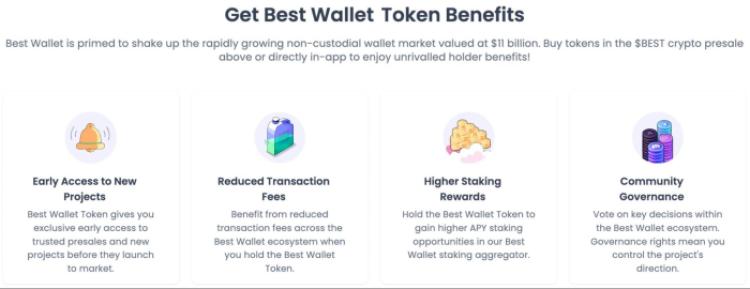
Best Wallet Token ($BEST) benefits for holders.

And that token is what powers the entire ecosystem. Holding $BEST unlocks reduced transaction fees, higher staking rewards, and early access to new token launches through the in-app ‘Upcoming Tokens’ feature.

Discover how to buy Best Wallet Token in our step-by-step walkthrough.

The project has drawn over 57K followers on X and raised $16.5M so far in the presale. Tokens are priced at $0.025795, and with ambitions to capture 40% of the crypto-wallet market by the end of 2026, you can see why we a Best Wallet Token price prediction of $0.05106175 is not unreasonable.

As stablecoins come under the OCC’s watch, wallets integrating compliant rails and institutional security will stand out. Best Wallet is built precisely for that world, connecting regulated stablecoin infrastructure with DeFi native opportunities.

In that sense, the GENIUS Act sets the stage for wallets like Best Wallet to become the banks of the future,

Join the $BEST presale and stake now for up to 80% APY.

This article does not constitute financial advice. Crypto carries inherent risks, so please do your own research (DYOR) and never invest more than you are willing to lose.

Authored by X, NewsBTC — www.newsbtc.com/news/stablecoin-season-stripe-bridge-impact-best-wallet-token


Market Opportunity
Hyperbridge Logo
Hyperbridge Price(BRIDGE)
$0.0155
$0.0155$0.0155
+1.50%
USD
Hyperbridge (BRIDGE) Live Price Chart
Disclaimer: The articles reposted on this site are sourced from public platforms and are provided for informational purposes only. They do not necessarily reflect the views of MEXC. All rights remain with the original authors. If you believe any content infringes on third-party rights, please contact service@support.mexc.com for removal. MEXC makes no guarantees regarding the accuracy, completeness, or timeliness of the content and is not responsible for any actions taken based on the information provided. The content does not constitute financial, legal, or other professional advice, nor should it be considered a recommendation or endorsement by MEXC.

You May Also Like

The Channel Factories We’ve Been Waiting For

The Channel Factories We’ve Been Waiting For

The post The Channel Factories We’ve Been Waiting For appeared on BitcoinEthereumNews.com. Visions of future technology are often prescient about the broad strokes while flubbing the details. The tablets in “2001: A Space Odyssey” do indeed look like iPads, but you never see the astronauts paying for subscriptions or wasting hours on Candy Crush.  Channel factories are one vision that arose early in the history of the Lightning Network to address some challenges that Lightning has faced from the beginning. Despite having grown to become Bitcoin’s most successful layer-2 scaling solution, with instant and low-fee payments, Lightning’s scale is limited by its reliance on payment channels. Although Lightning shifts most transactions off-chain, each payment channel still requires an on-chain transaction to open and (usually) another to close. As adoption grows, pressure on the blockchain grows with it. The need for a more scalable approach to managing channels is clear. Channel factories were supposed to meet this need, but where are they? In 2025, subnetworks are emerging that revive the impetus of channel factories with some new details that vastly increase their potential. They are natively interoperable with Lightning and achieve greater scale by allowing a group of participants to open a shared multisig UTXO and create multiple bilateral channels, which reduces the number of on-chain transactions and improves capital efficiency. Achieving greater scale by reducing complexity, Ark and Spark perform the same function as traditional channel factories with new designs and additional capabilities based on shared UTXOs.  Channel Factories 101 Channel factories have been around since the inception of Lightning. A factory is a multiparty contract where multiple users (not just two, as in a Dryja-Poon channel) cooperatively lock funds in a single multisig UTXO. They can open, close and update channels off-chain without updating the blockchain for each operation. Only when participants leave or the factory dissolves is an on-chain transaction…
Share
BitcoinEthereumNews2025/09/18 00:09
Ethereum unveils roadmap focusing on scaling, interoperability, and security at Japan Dev Conference

Ethereum unveils roadmap focusing on scaling, interoperability, and security at Japan Dev Conference

The post Ethereum unveils roadmap focusing on scaling, interoperability, and security at Japan Dev Conference appeared on BitcoinEthereumNews.com. Key Takeaways Ethereum’s new roadmap was presented by Vitalik Buterin at the Japan Dev Conference. Short-term priorities include Layer 1 scaling and raising gas limits to enhance transaction throughput. Vitalik Buterin presented Ethereum’s development roadmap at the Japan Dev Conference today, outlining the blockchain platform’s priorities across multiple timeframes. The short-term goals focus on scaling solutions and increasing Layer 1 gas limits to improve transaction capacity. Mid-term objectives target enhanced cross-Layer 2 interoperability and faster network responsiveness to create a more seamless user experience across different scaling solutions. The long-term vision emphasizes building a secure, simple, quantum-resistant, and formally verified minimalist Ethereum network. This approach aims to future-proof the platform against emerging technological threats while maintaining its core functionality. The roadmap presentation comes as Ethereum continues to compete with other blockchain platforms for market share in the smart contract and decentralized application space. Source: https://cryptobriefing.com/ethereum-roadmap-scaling-interoperability-security-japan/
Share
BitcoinEthereumNews2025/09/18 00:25
UK crypto holders brace for FCA’s expanded regulatory reach

UK crypto holders brace for FCA’s expanded regulatory reach

The post UK crypto holders brace for FCA’s expanded regulatory reach appeared on BitcoinEthereumNews.com. British crypto holders may soon face a very different landscape as the Financial Conduct Authority (FCA) moves to expand its regulatory reach in the industry. A new consultation paper outlines how the watchdog intends to apply its rulebook to crypto firms, shaping everything from asset safeguarding to trading platform operation. According to the financial regulator, these proposals would translate into clearer protections for retail investors and stricter oversight of crypto firms. UK FCA plans Until now, UK crypto users mostly encountered the FCA through rules on promotions and anti-money laundering checks. The consultation paper goes much further. It proposes direct oversight of stablecoin issuers, custodians, and crypto-asset trading platforms (CATPs). For investors, that means the wallets, exchanges, and coins they rely on could soon be subject to the same governance and resilience standards as traditional financial institutions. The regulator has also clarified that firms need official authorization before serving customers. This condition should, in theory, reduce the risk of sudden platform failures or unclear accountability. David Geale, the FCA’s executive director of payments and digital finance, said the proposals are designed to strike a balance between innovation and protection. He explained: “We want to develop a sustainable and competitive crypto sector – balancing innovation, market integrity and trust.” Geale noted that while the rules will not eliminate investment risks, they will create consistent standards, helping consumers understand what to expect from registered firms. Why does this matter for crypto holders? The UK regulatory framework shift would provide safer custody of assets, better disclosure of risks, and clearer recourse if something goes wrong. However, the regulator was also frank in its submission, arguing that no rulebook can eliminate the volatility or inherent risks of holding digital assets. Instead, the focus is on ensuring that when consumers choose to invest, they do…
Share
BitcoinEthereumNews2025/09/17 23:52