This article evaluates RECKONING's generalizability on the real-world multi-hop logical reasoning task, FOLIO.This article evaluates RECKONING's generalizability on the real-world multi-hop logical reasoning task, FOLIO.

RECKONING: Reasoning through Dynamic Knowledge Encoding: Generalization to Real-World knowledge

2025/10/25 00:41

Abstract and 1. Introduction

  1. Background

  2. Method

  3. Experiments

    4.1 Multi-hop Reasoning Performance

    4.2 Reasoning with Distractors

    4.3 Generalization to Real-World knowledge

    4.4 Run-time Analysis

    4.5 Memorizing Knowledge

  4. Related Work

  5. Conclusion, Acknowledgements, and References

\ A. Dataset

B. In-context Reasoning with Distractors

C. Implementation Details

D. Adaptive Learning Rate

E. Experiments with Large Language Models

4.3 Generalization to Real-World knowledge

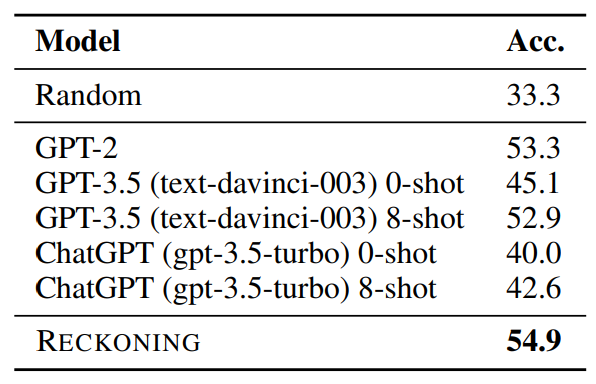
To investigate how generalizable our method is to real-world knowledge beyond the synthetic setting, we evaluate RECKONING on a more real-world multi-hop logical reasoning task, FOLIO [29], and report the result in Table 2. The dataset has a rich vocabulary, diverse logic patterns, and abundant language variations. It has been shown to challenge LLMs in both supervised fine-tuning and in-context learning settings. We fine-tune the GPT-2 model following the in-context reasoning setting as the baseline. As before, we train the GPT-2 model and RECKONING using the multi-task objective. We also compare to more advanced baselines, including GPT-3.5 (text-davinci-003 [55]) and ChatGPT(gpt-3.5-turbo[2]), two popular large language models with around 175B parameters. For these two large models, we evaluate both in the zero-shot and few-shot settings. In the few-shot setting, we prompt the model with 8 single-task examples randomly sampled from the training set to perform in-context learning. We find that RECKONING’s performance (which is initiated here from GPT-2) is better than the GPT-2 in-context reasoning baseline. Compared to the two advanced large language models, RECKONING outperforms them by a significant margin (12% 0-shot and 7% 8-shot). We conclude that RECKONING is effective and significantly benefits reasoning tasks using real-world knowledge.

\ Table 2: Evaluation results on FOLIO. We compare RECKONING against the FT-ICR baseline with GPT-2 and two popular large language models.
\

:::info Authors:

(1) Zeming Chen, EPFL (zeming.chen@epfl.ch);

(2) Gail Weiss, EPFL (antoine.bosselut@epfl.ch);

(3) Eric Mitchell, Stanford University (eric.mitchell@cs.stanford.edu)';

(4) Asli Celikyilmaz, Meta AI Research (aslic@meta.com);

(5) Antoine Bosselut, EPFL (antoine.bosselut@epfl.ch).

:::


:::info This paper is available on arxiv under CC BY 4.0 DEED license.

:::

2 https://openai.com/blog/chatgpt

Disclaimer: The articles reposted on this site are sourced from public platforms and are provided for informational purposes only. They do not necessarily reflect the views of MEXC. All rights remain with the original authors. If you believe any content infringes on third-party rights, please contact service@support.mexc.com for removal. MEXC makes no guarantees regarding the accuracy, completeness, or timeliness of the content and is not responsible for any actions taken based on the information provided. The content does not constitute financial, legal, or other professional advice, nor should it be considered a recommendation or endorsement by MEXC.

You May Also Like

MoneyGram launches stablecoin-powered app in Colombia

MoneyGram launches stablecoin-powered app in Colombia

The post MoneyGram launches stablecoin-powered app in Colombia appeared on BitcoinEthereumNews.com. MoneyGram has launched a new mobile application in Colombia that uses USD-pegged stablecoins to modernize cross-border remittances. According to an announcement on Wednesday, the app allows customers to receive money instantly into a US dollar balance backed by Circle’s USDC stablecoin, which can be stored, spent, or cashed out through MoneyGram’s global retail network. The rollout is designed to address the volatility of local currencies, particularly the Colombian peso. Built on the Stellar blockchain and supported by wallet infrastructure provider Crossmint, the app marks MoneyGram’s most significant move yet to integrate stablecoins into consumer-facing services. Colombia was selected as the first market due to its heavy reliance on inbound remittances—families in the country receive more than 22 times the amount they send abroad, according to Statista. The announcement said future expansions will target other remittance-heavy markets. MoneyGram, which has nearly 500,000 retail locations globally, has experimented with blockchain rails since partnering with the Stellar Development Foundation in 2021. It has since built cash on and off ramps for stablecoins, developed APIs for crypto integration, and incorporated stablecoins into its internal settlement processes. “This launch is the first step toward a world where every person, everywhere, has access to dollar stablecoins,” CEO Anthony Soohoo stated. The company emphasized compliance, citing decades of regulatory experience, though stablecoin oversight remains fluid. The US Congress passed the GENIUS Act earlier this year, establishing a framework for stablecoin regulation, which MoneyGram has pointed to as providing clearer guardrails. This is a developing story. This article was generated with the assistance of AI and reviewed by editor Jeffrey Albus before publication. Get the news in your inbox. Explore Blockworks newsletters: Source: https://blockworks.co/news/moneygram-stablecoin-app-colombia
Share
BitcoinEthereumNews2025/09/18 07:04