

The reason new crypto ETFs launched despite the U.S. government shutdown
The latest round of spot crypto ETFs went live on major exchanges, advancing under existing SEC rules despite the U.S. government shutdown.
- New spot crypto ETFs tied to Solana, Litecoin, and Hedera launched on the NYSE despite the ongoing U.S. government shutdown.
- The launches proceeded through automatic-effect filings and pre-approved listing standards that enabled progress without direct SEC intervention.
- Solana led early traction with a staking-based ETF model offering yield, stronger liquidity, and broader institutional appeal than Litecoin or Hedera.
- Nearly 100 more crypto ETF proposals remain in the SEC pipeline, pointing to a broader expansion of regulated digital-asset products in 2026.
Table of Contents
- NYSE opens the door to new crypto ETFs
- Crypto ETFs survived the U.S. government shutdown
- Why Solana could outpace Litecoin and Hedera
- Dozens of new crypto ETFs wait in line
NYSE opens the door to new crypto ETFs
On Oct. 27, the New York Stock Exchange quietly marked a new chapter in digital asset investing. It listed four new spot crypto ETFs linked to Solana, Litecoin, and Hedera, expanding the ETF universe beyond Bitcoin (BTC) and Ethereum (ETH) for the first time.
The listings came after months of anticipation from asset managers who had been preparing filings to launch spot products once the U.S. SEC cleared the path.
In mid-September 2025, the SEC introduced a procedural reform called “generic listing standards” for commodity-based exchange-traded products, a category that now includes cryptocurrencies. The policy was published in the Federal Register on Sep. 17 and took effect immediately after approval.
The new rule removed the need for individual applications under Section 19(b) of the Securities Exchange Act, a process that previously required up to eight months of review for each new ETF.
Under this framework, exchanges such as the NYSE, Nasdaq, and Cboe can now list crypto-backed ETFs directly if the underlying asset meets conditions such as having a regulated futures market or a surveillance-sharing agreement with another exchange.
The SEC’s move built on years of precedent. Spot Bitcoin ETFs were approved in January 2024 after court rulings found the agency’s earlier denials inconsistent with its approval of Bitcoin futures ETFs. Ethereum spot ETFs followed in May 2024.
The new rule extended the same logic to other cryptocurrencies that showed sufficient market maturity and trading oversight.
With the framework in place, the NYSE moved first and listed the four spot ETFs. Bitwise confirmed that its Solana Staking ETF had been declared effective and debuted the same day.
According to Bloomberg ETF analyst Eric Balchunas, the Canary Litecoin ETF and Canary Hedera ETF are already effective and will begin trading on the Nasdaq on Tuesday.
Meanwhile, Grayscale’s Solana ETF, converted from its existing closed-end Solana Trust, will list on Wednesday.
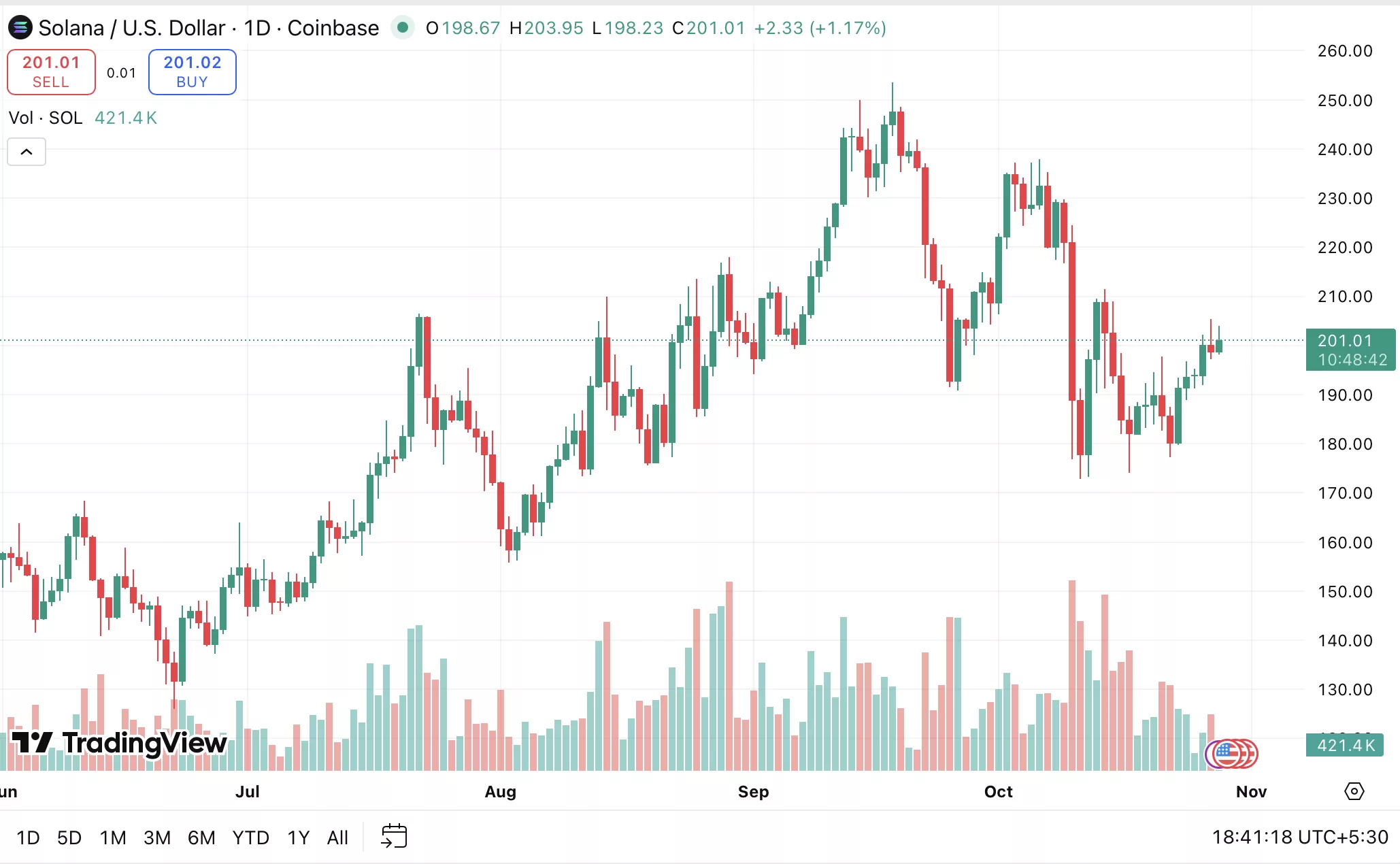
Within hours of the announcement, Solana’s (SOL) price rose about 4%, while Litecoin (LTC) and Hedera (HBAR) also recorded modest gains. Trading volumes are expected to remain small compared with Bitcoin’s debut but could rise as institutional brokerages start coverage.
Crypto ETFs survived the U.S. government shutdown
On Oct. 1, the U.S. federal government entered a shutdown after Congress failed to pass funding legislation, forcing key regulatory agencies, including the SEC, to begin widespread staff furloughs.
The SEC announced that it would retain only a limited number of employees for emergency enforcement and market-surveillance duties. More than 90% of its workforce was placed on furlough under its contingency plan.
Under these conditions, the launch of spot crypto ETFs tied to Solana, Litecoin, and Hedera in late October appeared impossible. Yet on Oct. 27, exchanges confirmed that trading would begin as planned.
The explanation lies in the structure of U.S. securities law and the timing of the filings submitted before the shutdown began.
A report by FOX Business journalist Eleanor Terrett, later confirmed by Bloomberg’s Eric Balchunas, described the exact process. Each ETF issuer filed two documents: the S-1 registration under the Securities Act of 1933 and the 8-A registration under the Securities Exchange Act of 1934.
The S-1 governs the offering of shares to the public, while the 8-A formally registers those shares for trading on an exchange. The 8-A becomes valid only once the S-1 is effective, so both filings had to align in timing. The NYSE certified all 8-A filings early on Monday morning, completing the final procedural step before trading could begin.
Ordinarily, SEC staff review S-1 filings and declare them effective. However, by law, S-1 filings automatically become effective twenty days after submission unless the issuer requests a delay or the SEC intervenes. This rule was designed to prevent bureaucratic delays and to ensure that registration statements cannot be indefinitely stalled.
In this case, issuers included language in their amended S-1s confirming that they would become automatically effective after the statutory period, allowing them to move forward without direct SEC approval.
Since the automatic effectiveness provision carries the same legal weight as a formal SEC declaration, the process remained valid even during the government shutdown. That mechanism allowed the ETFs to proceed to launch despite the agency being largely inactive.
With all 8-A filings certified by the exchange and the S-1s reaching automatic effectiveness, every legal and procedural requirement was satisfied.
In essence, the ETFs went live since the entire process had already been designed to function lawfully without real-time regulatory involvement.
Why Solana could outpace Litecoin and Hedera
The funds launching this week reveal how issuers are taking different routes into the same market.
Canary Capital’s Litecoin and Hedera ETFs are classic spot products. They hold the actual LTC and HBAR tokens in custody through regulated partners such as BitGo and Coinbase Custody.
Bitwise’s Solana Staking ETF takes a more advanced approach. Instead of only holding SOL, the fund stakes the tokens directly on the Solana network and distributes the rewards, expected to average around 7% annually to its shareholders, making it the first U.S. crypto ETF to combine spot exposure with on-chain yield.
Grayscale’s Solana ETF, set to convert its existing Solana Trust into an open-ended ETF on Oct. 29, will add liquidity and scale to this category, giving Solana two separate ETF vehicles trading within the same week.
Solana appears best positioned to lead this new wave for several reasons. First, its network processes over 65,000 transactions per second, far higher than most competing blockchains, and average transaction costs remain below $0.01.
Second, it supports one of the most active ecosystems in crypto, with large volumes in DeFi platforms, memecoins, and blockchain gaming.
Third, Solana’s market cap and liquidity rank among the top 5 global crypto assets, while Litecoin and Hedera remain outside the top 20 by total value, making SOL easier to integrate into large portfolios and lowering the risk of slippage or illiquidity.
The structure of the Bitwise ETF could also help Solana stand out. Yield from staking offers a tangible source of return, something absent in most traditional ETFs. For institutions, that feature mirrors income-generation models already used in fixed-income and dividend strategies.
Litecoin and Hedera will still test demand for smaller networks and measure how far investor appetite extends beyond major assets. But Solana represents a midpoint between technical maturity and institutional comfort.
Dozens of new crypto ETFs wait in line
The approval of these new ETFs opens the floodgates for a wider lineup of crypto funds waiting for their turn. Industry trackers show that nearly 100 digital-asset ETFs are now sitting in the U.S. regulatory pipeline, covering more than 20 tokens.
Many of these filings were submitted months ago and are now positioned to move faster under the SEC’s generic listing standards once normal government operations resume.
The most closely watched proposals include spot ETFs tied to Ripple (XRP), Cardano (ADA), and Avalanche (AVAX), along with multi-asset “basket” products that would hold a mix of leading cryptocurrencies.
Several issuers are also experimenting with hybrid models that incorporate staking rewards or on-chain lending income into traditional spot exposure, taking cues from Bitwise’s Solana Staking ETF.
Analysts believe the next likely approvals could arrive between late 2025 and early 2026, depending on how the SEC prioritizes its backlog.
The broader market effect could be substantial. ETFs make crypto exposure accessible to large financial advisors, retirement funds, and brokerage platforms that cannot hold tokens directly. Since that structural access opens a new channel for institutional participation, it can redirect substantial capital toward assets that previously saw limited demand outside exchanges.
Bitcoin spot ETFs brought over $10 billion in inflows within their first month after launch in January 2024. Ethereum ETFs crossed $1 billion within weeks of approval in May 2024.
If even a fraction of that capital rotates into newer products, Solana, Litecoin, and others could see liquidity deepen and volatility compress over time.
Beyond inflows, the next wave of ETFs may change how altcoins are perceived. Instead of being treated as speculative tokens, some could evolve into investable assets that meet compliance, custody, and transparency standards, bringing crypto closer to the institutional market, where price discovery, regulation, and investor protection coexist.


You May Also Like

Silver Rebounds But Fed Rate Hike Expectations Cap Gains Ahead of US Jobs Data

Outcry over elephant wedding procession in Kelantan prompts Perhilitan task force


