Shiba Inu’s effort to grow beyond being a meme coin is struggling. Its blockchain network, Shibarium, was created to bring real use and value to the project, but it has not gained much attention or activity. Developer interest and user engagement are very low, and the network’s overall growth has slowed down sharply. Recent network issues, including technical troubles and security problems, have made things worse. Many users have left, and new projects are not joining. As a result, Shibarium now shows very little activity, leading many in the crypto community to call it a “ghost chain.”  Shiba Inu’s Struggle To Evolve Beyond A Meme Coin Shiba Inu tried to change its image from a simple meme coin into a real blockchain project capable of competing with other networks. The team launched Shibarium, a layer-2 blockchain, in 2023 to help make this move. However, this plan has not worked as expected, with Shibarium failing to attract developers, projects, or users and gaining no market share. Related Reading: XRP At $1,000 Is Peanuts If Used To Clear US National Debt; Pundit Explains According to data from DeFi Llama, Shibarium has only 18 developers since it began. It is a much lower number than on other blockchains, which have hundreds or even thousands of active developers. The total value locked (TVL) on the network, which shows how much money people have invested in it, has fallen to just $878,000.  Shibarium has also failed to attract any stablecoins, which are among the most widely used tokens in decentralized finance. Not a single stablecoin project has deployed on the network, reflecting Shibarium’s lack of presence in one of the most critical areas of the crypto world. Other newer and more active layer-2 networks like Base, Arbitrum, Plasma, and Linea have already moved far ahead, leaving Shibarium behind. Hacks And The Decline Of Shibarium Network Activity Things got worse for the network when ShibaSwap, the most popular decentralized app (dApp) on the Shibarium network, was recently compromised. The attack eroded user confidence and forced developers to pause a key bridge connecting Shibarium to other networks. Even with the bridge now active, most of the network’s activity stopped. Many users could not move their tokens or use apps, making the network almost entirely silent. Related Reading: Here’s Why The XRP Price Still Isn’t Bearish Despite The 50% Flash Crash Because of this drop in network activity, Shibarium is no longer helping burn SHIB tokens. Typically, a portion of network transaction fees goes toward buying and burning Shiba Inu tokens, helping reduce supply and support the token’s price. But now, with very few transactions, the burn process has slowed down significantly. The decline in users, developers, and activity are indicators that Shibarium’s dream of becoming a strong, useful blockchain has not come to fruition. Instead of growing into a central crypto platform, it has become what some would call the real ghost chain.  Featured image created with Dall.E, chart from Tradingview.comShiba Inu’s effort to grow beyond being a meme coin is struggling. Its blockchain network, Shibarium, was created to bring real use and value to the project, but it has not gained much attention or activity. Developer interest and user engagement are very low, and the network’s overall growth has slowed down sharply. Recent network issues, including technical troubles and security problems, have made things worse. Many users have left, and new projects are not joining. As a result, Shibarium now shows very little activity, leading many in the crypto community to call it a “ghost chain.”  Shiba Inu’s Struggle To Evolve Beyond A Meme Coin Shiba Inu tried to change its image from a simple meme coin into a real blockchain project capable of competing with other networks. The team launched Shibarium, a layer-2 blockchain, in 2023 to help make this move. However, this plan has not worked as expected, with Shibarium failing to attract developers, projects, or users and gaining no market share. Related Reading: XRP At $1,000 Is Peanuts If Used To Clear US National Debt; Pundit Explains According to data from DeFi Llama, Shibarium has only 18 developers since it began. It is a much lower number than on other blockchains, which have hundreds or even thousands of active developers. The total value locked (TVL) on the network, which shows how much money people have invested in it, has fallen to just $878,000.  Shibarium has also failed to attract any stablecoins, which are among the most widely used tokens in decentralized finance. Not a single stablecoin project has deployed on the network, reflecting Shibarium’s lack of presence in one of the most critical areas of the crypto world. Other newer and more active layer-2 networks like Base, Arbitrum, Plasma, and Linea have already moved far ahead, leaving Shibarium behind. Hacks And The Decline Of Shibarium Network Activity Things got worse for the network when ShibaSwap, the most popular decentralized app (dApp) on the Shibarium network, was recently compromised. The attack eroded user confidence and forced developers to pause a key bridge connecting Shibarium to other networks. Even with the bridge now active, most of the network’s activity stopped. Many users could not move their tokens or use apps, making the network almost entirely silent. Related Reading: Here’s Why The XRP Price Still Isn’t Bearish Despite The 50% Flash Crash Because of this drop in network activity, Shibarium is no longer helping burn SHIB tokens. Typically, a portion of network transaction fees goes toward buying and burning Shiba Inu tokens, helping reduce supply and support the token’s price. But now, with very few transactions, the burn process has slowed down significantly. The decline in users, developers, and activity are indicators that Shibarium’s dream of becoming a strong, useful blockchain has not come to fruition. Instead of growing into a central crypto platform, it has become what some would call the real ghost chain.  Featured image created with Dall.E, chart from Tradingview.com


Forget Cardano, Why Shiba Inu’s Shibarium Is The Real Ghost Chain

2025/10/31 03:00
3 min read

Shiba Inu’s effort to grow beyond being a meme coin is struggling. Its blockchain network, Shibarium, was created to bring real use and value to the project, but it has not gained much attention or activity. Developer interest and user engagement are very low, and the network’s overall growth has slowed down sharply.

Recent network issues, including technical troubles and security problems, have made things worse. Many users have left, and new projects are not joining. As a result, Shibarium now shows very little activity, leading many in the crypto community to call it a “ghost chain.” 

Shiba Inu’s Struggle To Evolve Beyond A Meme Coin

Shiba Inu tried to change its image from a simple meme coin into a real blockchain project capable of competing with other networks. The team launched Shibarium, a layer-2 blockchain, in 2023 to help make this move. However, this plan has not worked as expected, with Shibarium failing to attract developers, projects, or users and gaining no market share.

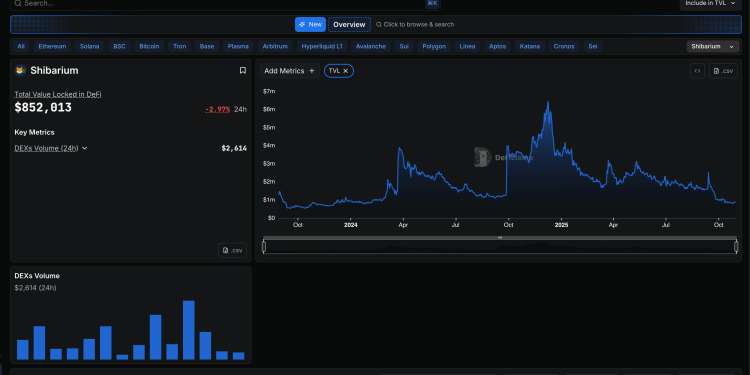
According to data from DeFi Llama, Shibarium has only 18 developers since it began. It is a much lower number than on other blockchains, which have hundreds or even thousands of active developers. The total value locked (TVL) on the network, which shows how much money people have invested in it, has fallen to just $878,000. 

Shiba Inu Shibarium

Shibarium has also failed to attract any stablecoins, which are among the most widely used tokens in decentralized finance. Not a single stablecoin project has deployed on the network, reflecting Shibarium’s lack of presence in one of the most critical areas of the crypto world. Other newer and more active layer-2 networks like Base, Arbitrum, Plasma, and Linea have already moved far ahead, leaving Shibarium behind.

Hacks And The Decline Of Shibarium Network Activity

Things got worse for the network when ShibaSwap, the most popular decentralized app (dApp) on the Shibarium network, was recently compromised. The attack eroded user confidence and forced developers to pause a key bridge connecting Shibarium to other networks. Even with the bridge now active, most of the network’s activity stopped. Many users could not move their tokens or use apps, making the network almost entirely silent.

Because of this drop in network activity, Shibarium is no longer helping burn SHIB tokens. Typically, a portion of network transaction fees goes toward buying and burning Shiba Inu tokens, helping reduce supply and support the token’s price. But now, with very few transactions, the burn process has slowed down significantly.

The decline in users, developers, and activity are indicators that Shibarium’s dream of becoming a strong, useful blockchain has not come to fruition. Instead of growing into a central crypto platform, it has become what some would call the real ghost chain. 

Shiba Inu price chart from Tradingview.com (Shibarium)
Market Opportunity
RealLink Logo
RealLink Price(REAL)
$0,05405
$0,05405$0,05405
+4,12%
USD
RealLink (REAL) Live Price Chart
Disclaimer: The articles reposted on this site are sourced from public platforms and are provided for informational purposes only. They do not necessarily reflect the views of MEXC. All rights remain with the original authors. If you believe any content infringes on third-party rights, please contact service@support.mexc.com for removal. MEXC makes no guarantees regarding the accuracy, completeness, or timeliness of the content and is not responsible for any actions taken based on the information provided. The content does not constitute financial, legal, or other professional advice, nor should it be considered a recommendation or endorsement by MEXC.

You May Also Like

Trump’s 'desperate' push to rename landmarks for himself is a 'growing problem': analysis

Trump’s 'desperate' push to rename landmarks for himself is a 'growing problem': analysis

President Donald Trump's fixation on adding his name to major landmarks is presenting numerous problems both for himself and his party.That's according to a Friday
Share
Alternet2026/02/07 05:30
Can XRP Repeat Its 300% Surge and Reach $5? Analysts Weigh In

Can XRP Repeat Its 300% Surge and Reach $5? Analysts Weigh In

The post Can XRP Repeat Its 300% Surge and Reach $5? Analysts Weigh In appeared on BitcoinEthereumNews.com. One of the most notable outcomes of the bull run has been the 300% price increase of XRP this year. Investors are wondering if XRP may reach $5 in 2025, given the pace driven by ecosystem improvements, institutional interest, and legal clarity. Numerous analysts hold this view, pointing to significant demand stimulants such as the impending approval of the XRP ETF and the introduction of XRP options on CME. Beyond conjecture, the fundamentals of XRPL are more solid than ever. In just a few months, the network’s TVL increased from $20 million to over $100 million, and cross-chain DeFi applications are becoming more accessible because to EVM compatibility. XRPL is changing into a center for liquidity and intelligent financial solutions as a result of this innovation surge. As the native DEX that XRPL has long required, DeXRP is becoming more and more popular. DeXRP is getting ready to launch as the focal point of XRPL’s new DeFi economy, having already generated over $6.6 million in presale and attracted over 9,500 investors. What is DeXRP?  As the first decentralized exchange (DEX) based on XRPL, DeXRP is taking center stage as XRP continues to solidify its place in the global market. Massive expectation has been generated by the combination of DeXRP’s ambition for an advanced trading platform and XRPL’s established infrastructure, which is renowned for its quick transactions, cheap fees, and institutional-ready capabilities. In contrast to a lot of speculative presales, DeXRP’s development shows both institutional interest and community-driven momentum. Its early achievement of the $6.4 million milestone demonstrates how rapidly investors are realizing its potential. DeXRP Presale Success More than 9,300 distinct wallets have already joined the DeXRP presale, indicating a high level of interest from around the world. A crucial aspect is highlighted by the volume and variety of participation:…
Share
BitcoinEthereumNews2025/09/19 20:01
Crypto Investor Loses $6.28M to Sophisticated Phishing Permit Scam

Crypto Investor Loses $6.28M to Sophisticated Phishing Permit Scam

A cryptocurrency investor recently lost $6.28 million to a sophisticated phishing scam that exploited malicious signature approvals. The incident serves as a significant reminder of the increasing prevalence of “permit phishing” schemes, which pose a serious threat to users in the DeFi ecosystem. Attacker Steals $6.28 Million   The attack began when the victim received a targeted phishing message that appeared to be a legitimate update from a decentralized finance (DeFi) platform. Tempted by offers of better returns, the investor connected their wallet to a fake website. There, they signed an EIP-2612, which includes a feature that allows token approvals without gas fees. However, it can also unintentionally give scammers unlimited spending access to a smart contract.  The theft occurred shortly after the approvals were granted. The scammer quickly executed a contract that drained 3,200 stETH and a matching amount of aEthWBTC from the victim’s wallet. The loot, which was traced to a mixer address, revealed a calculated plan to conceal the trail.  The entire theft took less than 12 minutes, using automated scripts for speed. Scam Sniffer noted that the victim’s portfolio, which was worth over $10 million before the attack, lost half its value immediately. The rapid process allowed no time for intervention, as blockchain transactions cannot be reversed once completed. On-chain analysis indicated that the assets were unlikely to be recovered, as they were likely laundered through exchanges. Not New   Following the exploit, some users on X have expressed shock, wondering how the victim unwittingly signed malicious token approvals. However, this subtle trap has long troubled the crypto space. For instance, earlier this month, a user of Venus Protocol lost $13.5 million. The victim fell prey to a phishing scam by approving a transaction from a malicious Core Pool Comptroller contract, which granted the attacker access to their funds. Once permission was given, the hacker quickly drained stablecoins and wrapped tokens from the trader’s wallet.  Surprisingly, though, a few hours after the incident, the Venus team tracked the stolen funds by force-liquidating the hackers’ trade positions. The team fully recovered the stolen funds afterwards, leaving the thief with nothing. The post Crypto Investor Loses $6.28M to Sophisticated Phishing Permit Scam appeared first on Cointab.
Share
Coinstats2025/09/19 01:35