

Filecoin Storage Utilization Hits 36% as Verified Deals Dominate in Q3 2025

- Filecoin’s total active storage remained stable at 1,110 PiB despite a slowdown in new deals.
- Storage utilization rose to 36% as smaller miners exited, reflecting network consolidation.
- Verified and high-volume datasets continued to dominate, supported by enterprise and research onboarding.
According to Messari’s Q3 2025 report, Filecoin’s total data stored through active deals reached 1,110 pebibytes (PiB), a marginal 1% decline from 1,120 PiB in Q2. The number of active deals also slipped slightly to 35.2 million. This small drop highlights a continued focus on higher-value storage rather than simply increasing raw supply.
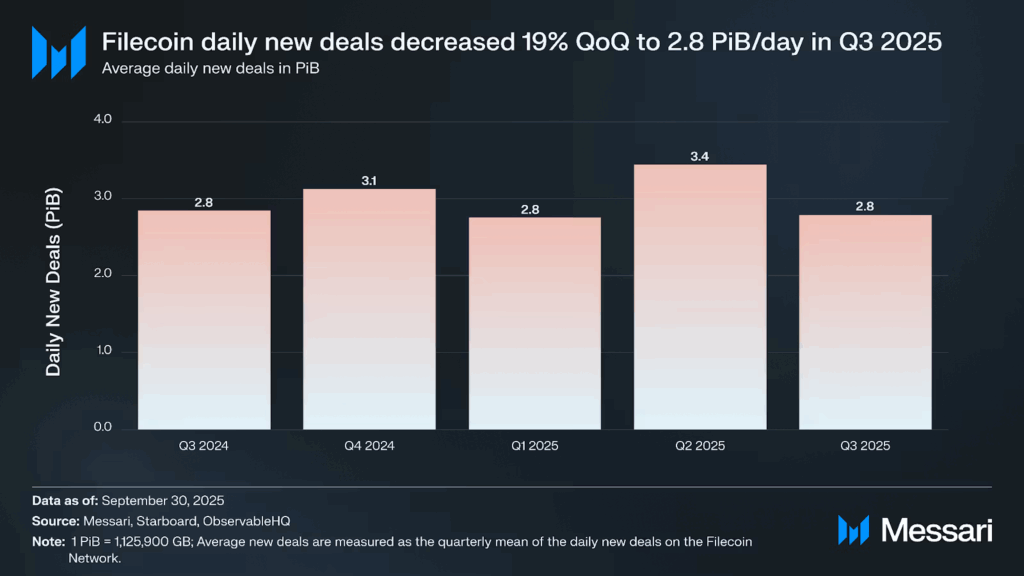
Average daily new storage deals declined 19% quarter-over-quarter, falling from 3.4 PiB to 2.8 PiB. The slowdown in new data onboarding contrasts with the relative stability of total active storage.
 Source: Messari
Experts suggest this indicates that while fewer new deals are being added, existing verified datasets remain intact, reflecting long-term demand from enterprise and research clients.
The rollout of Filecoin Plus (Fil+) Allocator Pathways in late Q2 prioritized larger, verified clients. As a result, smaller and short-term deals have become rare, while high-value storage dominates.
Additionally, the Network v27 “Golden Week” upgrade simplified miner operations but temporarily slowed new deal formation. Consolidation among miners also contributed, as many smaller operators left the network amid stricter operational and collateral requirements.
Efficiency Gains Amid Capacity Reduction
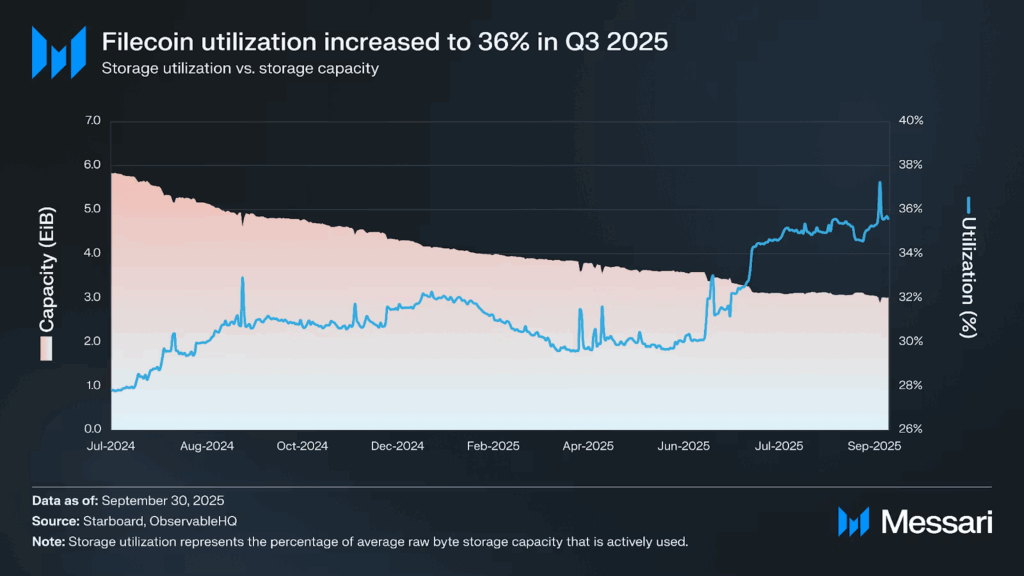
The storage usage ratio for Filecoin has also shown improvement, going to 36% during the third quarter, up from the second quarter’s 32%, even though the total committed capacity declined by 10% to 3.0 EiB.
 Source: Messari
Many of the smaller and less efficient storage providers left the network after the v27 change, which deprecated old sealing and aggregation schemes. Although the capacity and the new deals are decreasing, the remaining storage capacity is being utilized efficiently.
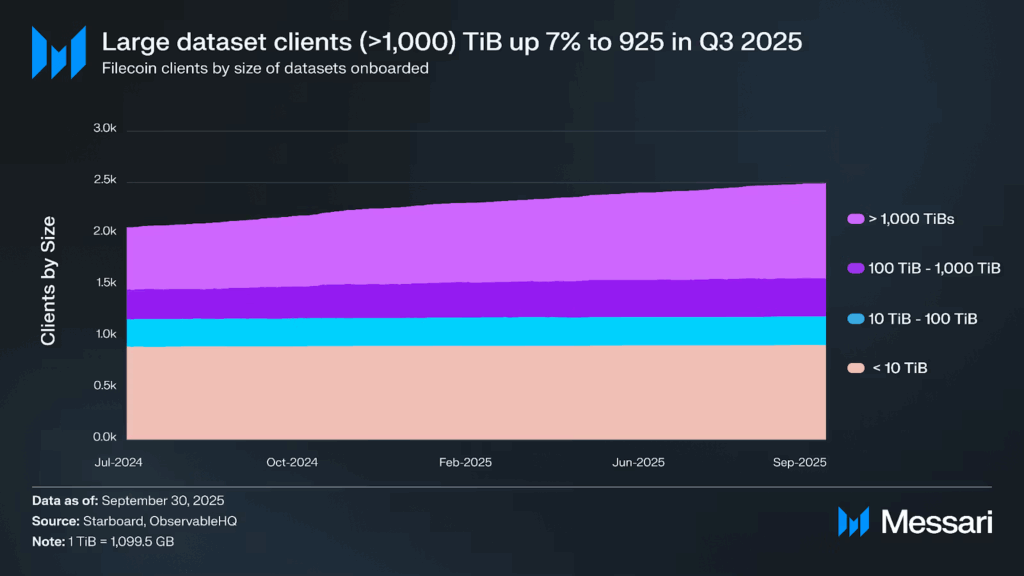
At the end of the Q3 period, Filecoin supported a total of 2,491 datasets, a growth of 3%, up from 2,416 at the end of the last quarter. What is significant is that the number of datasets over 1,000 TiB has grown to 925, reflecting a rise of 7%.
 Source: Messari
This is enabled through ongoing Filecoin Plus adoption, the new integration tools that make data ingestion easier, and workloads that are enterprise-centric.
The FVM has also added further capabilities to the network by facilitating the Ethereum-style smart contract functionality on the storage level. This further provides developers with the capability of automating functions such as data onboarding, pricing, and retrieval and computation.
Filecoin Records $62.4M in Q3 Inflows, Down From Q2
The third quarter of 2025 reported a total inflow of $62.4 million for Filecoin, a decline of 6.5% from the $66.8 million inflow of the second quarter. The outflows and borrowings were also lower, sliding from $43.4 million to $40.5 million.
 Source: Messari
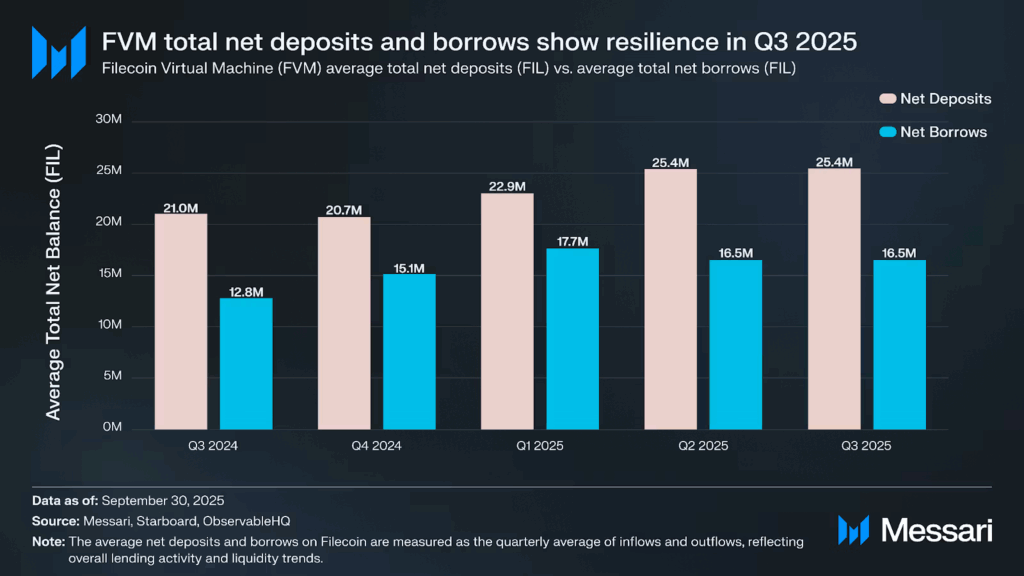
The trend for FIL token transactions was the reverse, however, with the inflows slightly up at 25.43 million FIL and the outflows slightly lower at 16.52 million FIL. The difference between the USD and FIL-denominated transaction amounts is caused by a drop of 5% in the FIL token’s price, which declined to $2.19 from $2.30.
Also Read: Filecoin (FIL) Price Prediction 2025: Can This Hidden Gem Soar to $5.56?


You May Also Like

The changing face of elder care in Malaysia — Sayed Mohammad Reza Yamani Sayed Umar

Covéa Chooses Shift Technology as Strategic Partner for Fraud and Risk Management

Not a loophole: Singapore AI export controls let China tap US AI legally



