

How AI is securing India's digital payments revolution while building infrastructure for a billion users
How does a nation process billions of digital transactions daily while keeping fraud at bay and building infrastructure to serve over a billion people? This question sits at the heart of India's ambitious journey toward becoming a $5 trillion digital economy by 2030.
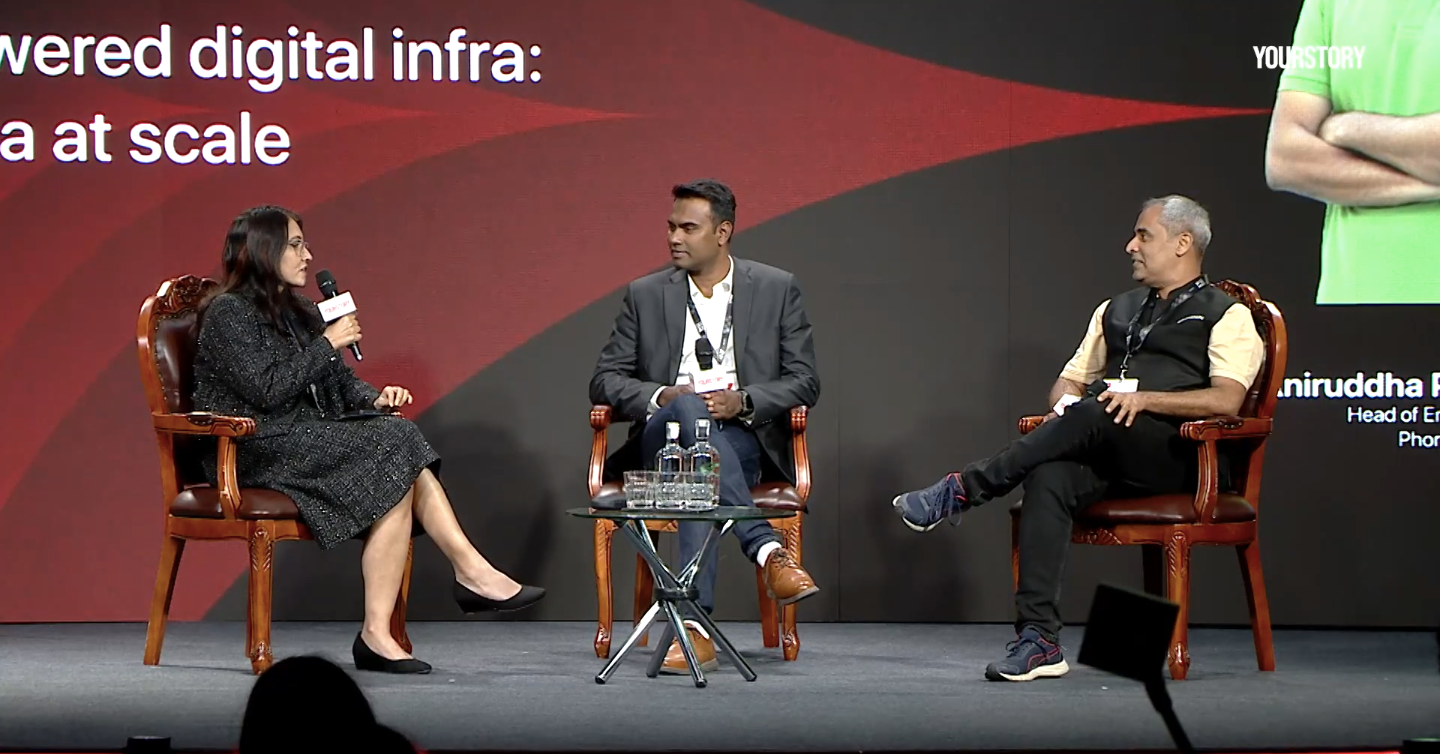
At TechSparks 2025, India's biggest tech and startup conference hosted by YourStory, industry leaders gathered to dissect the complex challenge of building India's AI-powered digital infrastructure. The panel discussion, moderated by Priya Patankar, Head of Corporate Communications at PhonePe, brought together Aniruddha Patwardhan, Head of Engineering at PhonePe, and Venkat Ragothaman, Senior Director of Engineering, Security, and AI at NetApp.
The conversation began with a reality check. Nearly everyone in the packed evening session raised their hands when asked about using UPI, India's unified payments interface. This near-universal adoption underscores both the success of India's digital transformation and the massive responsibility of maintaining trust at scale.
Fighting fraud with AI agents
Patwardhan began by acknowledging how dramatically fraud patterns have evolved. What once revolved around “account takeover” scams from specific clusters, the kind popularized by shows like Jamtara, has now shifted to highly sophisticated threats such as digital arrest scams and mule accounts, where unsuspecting individuals are recruited to route illicit funds.
"While we are not saving human lives, not doctors, wealth or money is the next immediate thing," Patwardhan said, emphasizing why trust remains critical in digital payments.
PhonePe has moved from cluster-based fraud detection to entity-level vector modeling. The company now deploys AI agents that model transaction patterns in real time, creating what Patwardhan calls "namespaces" to categorize suspected transactions. These agents use generative AI frameworks to improve signal-to-noise ratios, ensuring human evaluators can focus on genuine threats without being overwhelmed.
"Our ability to train these AI agents, keep the guardrails in terms of avoiding hallucination, to do entity vector modeling, is something we use extensively," Patwardhan explained. The goal is to prevent the workforce from growing linearly as transactions scale to a billion daily.
The system has proven successful enough that PhonePe has open-sourced some of its tools, contributing to the broader fight against fraud in India's digital ecosystem.
Building infrastructure for 100 exabytes monthly
Venkat Ragothaman shifted the discussion to a fundamental challenge: India produces 20% of the world's data but hosts only 3% of global data center capacity. Most Indian data gets exported, processed elsewhere, and returned, creating latency and sovereignty concerns.
The numbers are staggering. Each mobile consumer uses roughly 20 gigabytes monthly, projected to triple by 2030. India collectively generates 100 exabytes of data every month. To put that in perspective, storing that much data would require 100 million handheld devices or laptops.
"India requires its data center infrastructure to be built out to be able to meet the ambitious 2030 AI mission," Ragothaman said, outlining the scale of investment needed.
The solution requires rethinking the entire technology stack. Modern AI demands disaggregated, shared-everything architectures that differ fundamentally from cloud computing models. Storage systems must handle massive scale while delivering the throughput and low latency required for real-time AI inferencing.
Beyond hardware, India needs what Venkat calls an "India layer" of context sensitivity. Frontier models like OpenAI lack understanding of local sensibilities, cultural nuances, and vernacular languages. Something said in a regional language might carry an entirely different meaning in English. Building guardrails that understand these contexts becomes essential for deploying AI safely across a diverse nation.
Personalizing financial services
Patwardhan detailed how AI is democratizing access to financial services for first-time digital users. Many Indians encounter lending, insurance, and wealth management products through PhonePe for the first time.
Computer vision models now extract data from old insurance policies, eliminating tedious form-filling. AI analyzes transaction histories to create alternative credit models for the "new to credit" segment, people without formal credit scores. By examining electricity bills, property taxes, and fuel purchases, PhonePe can infer homeownership, vehicle ownership, and lifestyle patterns.
"We are able to give very good alternate credit data pointers to create a data model," said Patwardhan, describing how this approach opens credit markets to millions previously excluded from formal lending.
In wealth management, AI generates dynamic watch lists based on portfolio holdings and real-time news, replacing static index tracking. For insurance sales, AI prompts agents with relevant questions based on conversation flow while monitoring compliance.
Securing the AI future
“AI security will be the theme of 2026,” Venkat Ragothaman predicted. The challenge is stark: 80% of enterprise data sits in unstructured files, not databases. Making this data available to AI systems while protecting sensitive information requires automated detection of personally identifiable information at scale.
Prompt injection has emerged as the top attack vector. Unlike traditional phishing that requires clicking malicious links, prompt injection can extract confidential information with zero clicks, simply through carefully crafted queries.
The rise of autonomous agents compounds these challenges. Organizations must develop authorization systems for non-human identities and ensure agents have appropriate autonomy levels, nothing more.
As India races toward its digital future, the message from TechSparks 2025 is clear: building AI-powered infrastructure requires simultaneous innovation in fraud detection, data sovereignty, personalization, and security. The technology exists. The challenge lies in deploying it at scale while maintaining the trust that makes India's digital revolution possible.



You May Also Like

Bitcoin World Reveals Top 5 Stunning Gainers And Losers

Quantum Test Breaks ECC Key, Raises New Bitcoin Security Concerns




