The post Bitcoin Hyper Boosts as Texas Is First US State to Buy Bitcoin appeared on BitcoinEthereumNews.com. What to Know: Texas buying bitcoin via an ETF signals growing state-level comfort with regulated BTC exposure, but it primarily benefits long-term, low-beta allocators. As institutions choose ETFs, crypto-native investors may look one layer deeper, into Bitcoin Layer 2 infrastructure, for higher potential upside. Bitcoin still struggles with low throughput, variable fees, and limited programmability, keeping most complex DeFi and gaming activity on alternative smart contract chains. Bitcoin Hyper aims to solve this by bringing SVM-based, high-throughput smart contracts to a Bitcoin-secured Layer 2, targeting payments, DeFi, NFTs, and gaming. Texas just became the first US state to buy bitcoin, doing it not through a cold wallet but via BlackRock’s spot $BTC ETF. For institutions and treasuries, that’s a historic green light: clean regulatory rails, audited custody, and Bitcoin exposure that fits neatly into a traditional portfolio. For you as a retail investor, though, ETFs cap the upside. You get price tracking, not yield, leverage, or early-stage asymmetry. When a sovereign-scale buyer like Texas enters through an ETF, it reinforces Bitcoin as a macro asset, but it also pushes smaller investors to ask where the next outsized growth might actually come from. That’s why early-stage Bitcoin infrastructure plays are suddenly back in focus. Instead of just holding ‘paper BTC’ via an ETF, some are rotating into projects trying to fix Bitcoin’s biggest pain points: slow confirmation times, rising on-chain fees, and a scripting model that makes complex DeFi almost impossible. That’s the gap Bitcoin Hyper ($HYPER) is aiming to fill. As more headlines frame Texas’s move as the start of state-level Bitcoin adoption and another win for institutional adoption, a parallel conversation is happening in crypto-native circles. If institutions are content with ETF exposure, can agile investors position one layer closer to the innovation stack, into Bitcoin Layer 2s like… The post Bitcoin Hyper Boosts as Texas Is First US State to Buy Bitcoin appeared on BitcoinEthereumNews.com. What to Know: Texas buying bitcoin via an ETF signals growing state-level comfort with regulated BTC exposure, but it primarily benefits long-term, low-beta allocators. As institutions choose ETFs, crypto-native investors may look one layer deeper, into Bitcoin Layer 2 infrastructure, for higher potential upside. Bitcoin still struggles with low throughput, variable fees, and limited programmability, keeping most complex DeFi and gaming activity on alternative smart contract chains. Bitcoin Hyper aims to solve this by bringing SVM-based, high-throughput smart contracts to a Bitcoin-secured Layer 2, targeting payments, DeFi, NFTs, and gaming. Texas just became the first US state to buy bitcoin, doing it not through a cold wallet but via BlackRock’s spot $BTC ETF. For institutions and treasuries, that’s a historic green light: clean regulatory rails, audited custody, and Bitcoin exposure that fits neatly into a traditional portfolio. For you as a retail investor, though, ETFs cap the upside. You get price tracking, not yield, leverage, or early-stage asymmetry. When a sovereign-scale buyer like Texas enters through an ETF, it reinforces Bitcoin as a macro asset, but it also pushes smaller investors to ask where the next outsized growth might actually come from. That’s why early-stage Bitcoin infrastructure plays are suddenly back in focus. Instead of just holding ‘paper BTC’ via an ETF, some are rotating into projects trying to fix Bitcoin’s biggest pain points: slow confirmation times, rising on-chain fees, and a scripting model that makes complex DeFi almost impossible. That’s the gap Bitcoin Hyper ($HYPER) is aiming to fill. As more headlines frame Texas’s move as the start of state-level Bitcoin adoption and another win for institutional adoption, a parallel conversation is happening in crypto-native circles. If institutions are content with ETF exposure, can agile investors position one layer closer to the innovation stack, into Bitcoin Layer 2s like…

Bitcoin Hyper Boosts as Texas Is First US State to Buy Bitcoin

What to Know:

  • Texas buying bitcoin via an ETF signals growing state-level comfort with regulated BTC exposure, but it primarily benefits long-term, low-beta allocators.
  • As institutions choose ETFs, crypto-native investors may look one layer deeper, into Bitcoin Layer 2 infrastructure, for higher potential upside.
  • Bitcoin still struggles with low throughput, variable fees, and limited programmability, keeping most complex DeFi and gaming activity on alternative smart contract chains.
  • Bitcoin Hyper aims to solve this by bringing SVM-based, high-throughput smart contracts to a Bitcoin-secured Layer 2, targeting payments, DeFi, NFTs, and gaming.

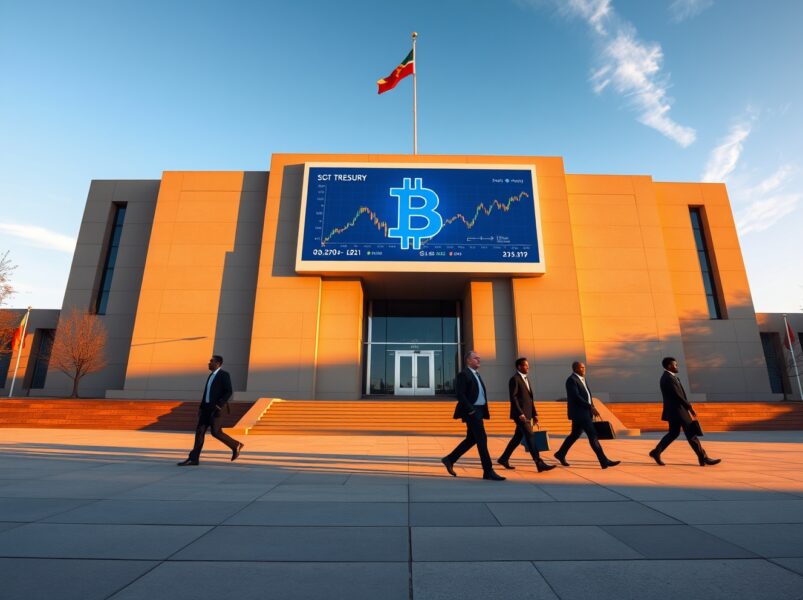
Texas just became the first US state to buy bitcoin, doing it not through a cold wallet but via BlackRock’s spot $BTC ETF.

For institutions and treasuries, that’s a historic green light: clean regulatory rails, audited custody, and Bitcoin exposure that fits neatly into a traditional portfolio.

For you as a retail investor, though, ETFs cap the upside. You get price tracking, not yield, leverage, or early-stage asymmetry.

When a sovereign-scale buyer like Texas enters through an ETF, it reinforces Bitcoin as a macro asset, but it also pushes smaller investors to ask where the next outsized growth might actually come from.

That’s why early-stage Bitcoin infrastructure plays are suddenly back in focus. Instead of just holding ‘paper BTC’ via an ETF, some are rotating into projects trying to fix Bitcoin’s biggest pain points: slow confirmation times, rising on-chain fees, and a scripting model that makes complex DeFi almost impossible.

That’s the gap Bitcoin Hyper ($HYPER) is aiming to fill.

As more headlines frame Texas’s move as the start of state-level Bitcoin adoption and another win for institutional adoption, a parallel conversation is happening in crypto-native circles.

If institutions are content with ETF exposure, can agile investors position one layer closer to the innovation stack, into Bitcoin Layer 2s like Bitcoin Hyper, where the risk is higher but so is the potential upside?

Why State-Level Bitcoin Adoption Highlights Layer 2’s Gap

Texas opting for a BlackRock ETF underscores a simple reality: institutions want Bitcoin exposure without on-chain friction. However, the Bitcoin base layer still processes around 7 transactions per second, with confirmation times measured in minutes and fees often spiking to several dollars when mempools become congested.

That’s fine for a state treasury or pension fund that treats $BTC like digital gold. It’s a problem if you’re trying to build payments, DeFi, or gaming experiences that feel like Web2: sub-second execution, predictable sub-cent fees, and composable smart contracts.

That performance gap is exactly where Bitcoin Layer 2 projects are racing to compete.

You’re already seeing multiple design paths emerge: pure payments, sidechains targeting EVM developers, and newer rollup-style architectures trying to anchor security on Bitcoin while offloading execution.

In that mix, Bitcoin Hyper is positioning itself as the Solana Virtual Machine (SVM)-powered option, aimed at high-frequency, Solana-style workloads, but has settled back on Bitcoin.

Why Bitcoin Hyper Is on Investors’ Radar Now

Where many Bitcoin L2 designs bolt on EVM, Bitcoin Hyper takes a different route: integrating the Solana Virtual Machine so developers can deploy high-throughput Rust smart contracts on a Bitcoin-secured stack.

The claim is aggressive; execution that can outperform Solana itself, but with architecture built around extremely low-latency Layer 2 processing and real-time SVM execution.

Under the hood, Bitcoin Hyper uses a modular approach: Bitcoin L1 acts as the settlement and security anchor, while a single trusted sequencer orders and executes transactions off-chain before periodically anchoring state to Bitcoin.


That design enables sub-second finality, low-cost swaps, lending, gaming, and NFT trades in wrapped $BTC, while still inheriting Bitcoin’s base-layer trust assumptions.

This is where investors start running the ETF-versus-early-stage math. The Bitcoin Hyper presale has already raised $28.5M with tokens at $0.013335, suggesting some market conviction that a Bitcoin-native SVM chain could capture meaningful DeFi and dApp flows.

Whale tracker data reveals significant purchases, including ones of $396K and a whopping $500K.

If Bitcoin continues to institutionalize via ETFs, the next leverage point for growth may be infrastructure that turns idle BTC into productive capital. That’s the bet behind $HYPER: that users will want fast swaps, lending, staking, and gaming in BTC terms, not just passive price exposure.

Learn more about Bitcoin Hyper or join the $HYPER presale.

This article is for informational purposes only and does not constitute financial, investment, or trading advice; always do your own research.

Authored by Aaron Walker for NewsBTC – https://www.newsbtc.com/news/texas-bitcoin-etf-vs-bitcoin-hyper-layer-2

Source: https://www.newsbtc.com/news/texas-bitcoin-etf-vs-bitcoin-hyper-layer-2/

Market Opportunity
Hyperlane Logo
Hyperlane Price(HYPER)
$0.09762
$0.09762$0.09762
-0.16%
USD
Hyperlane (HYPER) Live Price Chart
Disclaimer: The articles reposted on this site are sourced from public platforms and are provided for informational purposes only. They do not necessarily reflect the views of MEXC. All rights remain with the original authors. If you believe any content infringes on third-party rights, please contact service@support.mexc.com for removal. MEXC makes no guarantees regarding the accuracy, completeness, or timeliness of the content and is not responsible for any actions taken based on the information provided. The content does not constitute financial, legal, or other professional advice, nor should it be considered a recommendation or endorsement by MEXC.

You May Also Like

CEO Sandeep Nailwal Shared Highlights About RWA on Polygon

CEO Sandeep Nailwal Shared Highlights About RWA on Polygon

The post CEO Sandeep Nailwal Shared Highlights About RWA on Polygon appeared on BitcoinEthereumNews.com. Polygon CEO Sandeep Nailwal highlighted Polygon’s lead in global bonds, Spiko US T-Bill, and Spiko Euro T-Bill. Polygon published an X post to share that its roadmap to GigaGas was still scaling. Sentiments around POL price were last seen to be bearish. Polygon CEO Sandeep Nailwal shared key pointers from the Dune and RWA.xyz report. These pertain to highlights about RWA on Polygon. Simultaneously, Polygon underlined its roadmap towards GigaGas. Sentiments around POL price were last seen fumbling under bearish emotions. Polygon CEO Sandeep Nailwal on Polygon RWA CEO Sandeep Nailwal highlighted three key points from the Dune and RWA.xyz report. The Chief Executive of Polygon maintained that Polygon PoS was hosting RWA TVL worth $1.13 billion across 269 assets plus 2,900 holders. Nailwal confirmed from the report that RWA was happening on Polygon. The Dune and https://t.co/W6WSFlHoQF report on RWA is out and it shows that RWA is happening on Polygon. Here are a few highlights: – Leading in Global Bonds: Polygon holds 62% share of tokenized global bonds (driven by Spiko’s euro MMF and Cashlink euro issues) – Spiko U.S.… — Sandeep | CEO, Polygon Foundation (※,※) (@sandeepnailwal) September 17, 2025 The X post published by Polygon CEO Sandeep Nailwal underlined that the ecosystem was leading in global bonds by holding a 62% share of tokenized global bonds. He further highlighted that Polygon was leading with Spiko US T-Bill at approximately 29% share of TVL along with Ethereum, adding that the ecosystem had more than 50% share in the number of holders. Finally, Sandeep highlighted from the report that there was a strong adoption for Spiko Euro T-Bill with 38% share of TVL. He added that 68% of returns were on Polygon across all the chains. Polygon Roadmap to GigaGas In a different update from Polygon, the community…
Share
BitcoinEthereumNews2025/09/18 01:10
SHIB Price Analysis for February 8

SHIB Price Analysis for February 8

The post SHIB Price Analysis for February 8 appeared on BitcoinEthereumNews.com. Original U.Today article Can traders expect SHIB to test the $0.0000070 range soon
Share
BitcoinEthereumNews2026/02/09 00:26
UK Looks to US to Adopt More Crypto-Friendly Approach

UK Looks to US to Adopt More Crypto-Friendly Approach

The post UK Looks to US to Adopt More Crypto-Friendly Approach appeared on BitcoinEthereumNews.com. The UK and US are reportedly preparing to deepen cooperation on digital assets, with Britain looking to copy the Trump administration’s crypto-friendly stance in a bid to boost innovation.  UK Chancellor Rachel Reeves and US Treasury Secretary Scott Bessent discussed on Tuesday how the two nations could strengthen their coordination on crypto, the Financial Times reported on Tuesday, citing people familiar with the matter.  The discussions also involved representatives from crypto companies, including Coinbase, Circle Internet Group and Ripple, with executives from the Bank of America, Barclays and Citi also attending, according to the report. The agreement was made “last-minute” after crypto advocacy groups urged the UK government on Thursday to adopt a more open stance toward the industry, claiming its cautious approach to the sector has left the country lagging in innovation and policy.  Source: Rachel Reeves Deal to include stablecoins, look to unlock adoption Any deal between the countries is likely to include stablecoins, the Financial Times reported, an area of crypto that US President Donald Trump made a policy priority and in which his family has significant business interests. The Financial Times reported on Monday that UK crypto advocacy groups also slammed the Bank of England’s proposal to limit individual stablecoin holdings to between 10,000 British pounds ($13,650) and 20,000 pounds ($27,300), claiming it would be difficult and expensive to implement. UK banks appear to have slowed adoption too, with around 40% of 2,000 recently surveyed crypto investors saying that their banks had either blocked or delayed a payment to a crypto provider.  Many of these actions have been linked to concerns over volatility, fraud and scams. The UK has made some progress on crypto regulation recently, proposing a framework in May that would see crypto exchanges, dealers, and agents treated similarly to traditional finance firms, with…
Share
BitcoinEthereumNews2025/09/18 02:21