Hedera and cSigma turn blockchain into a tool for the global economy, benefiting stablecoin holders. cSigma picked Hedera for its focus on RWA utility, Cost Predictability, Legal Recourse, and Unified Access. The Hedera (HBAR) network has expanded real-world asset (RWA) utility through an integration with cSigma Finance. According to the Hedera Foundation, cSigma brings invoice [...]]]>Hedera and cSigma turn blockchain into a tool for the global economy, benefiting stablecoin holders. cSigma picked Hedera for its focus on RWA utility, Cost Predictability, Legal Recourse, and Unified Access. The Hedera (HBAR) network has expanded real-world asset (RWA) utility through an integration with cSigma Finance. According to the Hedera Foundation, cSigma brings invoice [...]]]>

Hedera Expands Real-World Asset Utility as cSigma Channels Invoice Financing Returns to Stablecoin Holders

2025/11/28 01:40
  • Hedera and cSigma turn blockchain into a tool for the global economy, benefiting stablecoin holders.
  • cSigma picked Hedera for its focus on RWA utility, Cost Predictability, Legal Recourse, and Unified Access.

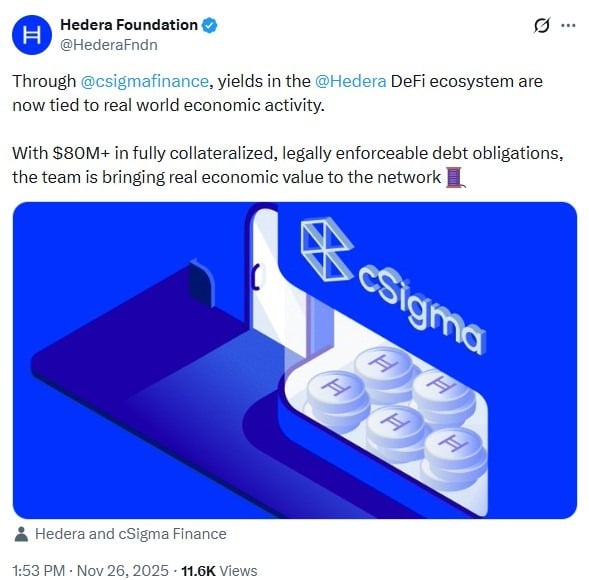
The Hedera (HBAR) network has expanded real-world asset (RWA) utility through an integration with cSigma Finance. According to the Hedera Foundation, cSigma brings invoice financing to stablecoin holders. The Hedera Foundation explained that with cSigma, yields in the Hedera decentralized finance (DeFi) ecosystem are now tied to real-world economic activity.

Rather than trying to become the single centralized storepoint for lending, cSigma Finance is taking a different approach. The platform aims to build the Shopify of institutional asset tokenization on Hedera. 

According to the Hedera Foundation, cSigma has built a complete technology stack. It allows independent asset originators like credit funds, fintechs, and supply chain financiers to spin up their own tokenized portfolios on-chain.
Hedera and cSigma partnersHedera and cSigma partners | Source: Hedera Foundation

In traditional finance (TradFi), there is a mountain of operational friction when a specialized credit fund wants to lend to logistics companies. There are usually challenges with setting up SPVs, managing legal compliance across jurisdictions, and manually reconciling payments.

To solve these issues, cSigma has provided the “merchant” experience for asset originators. This is similar to how Shopify gives a merchant the tools to sell products without building a server farm. As regards cSigma, it provides financial originators with the tools to deploy capital without building a blockchain engineering team.

cSigma provides infrastructure for asset originators to tokenize real-world debt portfolios as on-chain products. Lenders deposit stablecoins like USDC into pools, earning yields primarily from borrower interest. Notably, cSigma handles the heavy lifting by converting legal claims into digital assets and through automated KYB/KYC and whitelisting. The platform also connects to stablecoin pools seamlessly.

Summarily, cSigma captures real-world economic value often generated from invoices and purchase orders. It also bridges loans and passes them through to stablecoin holders. As the Hedera Foundation explained, cSigma, with its over $80 million collateralized and legally enforceable debt obligations, is bringing real economic value to the network.

Why Did cSigma Choose Hedera?

cSigma recognized an issue with many RWA projects launching on chains optimized for retail trading, only to struggle to attract institutional volume. 

Recognizing this challenge, cSigma said it chose Hedera for marketing and three critical operational necessities. This includes Cost Predictability, Legal Recourse, and Unified Access. Institutional credit is high-frequency, generating thousands of repayment transactions per month. On a network like Ethereum, a sudden spike in gas fees could wipe out the margin on a repayment.

This is in contrast with Hedera’s fixed fees, which allow originators to forecast costs with 100% accuracy. Additionally, the Hedera Governing Council comprises entities like Google, DLA Piper, and IBM. They provide a layer of enterprise-grade trust and stability that anonymous, decentralized chains cannot match.

This governance structure mitigates the counterparty risk of the network itself for a bank or credit fund. Hedera is known for its unique features in the market. As we covered in our earlier news piece, Hedera and Axelar recently teamed up to open access to 60 blockchains.

]]>


Disclaimer: The articles reposted on this site are sourced from public platforms and are provided for informational purposes only. They do not necessarily reflect the views of MEXC. All rights remain with the original authors. If you believe any content infringes on third-party rights, please contact service@support.mexc.com for removal. MEXC makes no guarantees regarding the accuracy, completeness, or timeliness of the content and is not responsible for any actions taken based on the information provided. The content does not constitute financial, legal, or other professional advice, nor should it be considered a recommendation or endorsement by MEXC.

You May Also Like

New Viral Presale on XRPL: DeXRP Surpassed $6.4 Million

New Viral Presale on XRPL: DeXRP Surpassed $6.4 Million

The post New Viral Presale on XRPL: DeXRP Surpassed $6.4 Million  appeared on BitcoinEthereumNews.com. One of the most talked-about ecosystems in the cryptocurrency space is the XRP Ledger (XRPL), and DeXRP, the first Presale on XRPL, recently made headlines for its growth story. Attracting over 9,300 investors globally, the project has now raised over $6.4 million and is rapidly emerging as one of the most viral cryptocurrency launches of 2025. By integrating AMM and Order Book trading with a cutting-edge LP system and an open voting process for holders, DeXRP hopes to establish itself as the preferred trading destination for the XRPL community. What is DeXRP?  As the first decentralized exchange (DEX) based on XRPL, DeXRP is taking center stage as XRP continues to solidify its place in the global market. Massive expectation has been generated by the combination of DeXRP’s ambition for an advanced trading platform and XRPL’s established infrastructure, which is renowned for its quick transactions, cheap fees, and institutional-ready capabilities. In contrast to a lot of speculative presales, DeXRP’s development shows both institutional interest and community-driven momentum. Its early achievement of the $6.4 million milestone demonstrates how rapidly investors are realizing its potential. DeXRP Presale Success More than 9,300 distinct wallets have already joined the DeXRP presale, indicating a high level of interest from around the world. A crucial aspect is highlighted by the volume and variety of participation: DeXRP is not merely a niche project; rather, it is emerging as a major force in the XRPL ecosystem. DeXRP’s recent collaborations with WOW Earn and Micro3, as well as its sponsorship of the WOW Summit in Hong Kong, are also contributing factors to this uptick in investor confidence. These actions are blatant attempts to increase the company’s awareness among institutional players and crypto-native groups. The Forbes article summed it up: DeXRP is embedding credibility where others chase hype, marking it as…
Share
BitcoinEthereumNews2025/09/18 20:14
Headwind Helps Best Wallet Token

Headwind Helps Best Wallet Token

The post Headwind Helps Best Wallet Token appeared on BitcoinEthereumNews.com. Google has announced the launch of a new open-source protocol called Agent Payments Protocol (AP2) in partnership with Coinbase, the Ethereum Foundation, and 60 other organizations. This allows AI agents to make payments on behalf of users using various methods such as real-time bank transfers, credit and debit cards, and, most importantly, stablecoins. Let’s explore in detail what this could mean for the broader cryptocurrency markets, and also highlight a presale crypto (Best Wallet Token) that could explode as a result of this development. Google’s Push for Stablecoins Agent Payments Protocol (AP2) uses digital contracts known as ‘Intent Mandates’ and ‘Verifiable Credentials’ to ensure that AI agents undertake only those payments authorized by the user. Mandates, by the way, are cryptographically signed, tamper-proof digital contracts that act as verifiable proof of a user’s instruction. For example, let’s say you instruct an AI agent to never spend more than $200 in a single transaction. This instruction is written into an Intent Mandate, which serves as a digital contract. Now, whenever the AI agent tries to make a payment, it must present this mandate as proof of authorization, which will then be verified via the AP2 protocol. Alongside this, Google has also launched the A2A x402 extension to accelerate support for the Web3 ecosystem. This production-ready solution enables agent-based crypto payments and will help reshape the growth of cryptocurrency integration within the AP2 protocol. Google’s inclusion of stablecoins in AP2 is a massive vote of confidence in dollar-pegged cryptocurrencies and a huge step toward making them a mainstream payment option. This widens stablecoin usage beyond trading and speculation, positioning them at the center of the consumption economy. The recent enactment of the GENIUS Act in the U.S. gives stablecoins more structure and legal support. Imagine paying for things like data crawls, per-task…
Share
BitcoinEthereumNews2025/09/18 01:27