Aster releases its 2026 roadmap, confirming a Q1 L1 mainnet launch, staking, governance, and ecosystem upgrades. Aster has outlined its 2026 H1 roadmap with a focus on strengthening infrastructure and expanding its token economy. The team announced that the Aster Chain L1 mainnet will launch in Q1 2026, which is a major technical milestone. Moreover, […] The post Aster Unveils 2026 Roadmap with L1 Mainnet Launch appeared first on Live Bitcoin News.Aster releases its 2026 roadmap, confirming a Q1 L1 mainnet launch, staking, governance, and ecosystem upgrades. Aster has outlined its 2026 H1 roadmap with a focus on strengthening infrastructure and expanding its token economy. The team announced that the Aster Chain L1 mainnet will launch in Q1 2026, which is a major technical milestone. Moreover, […] The post Aster Unveils 2026 Roadmap with L1 Mainnet Launch appeared first on Live Bitcoin News.

Aster Unveils 2026 Roadmap with L1 Mainnet Launch

2025/12/05 14:00

Aster releases its 2026 roadmap, confirming a Q1 L1 mainnet launch, staking, governance, and ecosystem upgrades.

Aster has outlined its 2026 H1 roadmap with a focus on strengthening infrastructure and expanding its token economy. The team announced that the Aster Chain L1 mainnet will launch in Q1 2026, which is a major technical milestone. Moreover, they confirmed that staking, governance, and advanced trading tools are to follow in Q2.

Aster Highlights Completed 2025 Milestones in New Update

The project stressed that 2025 was the proof of delivery on a number of fronts. According to the official updates and past references on the blog, Aster completed its merger between Astherus and ApolloX, launched its mobile app, ended its TGE, and acquired listings on several major centralized exchanges. Additionally, the platform launched hedge mode, trade-and-earn incentives, and a continuous buyback program.

Related Reading: ASTER News: Whale Increases Bet with $1M USDC Ahead of ASTER Stage 4 Airdrop | Live Bitcoin News

The team said that early December 2025 will see the introduction of Shield Mode, which will be focused on support for private high-leverage trading. Furthermore, TWAP strategies will be implemented to enhance the execution of large orders. These tools are designed to increase user efficiency and support wider risk management practices. As a result, traders can enjoy smoother activities during the volatile time.

In mid-December, Aster is planning on upgrading its RWA perpetual suite. This improvement will increase markets in stocks that are linked to one another, while increasing the depth of liquidity in active pairs. Reporting from past analysis of the market mentioned growing demand for diversified perpetual products in crypto native platforms. Therefore, Aster anticipates greater participation from users who are looking for cross-asset exposure.

Aster Chain Testnet Opens Before Full 2026 Rollout

The project also confirmed that the Aster Chain testnet will open to the community before the end of December. This step will enable builders to test features on Aster Code, which is the development framework for the platform. Additionally, the testnet is designed to test performance data before the mainnet is released. Due to the influence of the testnet on governance decisions, community reactions can impact upgrades afterward.
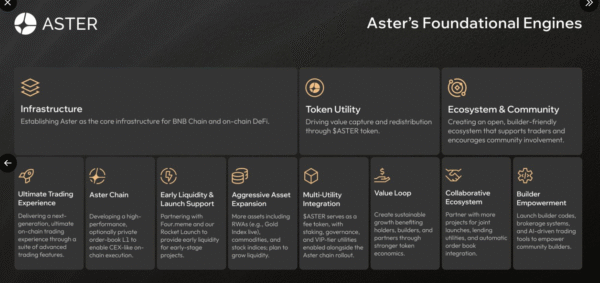
Aster releases its 2026 roadmap, confirming a Q1 L1 mainnet launch, staking, governance, and ecosystem upgrades.                                                                     Source: Aster

As per the roadmap, Aster Chain L1 mainnet will be launching in Q1 of 2026. Together with the release, the team will also introduce a fiat on- and off-ramp to simplify onboarding. Market observers said that seamless payment rails often promote wider adoption. Therefore, the integration can cover new user growth, especially in emerging regions.

Between Q1 through Q2, advancements will be made in the infrastructural field and will connect directly with the token utility features. By Q2 2026, Aster will have ASTER staking and on-chain governance mechanisms. Consequently, token holders will get more defined roles in the decision-making of the ecosystem. Additionally, smart money tools that can be used to track the best traders will be made available, providing strategic intelligence to retail participants.

Industry analysts see such developments as steps toward building a user-driven network. Because each upgrade strengthens liquidity, stability, and involvement, the ecosystem may develop in a cyclical expansion model. Furthermore, there was emphasis from experts that better governance and utility are often associated with healthier liquidation structures in periods of high volatility.

As Aster heads into 2026, the project continues to assert that it is not focused on creating another venue for trading but on delivering a network as defined by its community.

The post Aster Unveils 2026 Roadmap with L1 Mainnet Launch appeared first on Live Bitcoin News.

Disclaimer: The articles reposted on this site are sourced from public platforms and are provided for informational purposes only. They do not necessarily reflect the views of MEXC. All rights remain with the original authors. If you believe any content infringes on third-party rights, please contact service@support.mexc.com for removal. MEXC makes no guarantees regarding the accuracy, completeness, or timeliness of the content and is not responsible for any actions taken based on the information provided. The content does not constitute financial, legal, or other professional advice, nor should it be considered a recommendation or endorsement by MEXC.

You May Also Like

Grayscale debuts first US spot crypto ETPs with staking

Grayscale debuts first US spot crypto ETPs with staking

The post Grayscale debuts first US spot crypto ETPs with staking appeared on BitcoinEthereumNews.com. Grayscale Investments has just launched the first US-listed spot crypto exchange-traded products (ETPs) offering staking. The Grayscale Ethereum Trust ETF (ETHE) and Grayscale Ethereum Mini Trust ETF (ETH) now enable Ether staking, while the Grayscale Solana Trust (GSOL) has activated staking capabilities ahead of its proposed uplisting as a spot Solana ETP. The move provides traditional brokerage investors with access to staking rewards — previously confined to native crypto platforms — through regulated vehicles. The products are not registered under the Investment Company Act of 1940, meaning they operate outside the framework governing traditional mutual funds and ETFs. Staking, the process of locking up tokens to secure proof-of-stake blockchains like Ethereum and Solana in exchange for rewards, introduces yield potential but also adds operational and network risks.  Grayscale said staking will be managed through institutional custodians and diversified validator networks to reduce single-party risk. This marks the first time US investors can access staking yield through exchange-traded exposure to Ethereum and Solana, expanding upon regulatory acceptance that began with spot Bitcoin ETFs in January 2024 and spot Ether ETFs in July 2024.  Grayscale CEO Peter Mintzberg called the initiative “first mover innovation,” underscoring the firm’s role in shaping institutional crypto access. This is a developing story. This article was generated with the assistance of AI and reviewed by editor Jeffrey Albus before publication. Get the news in your inbox. Explore Blockworks newsletters: Source: https://blockworks.co/news/grayscale-us-spot-crypto-etps-staking
Share
BitcoinEthereumNews2025/10/06 21:29
Spot XRP ETFs Nears $1B AUM Milestone as Streak of No Outflows Continues

Spot XRP ETFs Nears $1B AUM Milestone as Streak of No Outflows Continues

The post Spot XRP ETFs Nears $1B AUM Milestone as Streak of No Outflows Continues appeared on BitcoinEthereumNews.com. The U.S. Spot XRP ETFs is now near the $1 billion mark of assets under management in less than a month since their launch. This follows from the product maintaining consistent inflows with no single outflow recorded yet. XRP ETFs See Continuous Inflows Since Launch Since its first launch on November 14, spot XRP funds have seen continued inflows. According to data from SoSoValue, the total inflows into these funds have now risen to $881.25 million. The funds attracted $12.84 million of new money yesterday. The daily trading volumes remained stable at $26.74 million. Source: SoSoValue Reaching nearly $1 billion in less than 30 days makes the product among the fastest growing crypto investment products in the United States. Notably, Spot Solana ETFs also accumulated over $600 million since their launch. On the other hand, Bitcoin and Ethereum ETFs are holding about $58 billion and about $13 billion in assets under management respectively. Much of the early growth traces back to the first Canary Capital’s XRP ETF. Its opening on November 13 brought one of the strongest crypto ETF openings to date. It saw more than $59 million in first-day trading volume and $245 million in net inflows. Shortly after Canary’s launch, firms like Grayscale, Bitwise, and Franklin Templeton introduced their own XRP products. Bitwise’s fund also did well on its launch, recording over $105 million in early inflows. Meanwhile, the market is getting ready for yet another addition. 21Shares’ U.S. spot XRP fund also got the green light from the SEC. It will trade under the ticker TOXR on the Cboe BZX Exchange. XRP Products Keep Gaining Momentum in the Market The token’s funds continued to expand this week. REX Shares and Tuttle Capital have launched the T-REX 2X Long XRP Daily Target ETF. This new ETF allows traders…
Share
BitcoinEthereumNews2025/12/05 14:11
Headwind Helps Best Wallet Token

Headwind Helps Best Wallet Token

The post Headwind Helps Best Wallet Token appeared on BitcoinEthereumNews.com. Google has announced the launch of a new open-source protocol called Agent Payments Protocol (AP2) in partnership with Coinbase, the Ethereum Foundation, and 60 other organizations. This allows AI agents to make payments on behalf of users using various methods such as real-time bank transfers, credit and debit cards, and, most importantly, stablecoins. Let’s explore in detail what this could mean for the broader cryptocurrency markets, and also highlight a presale crypto (Best Wallet Token) that could explode as a result of this development. Google’s Push for Stablecoins Agent Payments Protocol (AP2) uses digital contracts known as ‘Intent Mandates’ and ‘Verifiable Credentials’ to ensure that AI agents undertake only those payments authorized by the user. Mandates, by the way, are cryptographically signed, tamper-proof digital contracts that act as verifiable proof of a user’s instruction. For example, let’s say you instruct an AI agent to never spend more than $200 in a single transaction. This instruction is written into an Intent Mandate, which serves as a digital contract. Now, whenever the AI agent tries to make a payment, it must present this mandate as proof of authorization, which will then be verified via the AP2 protocol. Alongside this, Google has also launched the A2A x402 extension to accelerate support for the Web3 ecosystem. This production-ready solution enables agent-based crypto payments and will help reshape the growth of cryptocurrency integration within the AP2 protocol. Google’s inclusion of stablecoins in AP2 is a massive vote of confidence in dollar-pegged cryptocurrencies and a huge step toward making them a mainstream payment option. This widens stablecoin usage beyond trading and speculation, positioning them at the center of the consumption economy. The recent enactment of the GENIUS Act in the U.S. gives stablecoins more structure and legal support. Imagine paying for things like data crawls, per-task…
Share
BitcoinEthereumNews2025/09/18 01:27





